How to Bluff Correctly in Poker: A Complete Guide
Bluffing is one of the most romanticized topics in poker. In movies it looks like a "special state of mind" — the player simply senses that their opponent is about to give up, and bets big. In a real game it works differently.
Professional bluffing isn't about "playing a pretty hand" — it's about making a +EV decision over the long run. Sometimes a bluff will look spectacular. But more often it will look like an ordinary bet in a well-chosen hand where the opponent is forced to fold.
Bluffing isn't a story about courage — it's about discipline and the long run. It's about the ability to pick the right moment, the right hand, and the right bet size.
In this article we'll break down what kind of bluff can be considered effective and correct.
You'll learn:
what a bluff is and what its variations are
how board textures, bet sizes, blockers, and stack depth work
how to bluff against different types of opponents
how to recognize opponents' bluffs
What a bluff is, in simple terms
A bluff is a line where we bet or raise not because we have a strong hand, but because we want to take down the pot without a showdown.
The mechanics are simple: we represent a strong hand, make the opponent doubt, and force a fold from hands that are currently stronger than ours.
But behind this simplicity lie several key ideas.
First, a bluff is not a bet without a hand. It's a bet with a specific goal — to knock out a particular segment of the opponent's range. In other words, we don't just bet on a whim, we target hands that aren't ready to pay under pressure — middle pairs, weak top pairs on coordinated boards, straights on boards with flushes, and so on.
Second, a good bluff always answers the question — "what exactly are we knocking out?". If we can't clearly articulate which hands better than ours should fold here, then building a bluffing line is dangerous, unconvincing, and often fatal to the stack.
This is exactly why bluffing matters so much: it transforms our game from waiting for a good combination into the ability to take pots in spots where it's psychologically and strategically hard for the opponent to continue.
Is bluffing a rare option or a baseline mode of play?
If you look at how strong players actually make money, it turns out that most of the profit doesn't come from bluffs at all.
They win pots because they know how to extract the maximum from favorable situations and minimize losses in losing hands.
In this system, bluffing isn't the engine — it's the fine-tuning. We use it:
so that our play isn't too obvious
to extract extra profit in situations where we have position, initiative, or a convenient board structure.
It's important to understand one thing: a bluff isn't a default action. It's a conscious choice at a specific point in the hand. So there's a rule that sounds harsh but very quickly puts everything in place:
We never bluff just because we haven't bluffed in a while.
When we catch ourselves thinking "I haven't done anything in a while," there's almost always no strategy behind it. An emotion is hiding there:
we got bored
we want to crack the opponent open
irritation set in
a desire arose to prove to ourselves or the table that we can apply pressure
Such bluffs look active, but over the long run they just burn chips. A correct bluff starts with a different question:
"If we bet now, who exactly — and with which specific hands — should fold?"
If there's no answer, it's better to honestly admit it: bluffing now is a waste of chips and nerves. The sooner we understand this, the faster our game becomes calmer, more stable, and — most importantly — more profitable.
Types of bluff: pure bluff and semi-bluff
1. Pure bluff
This is a bet with a hand that has no chance of taking the pot once the cards are shown. In this case we're counting only on the opponent folding — any other outcome doesn't suit us.
Here it's important to set the emphasis right away. A pure bluff isn't an attempt to steal the pot on emotion — it's a logical continuation of a hand where:
the opponent has a lot of medium-strength hands
the board and the way the hand has developed look bad specifically for the opponent's hands
our line looks plausible and consistent.
Let's look at the situation with an example.
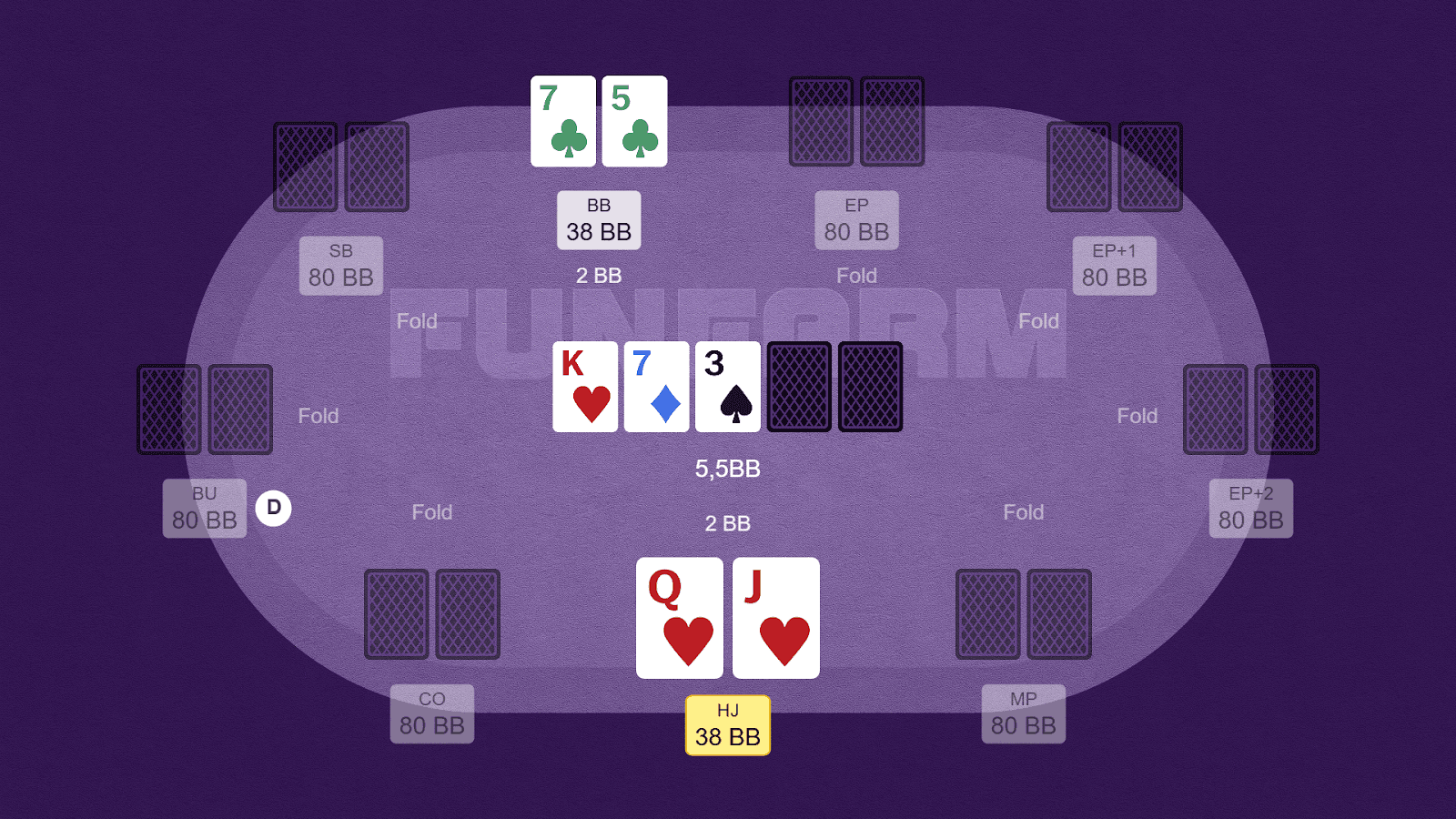
Situation: we open a hand in the HJ, effective stacks are 40bb, the opponent in the BB calls.
We're playing in position; the BB has a wide defending range. After the check, we bet 33% of the pot. The opponent calls.
What does this mean? The BB rarely has a very strong hand here. A check-call is most often Kx with a weak kicker, 7x, sometimes A-high or open-ended straight draws (if they didn't go for a check-raise).
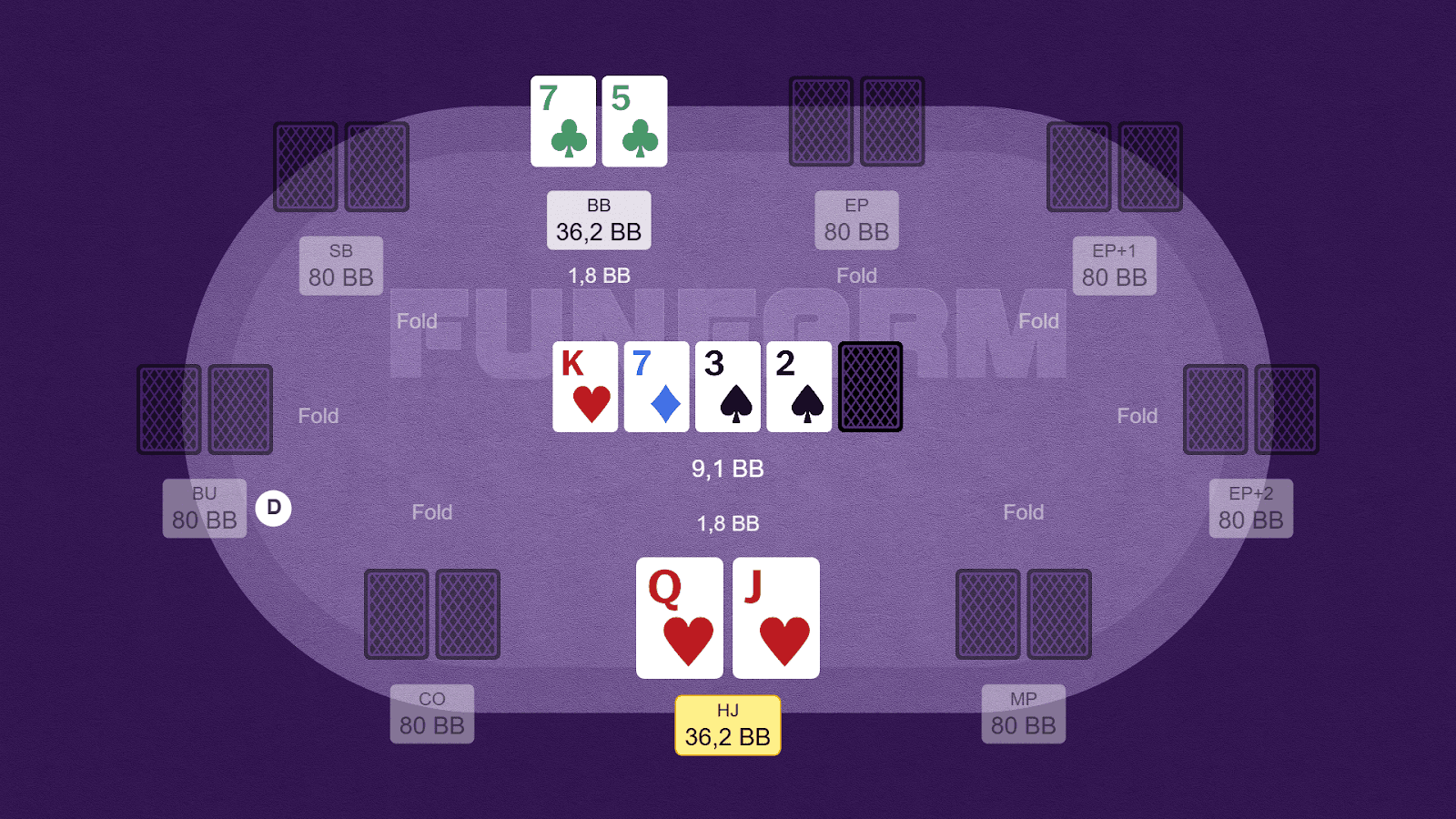
The turn brings the 2♠️. The BB checks again. There's 9.1 BB in the pot. We can keep applying pressure, because our range contains a sufficient number of hands that play for value against the opponent's range.
We bet bigger — about 70% of the pot. The BB calls again. And here is where the important part of the thinking begins.
If the BB really had a strong hand — a set, two pair — we'd very often see a check-raise back on the flop or turn. A repeated check-call is a signal of a limited-strength range.
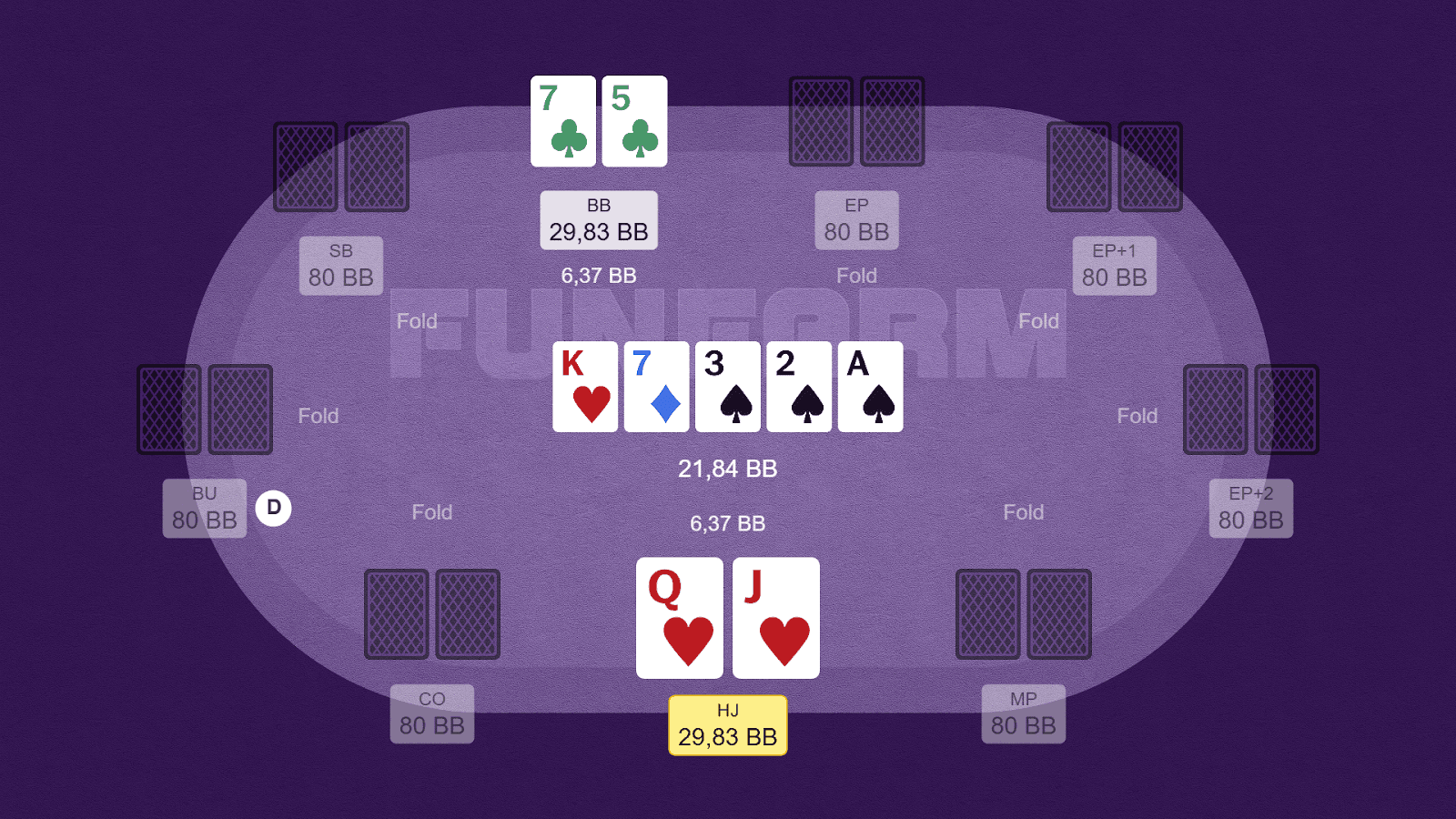
The BB checks. There's about 21 BB in the pot after the aggression on the subsequent streets. At showdown we never win.
But the river brings exactly the card that fits our range and matches the logic of our bets on the previous streets.
We can represent that we made a flush or that an ace arrived.
Decision: we bet big; in this case there are several options — a bet of 85%–90%, a pot-sized bet, or all-in.
Why can't we bet small?
a small bet leaves the BB room to call by pot odds
a big bet turns the decision into the question — "am I willing to risk my stack with a medium-strength hand where the opponent has obvious value combinations?"
This is a classic pure bluff, where we don't hope for a showdown, apply pressure to the opponent's range, and use the board to our advantage.
2. Semi-bluff
The semi-bluff is a much more "comfortable" and robust tool. Here we bet with a hand that isn't ready yet but can improve, while already applying pressure right now.
A semi-bluff always has two paths to victory — the opponent folds immediately, or the opponent pays but we can still hit our outs, make the nuts, and win a big pot.
* The nuts in poker is the strongest combination on the board.
Let's examine this variation of the bluff with an example hand.
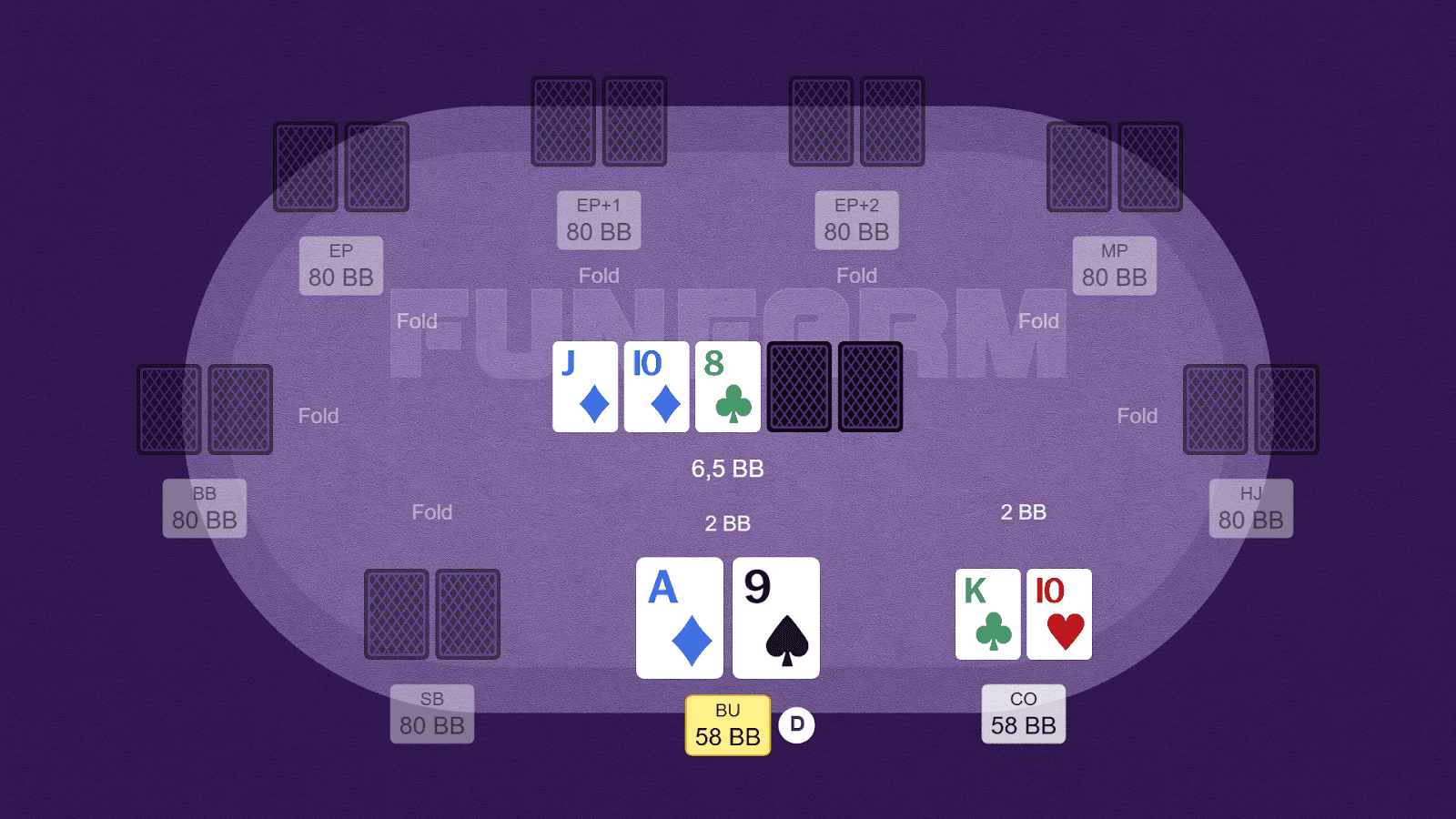
Situation: the CO opens with a bet of 2 blinds, we call on the BU with ace-nine offsuit, effective stacks are 60bb.
The CO makes a continuation bet of 33% of the pot. A very saturated, drawy board. The CO bets here often, including with strong hands — to protect a medium range.
Let's assume that in our case the player is protecting a medium range.
Our hand has an open-ended straight draw, a nut blocker* for the diamond card (the ace of diamonds), and good prospects for applying pressure.
* A nut blocker is a card that reduces or completely removes the opponent's ability to have the nuts, that is, the best possible combination on the current or potential board.
Put more simply, a nut blocker is a situation where we hold a key card, without which it's much harder for the opponent to make the strongest hand. And that's exactly why it's easier for us to apply pressure with a bet or a bluff.
Decision: we raise the opponent's bet 3.5x (7 bb).
Why is this a good play?
the flop is excellent for raising both with value and with bluffs
the ace of diamonds in our hand reduces the chance of strong flush draws for the opponent
we can already knock out part of the opponent's range
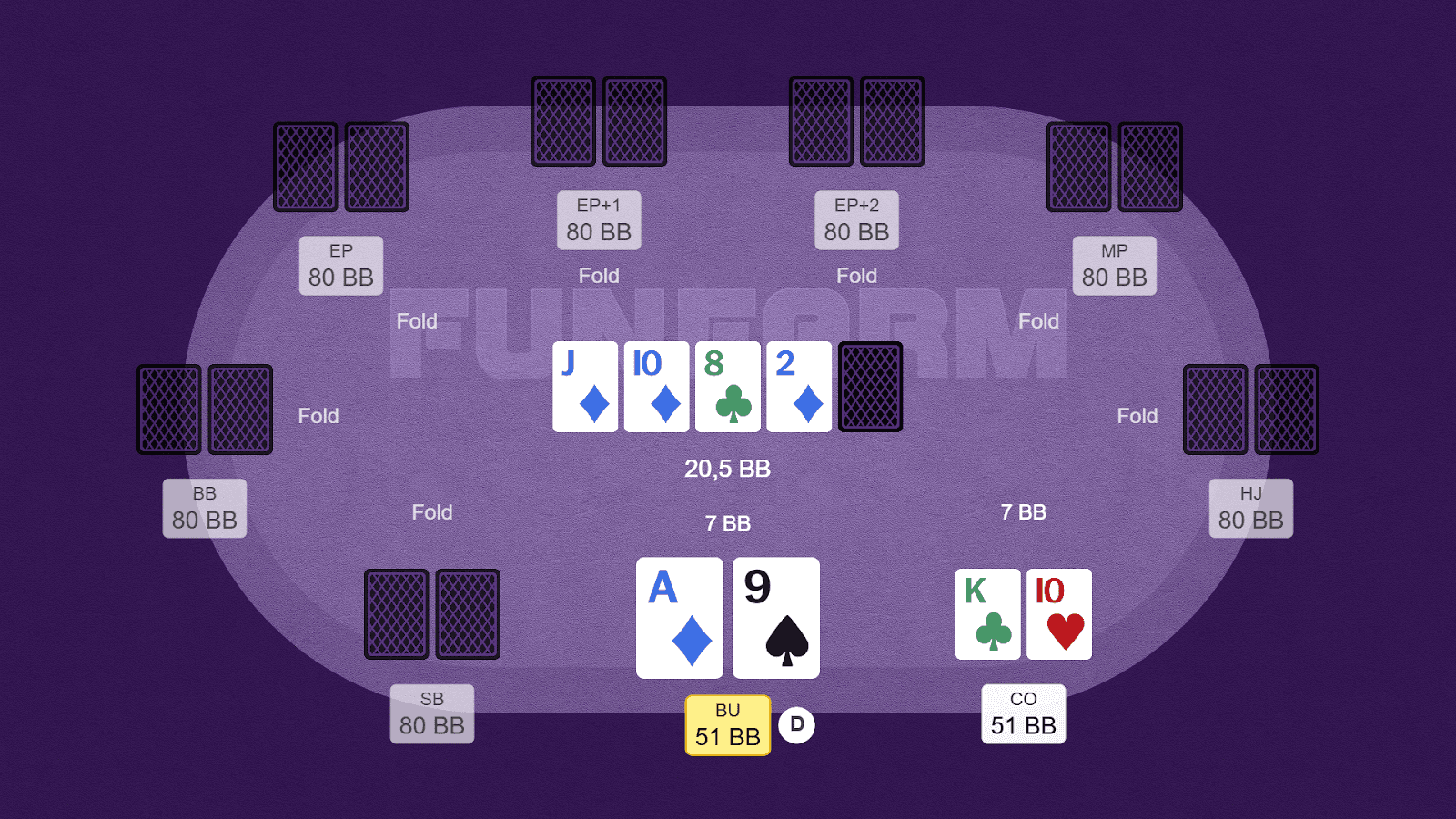
The turn brings the 2♦️. An excellent card — we get a draw to the nut flush and have every reason to keep betting.
If the CO checks — we have the opportunity to bet big. In this case part of the range will simply fold, part will pay and find itself in a tough spot on the river.
Even if our flush or straight doesn't complete on the river, our line is logical and consistent. And if it does complete, we'll be value betting rather than bluffing.
Position is our main ally
Why is bluffing in position easier and more profitable? The first factor — we see the opponent's action. This sharply reduces the number of mistakes.
We also control the size of the pot. In position we can:
bet small if we want to take the pot cheaply
bet big if we want to apply maximum pressure
take a free card if we realize the bluff is losing its point
Without position there's almost no such flexibility — we're forced to play more cautiously.
The flop continuation bet as the most frequent bluff in poker
A continuation bet is a bet on one of the betting rounds that continues the aggression started on the previous street.
If you want to learn how to use the continuation bet and why it's useful, see our article.
If you take all the bluffs we make over the long run, the continuation bet will be in first place by a wide margin. But there's a problem — this technique can be used incorrectly.
It's important to remember that the continuation bet works not as a mandatory rule, but as a consequence of the hand's structure.
This bet makes money not from the fact that we're the aggressor in the hand, but because:
most flops fit our range far better than the caller's range
the caller has a lot of hands on the flop with no connection and no prospects
even a small bet knocks out a huge layer of weak hands.
The continuation bet is a pressure tool that works only when we understand why we're betting and what exactly we're knocking out.
Let's look at a concrete example.
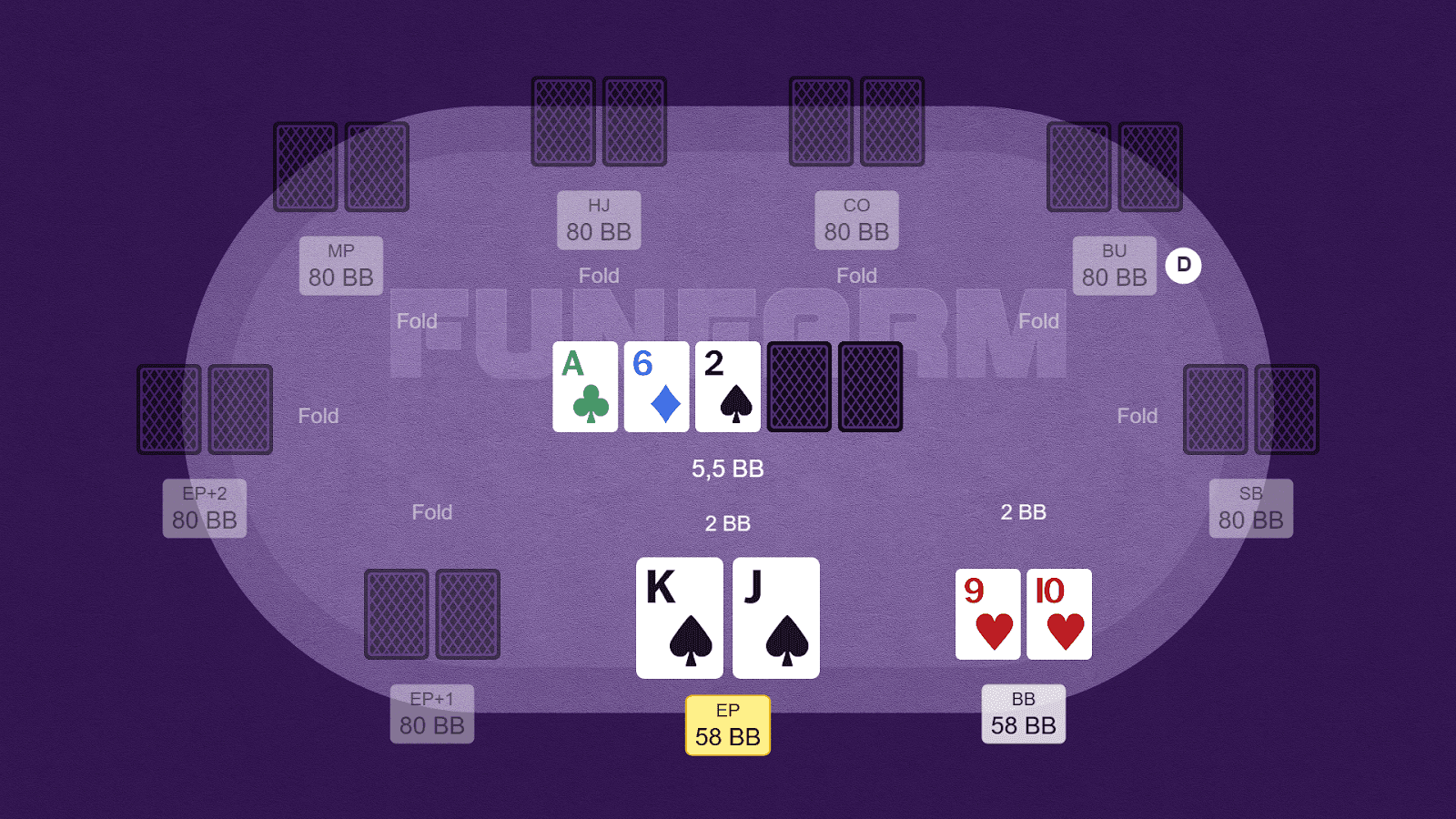
Situation: we open under the gun with king-jack suited. The BB calls with ten-nine suited.
A dry flop comes out, one we don't connect with. But it's important to understand: on such a flop our potential range is objectively stronger.
The BB, meanwhile, has plenty of hands that missed the board, weak connections that will struggle to defend on subsequent streets, and unmade combinations — straight and flush draws.
Decision: we make a small continuation bet — 25–33% of the pot. Why choose exactly this bet size?
1. We cheaply apply pressure to hands that missed the board
Hands like 8x, 9x, Jx, random suited connectors with no connection have no choice but to fold.
2. We don't inflate the pot unnecessarily
The bet is small, the risk is minimal, and the fold equity* is high.
* Fold equity is the probability that the opponent folds to our bet.
3. We preserve maneuverability
When the pot is small, we leave ourselves room to continue the bluff on the following streets.
If the opponent calls after our continuation bet, we can conclude that they have medium-strength hands — Qx, 6x, low pocket pairs, sometimes Ax hands.
And here is where the most important part begins — not to keep playing the hand on autopilot. On the turn you need to ask yourself the question — did the card that came out help our range?
If the turn helps our range — for example a K, Q, or J arrives — in such spots we can keep applying pressure. Our range still looks convincing, while the opponent's hands look vulnerable.
If the turn is clearly in the caller's favor — for example, the board pairs, a low connecting card comes, obvious draws complete — here the best decision is often to slow down, because fold equity drops sharply.
How board texture affects the bluff
There must always be grounds for a bluff: it's tied to the board — to the cards lying on the table and to how they interact with ranges.
There are flops where pressure feels natural, and there are those where every bet is a risk of losing chips. And most often the difference lies precisely in the texture.
1. Dry high boards: when the board helps the aggressor
Flops with an ace, king, or queen and no clear potential for straight and flush draws are classic territory for a careful, rational bluff.
All because such boards hit the preflop aggressor's range far more often than the caller's range.
If we open from an early position, we have many strong hands — top pairs, overpairs, strong Ax / Kx — while the opponent has a huge layer of hands that simply missed the board.
2. Drawy and paired boards: when a bluff must have serious grounds
Connected and drawy boards are the hardest place for a bluff, especially for beginning players. And it's exactly here that the most expensive mistakes are made.
It's important to lock in the key idea right away: a drawy board is one where opponents are more often ready to pay.
On such textures opponents have too many reasons not to fold — flush draws, straight draws, pairs + draws. So the universal rule for beginners is this:
On drawy boards we bluff less often and more cautiously than on dry ones.
For those who want to learn more about board textures, we've put together a separate article on this topic.
Bluffing against different types of opponents

One of the most common mistakes of beginning players is trying to bluff while ignoring the person sitting across from them.
But the truth is that the same bluff can be brilliant against one opponent and completely losing against another.
So before thinking about board texture and bet sizes, you should ask the question:
Is this player even capable of folding?
Let's break down the main types of opponents and how to play against them.
1. The nit
A nit is a player who enters hands rarely, doesn't like to take risks, and folds quickly without a strong connection.
At first glance it seems like the ideal target for bluffs. That's partly true, but there are nuances.
When does a bluff against a nit work well?
dry boards without draws
low or unconnected textures
situations where we show initiative from the very start
If a nit missed the board, they often fold already on the flop. One careful continuation bet — and the pot is ours.
The main mistake is to overestimate a nit's willingness to fold. If a nit called the flop and turn, it's almost always a signal that "the player has a strong hand."
So the key rule is simple: against a nit we bluff the early streets, but rarely follow through with a bluff on the river.
2. The unyielding recreational player
It's precisely against these players that pretty bluffs most often turn into lost chips.
How do we play against such a player? The main shift in thinking here is this: against an unyielding recreational player we almost never bluff — we earn on value.
What does this mean in practice? With empty hands — we fold without regret; with draws — careful bets or calls by odds; with strong hands — we bet and increase the sizing.
3. The player who applies pressure and is capable of aggressive bluffs
Such players are called "maniacs" in poker. This is the most emotional and dangerous type of opponent.
Against a "maniac," beginning players get the urge to hit back — and that's often a mistake.
Why can't you out-bluff a maniac?
not afraid of pressure
often perceives raises as a challenge
ready to go all the way with an unmade hand
If we start bluffing against them, we inflate the pot without a strong hand, play their game, and lose control of the situation.
The right approach in this case: the more aggressive the opponent, the calmer and more straightforward we play.
In practice it looks like this:
we check more often
we give the maniac the chance to bet themselves
with strong hands we play check-call
In conclusion
A strong bluff isn't a story about "playing a pretty hand" — it's about logic and understanding the game. Specifically — it's a way to take the pot in spots where the opponent can't withstand the pressure, the board structure supports your line of play, and you've chosen a bet size that knocks out the right segment of the opponent's range.
A professional doesn't bluff often: a professional bluffs in spots where it's logical and doesn't try to win every hand.
If you want to build a systematic approach to aggression — from sound continuation bets and semi-bluffs to big, deliberate bluffs on the river — apply to FunFarm.
We teach you to consistently play a winning game over the long run, break down ranges, build the logic of a hand, and choose bluffs that actually bring profit.
FAQ
How do I know I'm bluffing incorrectly?
If you have a lot of situations where "I decided to apply pressure without a plan," and then you get calls from weak hands, then your bluffs aren't part of a strategy — they're a manifestation of emotions.
Can you bluff at low stakes?
Yes, but selectively. At low stakes there are many unyielding recreational players, but also plenty who fold on the turn/river. Your task is to learn to tell them apart and plan the bluff according to the types of opponents.
Is it true that you should bluff more often on the flop than on the river?
Yes. On the flop there are many semi-bluffs, while on the river it's more often a pure bluff, and the cost of a mistake is higher.
What is the most frequent failure of beginning players when bluffing?
Bluffing against the wrong opponent and bluffing without understanding what exactly we're knocking out. In second place — the wrong bet size, which isn't convincing given the line of play.
Should you always follow through with a bluff on the river if you started on the flop?
No. Following through with a bluff isn't an obligation — it's a decision. If the runout worsened the situation or strengthened the opponent's range, folding isn't a mistake.
Read next
Bet sizing: how to make your opponents make mistakes
Pot-Limit Omaha (PLO): Rules and 5 Key Differences from Hold'em
Sit & Go: how to reach the money and win