RFI in poker or open-raise: how much should you bet preflop?
To evaluate the quality of their preflop play and to understand opponents' ranges, professionals use statistical indicators. One of the most important among them is RFI.

Most mistakes in poker are made before the flop even comes. A player may have a solid understanding of hand strength, know pot math, and feel confident postflop*, yet still regularly lose money due to poor starting-hand selection. This happens especially often when opening the action.
*Postflop — all betting rounds that happen after the flop (flop, turn, and river).
Some players enter the pot too tight* and miss out on profitable spots. Others, on the contrary, open too many hands from early position and constantly end up in unprofitable hands. Over the long run, such mistakes lead to losing a great deal of money — even if the other elements of the strategy are at a good level.
*Tight — a playing style in which a player plays a very narrow and strong range of hands.
To assess the quality of their preflop play and understand opponents' ranges, professionals use statistical metrics. One of the most important among them is RFI. This metric shows how often a player opens the action with a raise and which ranges they use in various positions.
In this article, we'll break down what RFI is in poker, how it differs from other statistical metrics, which values are considered optimal for different positions, how to use this information when analyzing opponents, and how to build a strategy that accounts for opening ranges.
What is RFI in poker
RFI is an abbreviation for Raise First In. This term refers to the situation where a player is the first to show aggression preflop and opens the action with a raise.
If everyone before you folds and you raise, that action counts as RFI. But if someone has already entered the hand, your subsequent raise no longer counts as RFI: that action is called a 3-bet.
We covered 3-bets in more detail in this article, head over and read it.
The formula looks like this:
RFI = number of open-raises / number of open-raise opportunities × 100%
It's important to understand that limping is not included in this metric. If a player simply completes the big blind, their RFI stat won't increase. The metric only accounts for aggressively entering the pot via a raise.
At first glance, it might seem that RFI is practically no different from PFR. However, that's not the case.
How RFI differs from PFR
PFR (Pre-Flop Raise) is a statistical metric that reflects the percentage of cases in which a player raises before the flop — i.e., this metric shows the overall percentage of preflop raises.
It includes:
open-raises
re-raises
isolation raises against limpers
squeezes*
*A squeeze is a tactical play that consists of an aggressive preflop raise after one player has raised and another opponent or several opponents have called.
We covered squeezes in more detail in this article.
RFI accounts only for opening raises.
Let's imagine two players with the same PFR of 20%. The first opens a lot of pots himself, while the second rarely makes open-raises but actively re-raises others' opens. Their overall PFR may be identical, yet their playing styles will be completely different.
That's exactly why experienced players use RFI for more precise determination of opponents' starting ranges.
What to track RFI with
Tracking such statistics manually is practically impossible. For this, special poker trackers and HUD programs are used.
The most popular solutions:
Holdem Manager 3
Hand2Note
PokerTracker
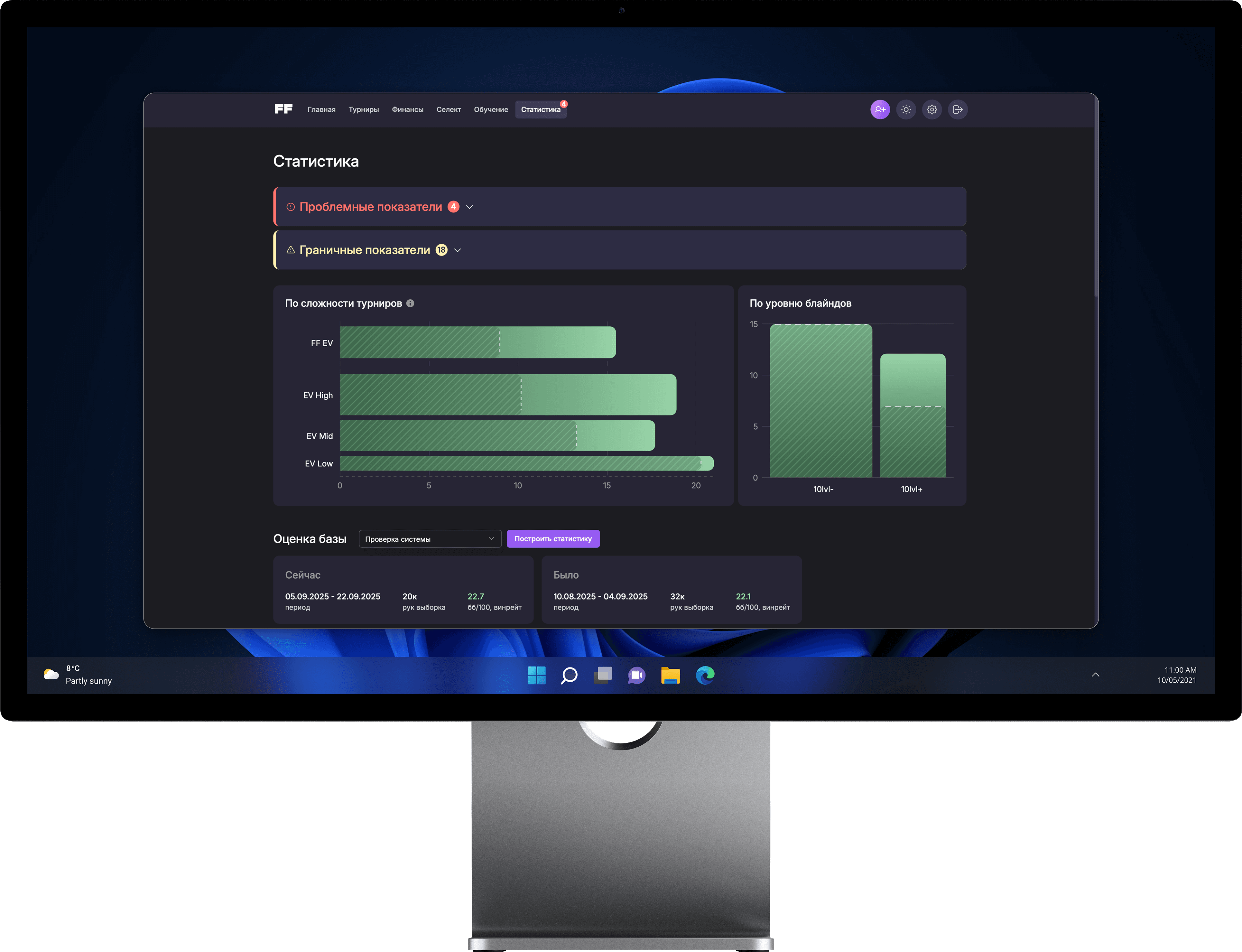
During play, these programs collect information about all of the opponents' actions and display the stats in a special HUD.
Usually the RFI metric is not displayed separately for each position right in the main HUD. It's much more convenient to open the extended stats (popup) and look at the breakdown by position.
Every player can build their own HUD with the values they need, so our recommendations on stat placement are just a starting point. Experiment.
For example, the overall opening metric may be 22%, but the player will be opening:
13% of hands from early position
18% from middle position
30% from the cutoff
48% from the button
This kind of information is far more useful than a single averaged number.
Sample size — when you can trust RFI
One of the most common mistakes beginning players make is drawing conclusions from too small a sample.
If an opponent has opened from the button four times out of eight possible situations, that doesn't yet mean their RFI is 50%.
To get reliable data, it's advisable to aim for the following figures:
button — at least 200 situations
early position — from 300 situations
overall RFI — no fewer than 500 hands
for accurate analysis, it's desirable to have 2,000 or more hands
It's especially important to look precisely at positional metrics. The average value often conceals serious differences in strategy.
For example, a strong regular and a beginning player may have an overall RFI of around 18%, but the first will competently widen his ranges in late positions, while the second will open roughly the same from any seat at the table.
Optimal RFI values
Range width depends directly on position.
The more players are left to act after us, the more carefully we have to choose our starting hands. As we approach the button, the number of opponents behind us decreases, so ranges become noticeably wider.
For 9-max tables — if we are in the early stage of a tournament — the following values are considered good benchmarks:
Position | RFI |
UTG | 15-18% |
MP | 18–24% |
HJ | 24–28% |
CO | 32–38% |
BU | 50–65% |
The difference between early and late positions looks enormous, but it's entirely justified. From the button, a player gains a positional advantage on practically all subsequent streets. Thanks to this, he can profitably open a large number of hands that would be unprofitable from early position. That's exactly why the button opening range is usually three times wider than the UTG opening range.
Let's look at how this percentage breakdown looks visually.
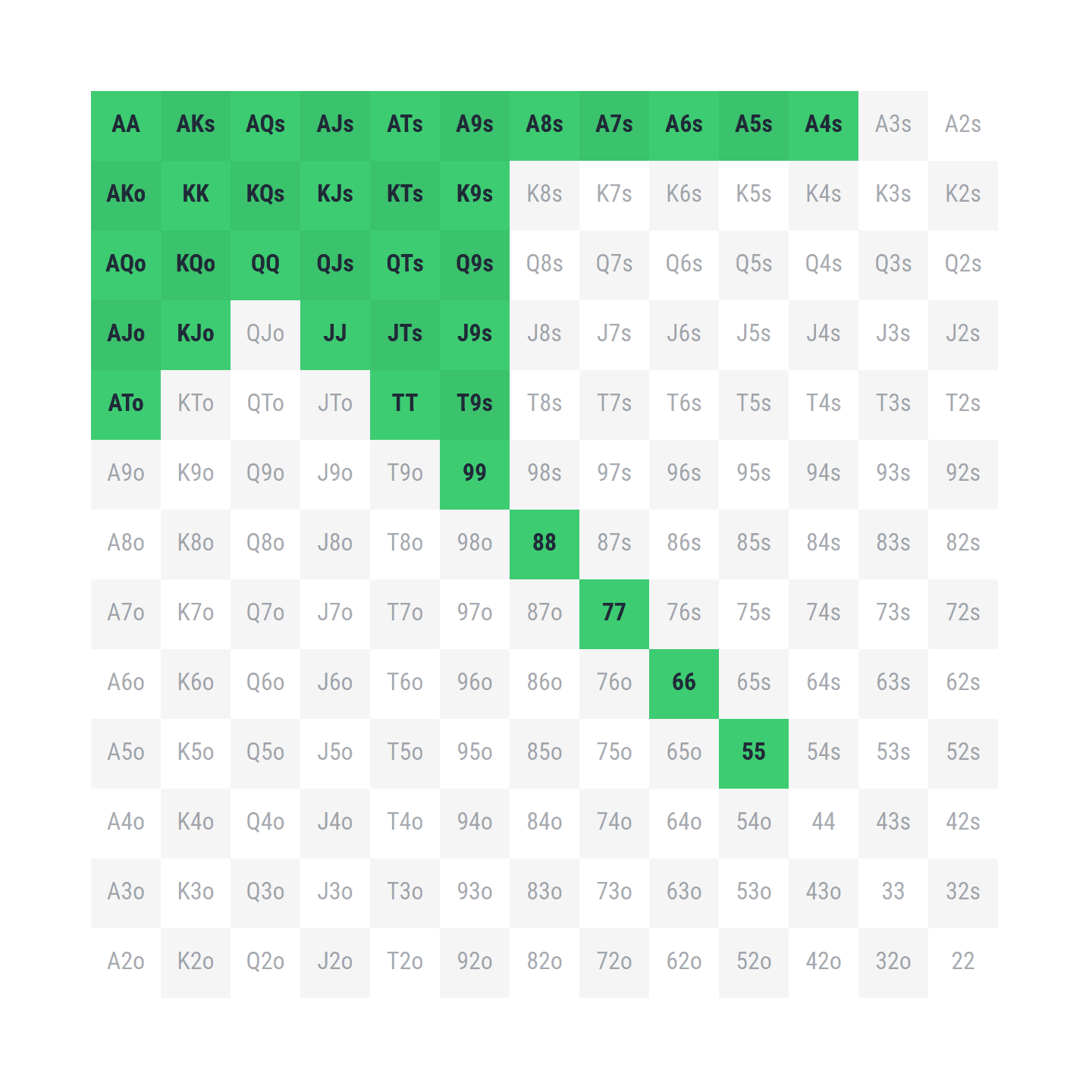
Opening from EP
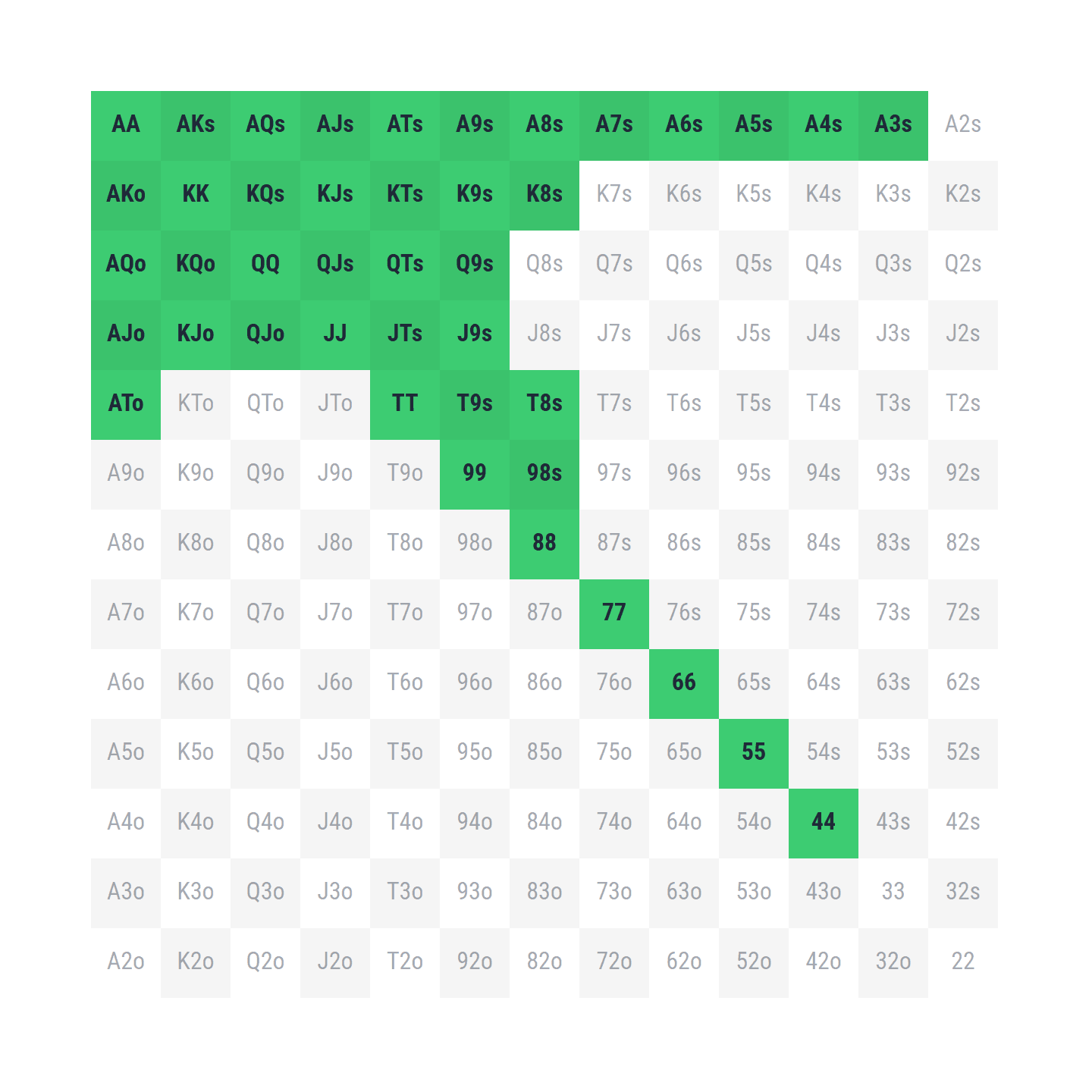
Opening from EP+1
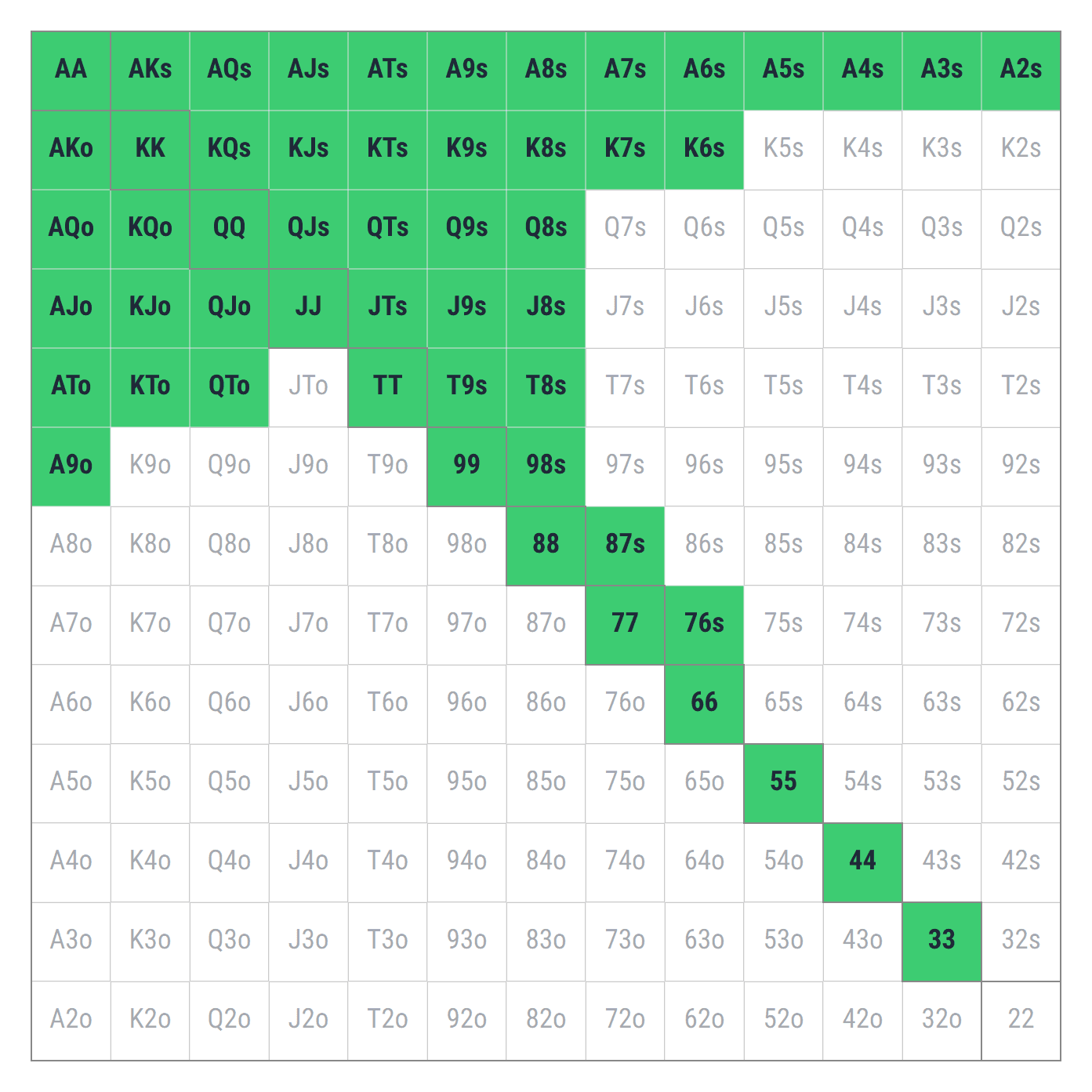
Opening from MP
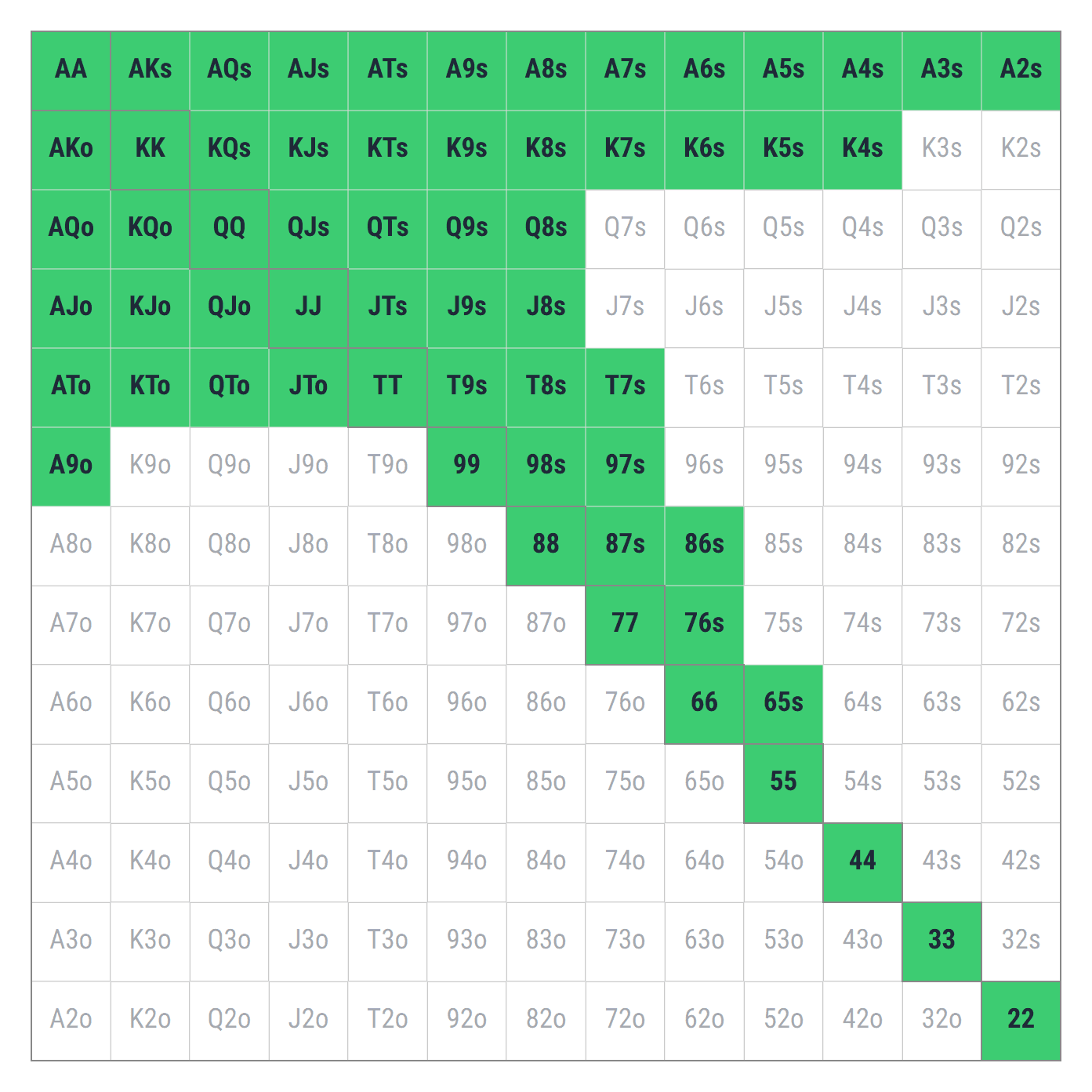
Opening from HJ
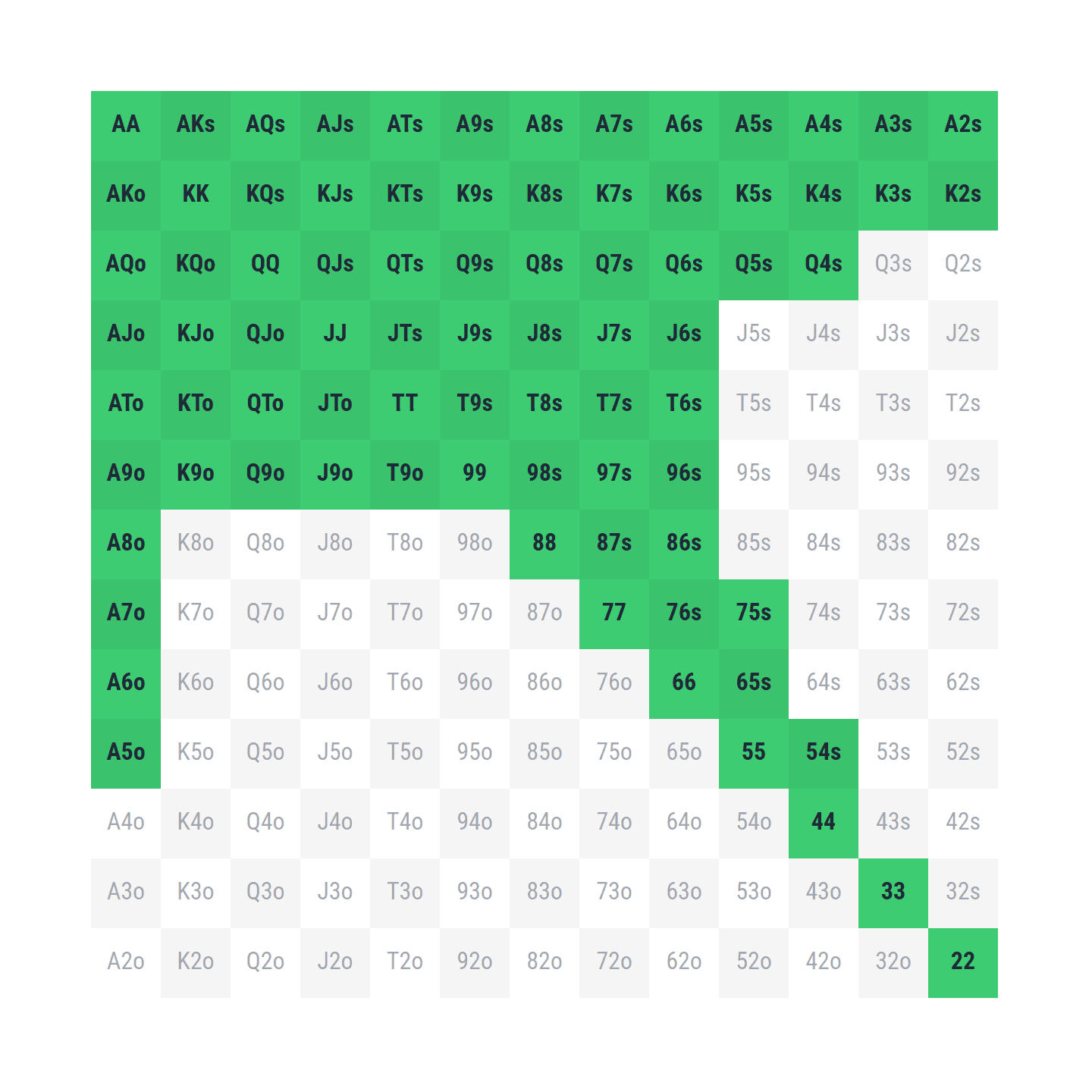
Opening from CO
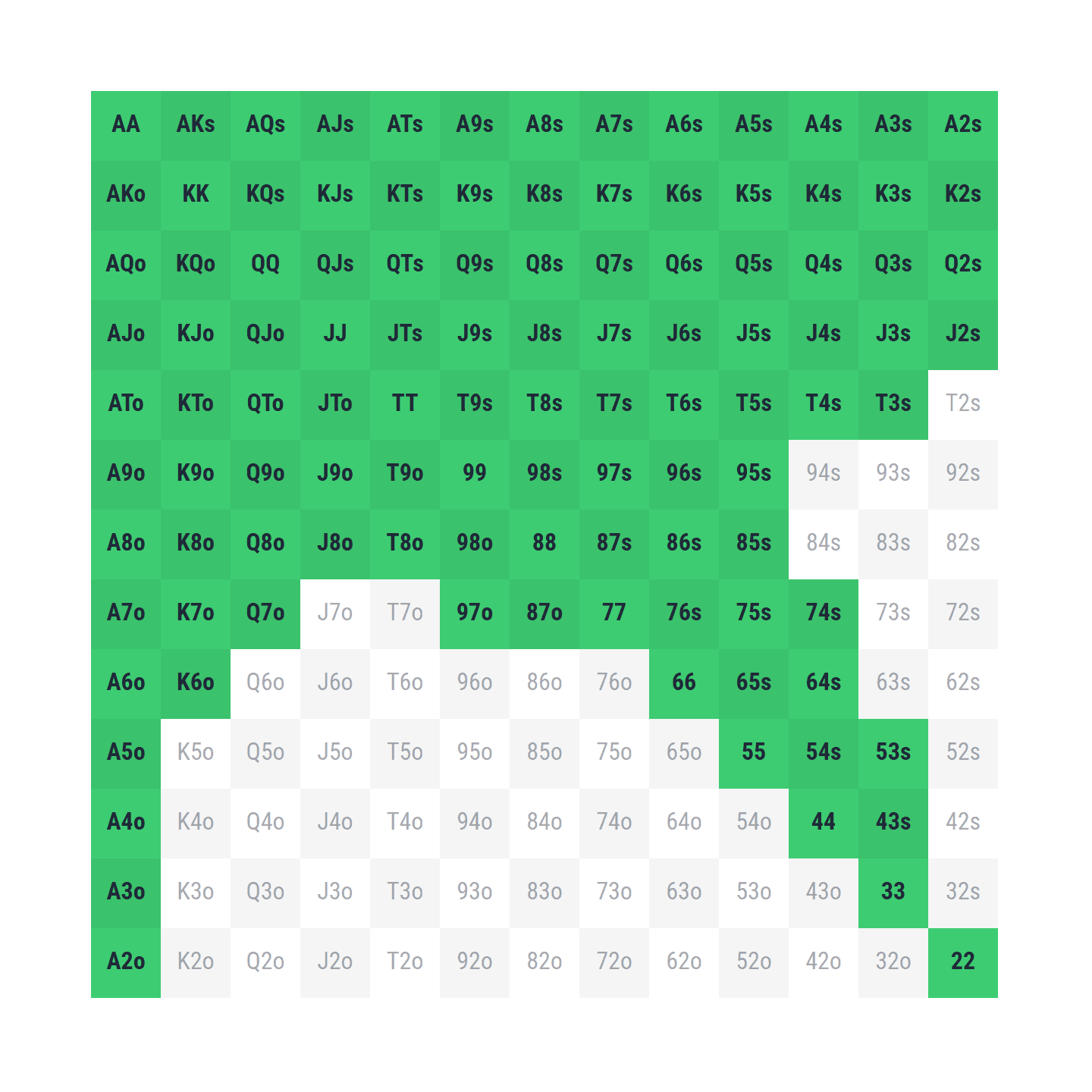
Opening from BU
To understand how to use poker charts, read our article on this topic.
RFI values in tournaments
In tournaments, opening ranges constantly change along with stack depth and the payout structure.
1. Early stage
At early blind levels, players usually have deep stacks and don't yet feel the tournament pressure of ICM*.
*ICM (Independent Chip Model) — a mathematical model used in poker tournaments to assess the monetary value of a player's stack.
Under these conditions, opening ranges are the widest compared to the middle and late stages, where a player more often needs to act based on tournament standing and the influence of ICM.
2. Middle stage
In the middle stage, fighting for uncontested pots becomes significantly more profitable. But there are circumstances you need to adapt to: the size of the effective stack in the hand, position, approaching the bubble zone, the opponents' standing in the game. As a rule, in the middle stage you more often need to exploit opponents' weaknesses and make sure other players don't take advantage of your position. Therefore, ranges may either widen or narrow depending on the context of the in-game situation.
3. Late stage and the final-table bubble
In the middle stage of a tournament, most decisions were made based on the number of chips in the stack. If a particular action brought in more chips over the long run, it was considered profitable and correct.
In the late stage, this approach no longer always works. Now what matters is not only the size of the stack but also its monetary value within the current payout structure. This is exactly where the Independent Chip Model — ICM — begins to play a key role.
Its core principle is that the value of tournament chips becomes nonlinear. Each additional chip won brings less benefit than it might seem at first glance, whereas losing part of your stack often turns out to be significantly more painful.
Because of this, strategy changes too. Decisions that were profitable in the middle stage can become unprofitable on the bubble* or near the final table. For example, calling an all-in with a small equity edge will far from always be correct if losing leads to elimination from the tournament.
The bubble in poker is the stage of a tournament when only a few spots or a few players remain before the money.
At the same time, the value of applying pressure increases. Many players begin to avoid risky situations, trying to preserve their stack and wait out the next payout jump. This allows big and medium stacks to take pots more often without showdown and gain additional profit from the opponents' caution.
Optimal open-raise size

RFI answers the question of how often we open. But it's no less important to understand what size to do it with.
The standard is considered to be opening to 2 BB. This bet size allows you to:
risk a smaller number of chips
maintain a wide opening range
respond more effectively to opponents' responses
How to read an opponent's RFI
By itself, the RFI metric doesn't make a player strong or weak. However, it helps quickly determine an opponent's overall style.
1. RFI below 10%
If a player opens fewer than 10% of hands from practically all positions, you're facing a very tight opponent.
Against such players you can:
steal blinds more often
bluff less often after their open
treat big pots more cautiously
When such an opponent shows aggression, their range usually contains a lot of strong hands.
2. RFI 22–27%
Such values are characteristic of most solid regular players.
They use relatively balanced ranges and rarely make serious preflop mistakes.
3. RFI above 30%
Players who open more than a third of all hands from early positions are especially interesting.
As a rule, their range contains a lot of weak and borderline hands.
Against such opponents you can:
make calls adjusted for a wide bluffing range
attack their opens more often
fight more actively for pots on later streets
How important the difference between positions is. Strong players understand the value of position perfectly. That's why for a good regular player the difference between opening from the button and from early position exceeds 30%.
But if a player opens roughly the same from all positions, that's a serious signal of insufficient understanding of basic strategy. Such opponents often become a convenient target for exploitation*.
*Exploit — a deliberate deviation from a balanced strategy (GTO — Game Theory Optimal) in order to extract maximum profit by taking advantage of specific opponents' weaknesses.
We covered profitable exploit strategies in this article; head over and read it if the topic interests you.
4. RFI above 40%
If a player opens more than 40% of hands, especially over a sample of several thousand hands, that's no longer just a loose style. Most often such figures are characteristic of so-called "maniacs" — very aggressive players who apply constant pressure on the table.
Such opponents open a large number of borderline and outright weak hands. Their range contains many hands that realize equity poorly postflop and often end up dominated by stronger hands.
Against players with an RFI above 40%, the following adjustments usually work:
more frequent blind defense
increasing the number of in-position calls against late opens
wider showdowns postflop against aggressive lines
reducing the frequency of automatic folds to c-bets.
At the same time, it's important to remember that maniacs create increased variance*. Therefore, the main task against this type of player is not to try to out-bluff them, but to wait for situations in which their overly wide range will produce mistakes over the long run.
*Variance — a measure of the spread of game results around the average value, i.e., the deviation of actual results from the mathematical expectation over short distances. We discussed this topic in more detail in this article.
Conclusion
It's important to remember that there is no universal RFI value. Opening frequency depends on the game format, table structure, stack depth, and the level of opponents.
Nevertheless, understanding the basic benchmarks helps you avoid common mistakes and find profitable decisions faster.
Submit an application to FunFarm to raise your level of understanding of the game and start winning.
FAQ
1. How does RFI differ from PFR?
PFR accounts for all preflop raises: open-raises, re-raises, isolation raises, and squeezes. RFI records only the situations where a player is the first to open the action with a raise. That's why RFI is far better suited for assessing starting ranges.
2. Why do players open more hands from the button?
On the button, a player gains a positional advantage on all subsequent streets. Thanks to this, he can profitably play significantly more starting hands and more often take the pot without resistance.
3. Can you use only RFI to analyze opponents?
No. The most accurate picture is provided by several metrics at once. RFI is usually analyzed together with VPIP, 3bet, and postflop play statistics.
4. What sample size is needed for RFI analysis?
For initial conclusions, it's advisable to have at least 200 situations for a specific position. For a full analysis, it's recommended to use a sample of 500 to 2,000 hands and more.
5. Do you need to stick to GTO opening ranges?
GTO ranges are a good foundation, but in actual play it's often more profitable to adjust to opponents' mistakes. If opponents fold too often or defend their blinds poorly, you can widen your opening range.