Donk Bet: Beginner's Mistake or Clever Move?
The donk bet has a bad reputation. In the poker community, this play was for a long time considered a sign of weak play — a bet without initiative, against the aggressor, looked impulsive and devoid of logic.
Even the word makes it sound like you've done something "wrong": a donk means a "donkey bet," impulsive and illogical. And indeed: if you simply bet "because you feel like it," a strong opponent will quickly turn that habit into a source of your losses.
But there's a nuance. A donk bet is not a mistake in itself. It becomes a mistake when the bet has no reason and no plan behind it. But when the donk is a conscious tool, it can bring a noticeable plus to your EV.
In this article, we'll break down where a donk bet is almost always negative, where it becomes a powerful play, and why the most profitable donk often happens not on the flop, but on the turn and river.
You'll learn:
what a donk bet is and why it's so often considered a "beginner's mistake"
why a donk really can be a negative action in standard situations
in which spots a donk turns into a strong strategy and increases EV
which runouts make a donk especially logical on the turn and river
what to fill your donk range with so you don't weaken your check line
why donking the river is one of the most underrated lines against the field.
What a donk bet is in poker
A donk bet is a bet made out of turn, that is, when the player doesn't have the initiative against an opponent who showed aggression on the previous street.
The classic example: a player called a raise preflop, went to the flop out of position, and suddenly bets first into the preflop aggressor.
Why has the term become a "swear word"? Because historically a donk was most often a sign of chaos — the player didn't understand ranges, bet on luck, didn't know what to do facing a raise or how to act without the initiative.
There's also a more neutral term — lead. Essentially it's the same action — betting first without being the previous street's aggressor. But the term "donk bet" has taken stronger root in poker culture, so it's used more often.
Why a donk bet is often a mistake
A donk bet becomes negative when the player bets in a situation where the opponent has more reasons to keep betting — and at the same time gets neither value nor fold equity.
Let's break down a few situations in which a donk bet has no logic:
1. The player bets into a board that better fits the opponent's range
There are boards that, by their structure, fit the preflop aggressor much better — high textures with an edge in top pairs and overpairs. In such situations, a donk looks like an attempt to take the initiative where there's no point in doing so.
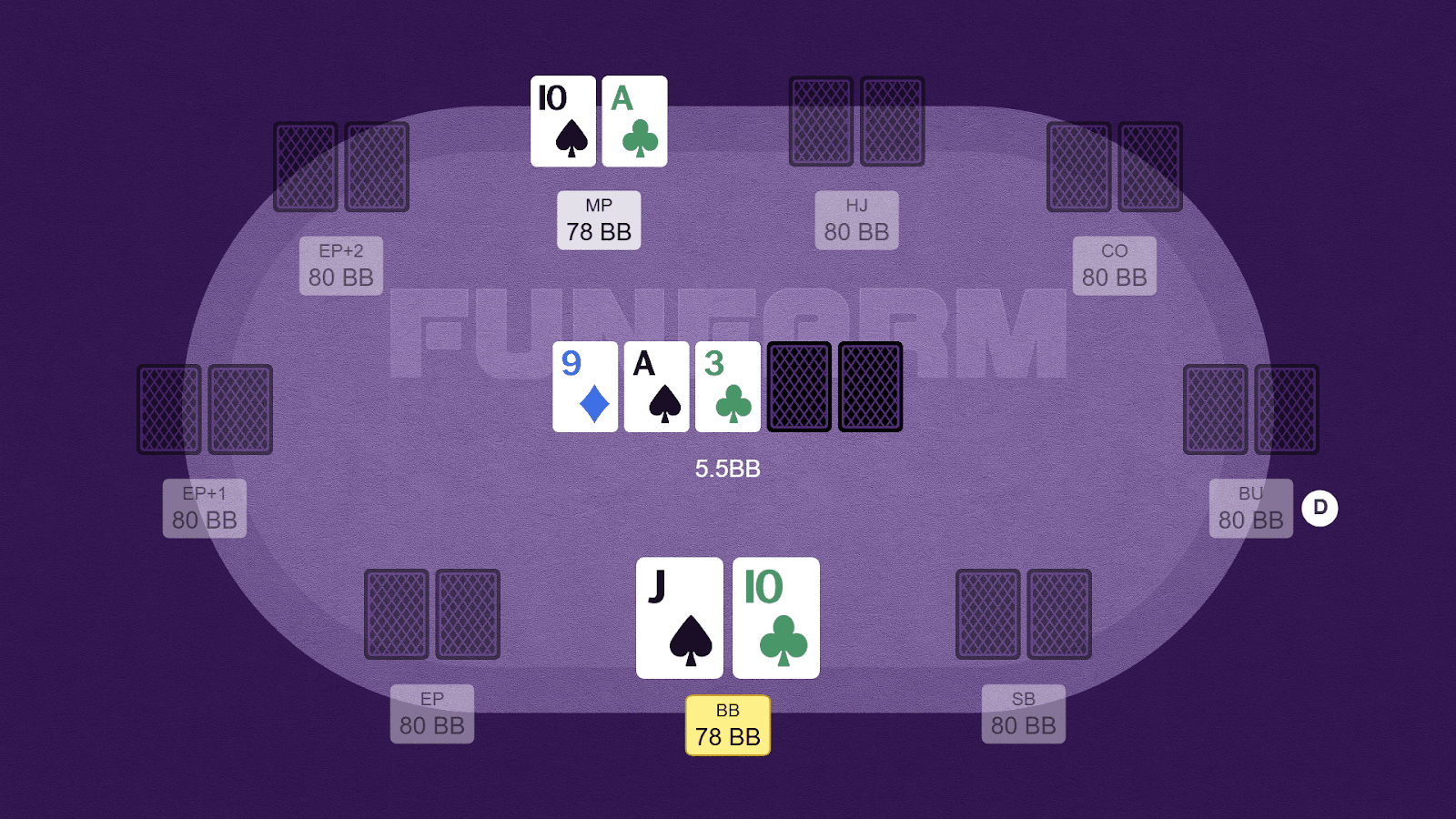
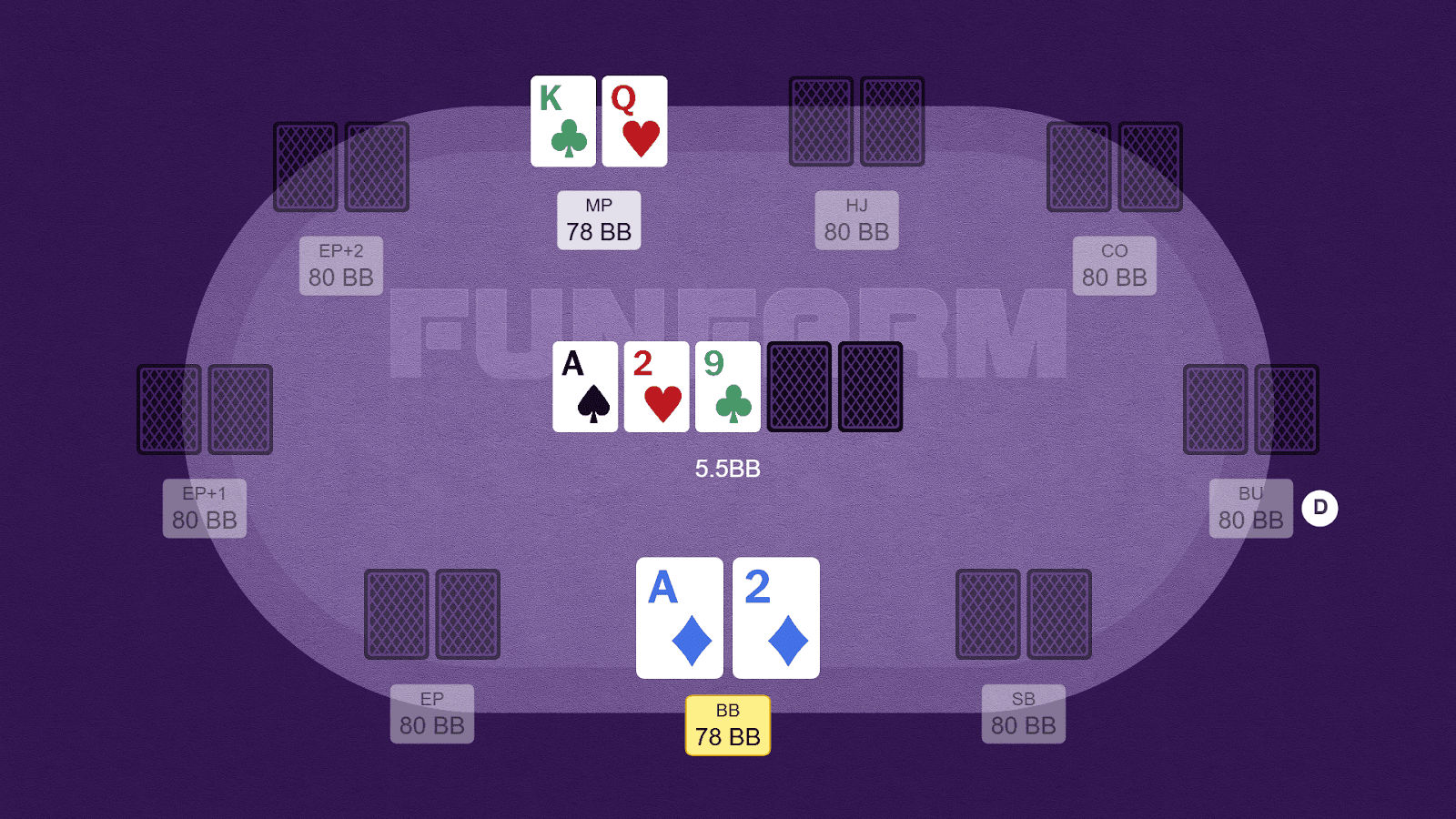
Example: an A-x-x board after a big blind defense. The opponent in MP has far more strong Ax hands in their range (AK, AQ, AJ), while the player in the BB often doesn't have them — as in this case.
Here, with a donk bet the player won't get a fold from the preflop aggressor and will extremely rarely make the opponent err and fold a stronger hand. And in this particular case, improving to the nuts on the turn and river is extremely difficult.
In this case, playing a donk on the flop has no basis whatsoever.
2. The player hit the board and bets first out of position
Many beginning players donk precisely when they've hit the board. But if the player has a strong hand against the aggressor, it's often more profitable to let the opponent do what they like to do themselves — bet.
Example: in this case the preflop aggressor in MP didn't make a strong combination, while the player in the BB got two pair. Most often, playing through a donk will make the opponent fold a weak hand, instead of turning it into a bluff on later streets.
Check-call and check-raise in such spots earn much more, because the player gives the opponent the chance to bluff, and gives themselves the chance to grow the pot already on the flop.
If you want to learn more about the check-raise, then read this article from our collection.
3. Facing aggression in response to a donk bet, the player loses track of how the hand is going
If a player donks as a bluff for no reason — especially into boards that better fit the opponents — then they'll often get raised and end up in a confusing situation.
Over the long run, such lines turn into expensive guessing.
Key takeaway: a donk must have a reason.
When a donk bet becomes a positive decision
A donk comes alive where the equity distribution and the structure of the ranges shift.
The classic logic is this:
on the flop the aggressor often bets with a small sizing and gets called
after the call the out-of-position player's range becomes stronger: made hands of medium strength and draws remain in it
on the turn a card comes that completes a draw or sharply changes the texture
this card better fits the out-of-position player's range than the aggressor's range (it completes their likely straight or flush draws, turns their second and third pairs into trips).
In such a situation a donk stops being a pointless bet and becomes a logical shift of initiative — now it's the player in defense who gets the right to take the floor and extract EV.
Such situations arise especially often in BB versus BTN/CO spots.
Why you need a donk bet — three main reasons
1. Add a street of value
The reason for the donk in this case is this — we want to extract value where there otherwise wouldn't be any.
The typical story looks like this: you play check-call on the flop, and on the turn the opponent starts checking back with medium hands and with part of their draws. As a result you reach the river and realize you have only one bet left — and that's only if the opponent finds something to pay it with.
A donk on the turn solves this: you add a street of extraction against a range the opponent will often play as a check-back, and you'll often be able to continue the aggression on the river.
This is especially relevant on the river: people don't extract value and don't bluff again as often as they should. So a river donk with a strong combination after calling the two previous streets becomes a way to take what they won't give you voluntarily.
2. Deny part of the opponent's equity
A donk isn't only about strong hands. It's also about pressuring the opponent's range.
There are many situations where the opponent, being in position, will happily take a free card — with two overcards, with backdoors, with weak or medium combinations that don't see value but can win at showdown. If you check, you let them realize their equity for free.
A donk makes them pay for realization. And even if the opponent doesn't fold right now, you put pressure on them and increase the probability of winning the pot without a showdown.
3. Make the opponent err
This is a reason that's underrated. Most players know how to play against standard lines — for example, defending against a c-bet — but a donk breaks out of that comfortable environment.
The opponent has to answer questions all over again:
what are we representing?
what does our range look like?
what does this sizing mean?
where does value end and bluff begin?
And this is where the field often makes mistakes — especially with marginal hands: overfolding in some spots, overpaying with calls in others.
If a donk forces the opponent to make decisions they aren't good at — that's a direct plus to your EV.
When donks are especially good
Most often a donk appears where you're out of position and your range on a certain runout becomes stronger than the aggressor's.
Good cards for a donk on the turn/river:
a flush completes
a straight completes — especially a low one, which the BB more often has
a low/medium card pairs the board
Bad boards for a donk:
A-K-x, A-x-x, K-x-x and similar high boards where the aggressor has many strong hits
blank turns that change nothing — if the equity and the structure of the ranges stayed the same, a donk is most often superfluous
How to choose donk bet sizing
Donk bet sizing should follow from the goal.
Goal #1: pressure on a single street
We want to maximize fold equity here and now. Then the size can be larger — starting from ⅔ of the pot up to an overbet. This way you "cut" the opponent's range more sharply and more often knock out hands that are uncomfortable continuing.
Goal #2: a two-street line (turn + river)
In this case it's important that the pot structure be convenient for continuing. Often this means a more controlled sizing on the turn (up to ⅔ of the pot) — you keep yourself the option to fire a second barrel without making the bluff too expensive.
On the river, non-standard bet sizes are sometimes effective, because that's exactly what breaks the opponent's habitual calling math. The key is for the sizing to be logical relative to your range and the situation, rather than looking random.
The river donk is one of the most underused lines among players. Many opponents prefer to check back too many hands — not bluffing again and not extracting value. That's why a river donk adds value, punishes passivity, and sometimes turns into a very strong exploit bluff when draws complete and the field starts to overfold.
Conclusion
A donk bet isn't only a "beginner's mistake" or "trickery for the sake of trickery." It's a tool. And like any tool, it works only under two conditions — the bet has a reason and you have a plan for continuing the hand.
If you understand why you're donking, and you choose situations where the board structure and the ranges give you the right to be aggressive, a donk can become a steady source of EV.
And if you haven't figured it out yet but want to learn, submit an application to FunFarm via the link.
FAQ
Can you donk on the flop?
You can, but rarely — and only when there's a clear reason. On the flop the preflop aggressor often has the initiative advantage, so a donk is generally not needed.
Why is a donk more common on the turn and river?
Because that's where cards that change the equity distribution come more often — completing a flush/straight, pairing the board, creating pressure on the opponent's range.
What's the most common failure of a donk bet?
A donk without a plan. If you don't understand what to do facing a raise or a call, the bet turns into an impulsive action and often leads to a loss of EV.
Read next

Check-Raise: A Powerful Weapon in Your Arsenal
What Is a 3-bet in Poker: A Complete Guide for Beginners

# Spin & Go: Strategy for Turbo Tournaments