Flush in Poker: How to Play It
Let's break down what a flush means in poker. How to make this hand and its rank among the other winning combinations.
To start playing poker, you need to learn the rules. At the early stage, beginners memorize the names of the cards, the positions, and the order of betting. They also pay a lot of attention to the hierarchy of combinations. Let's discuss the flush in poker and its rank among the other winning combinations.
Key facts about the flush
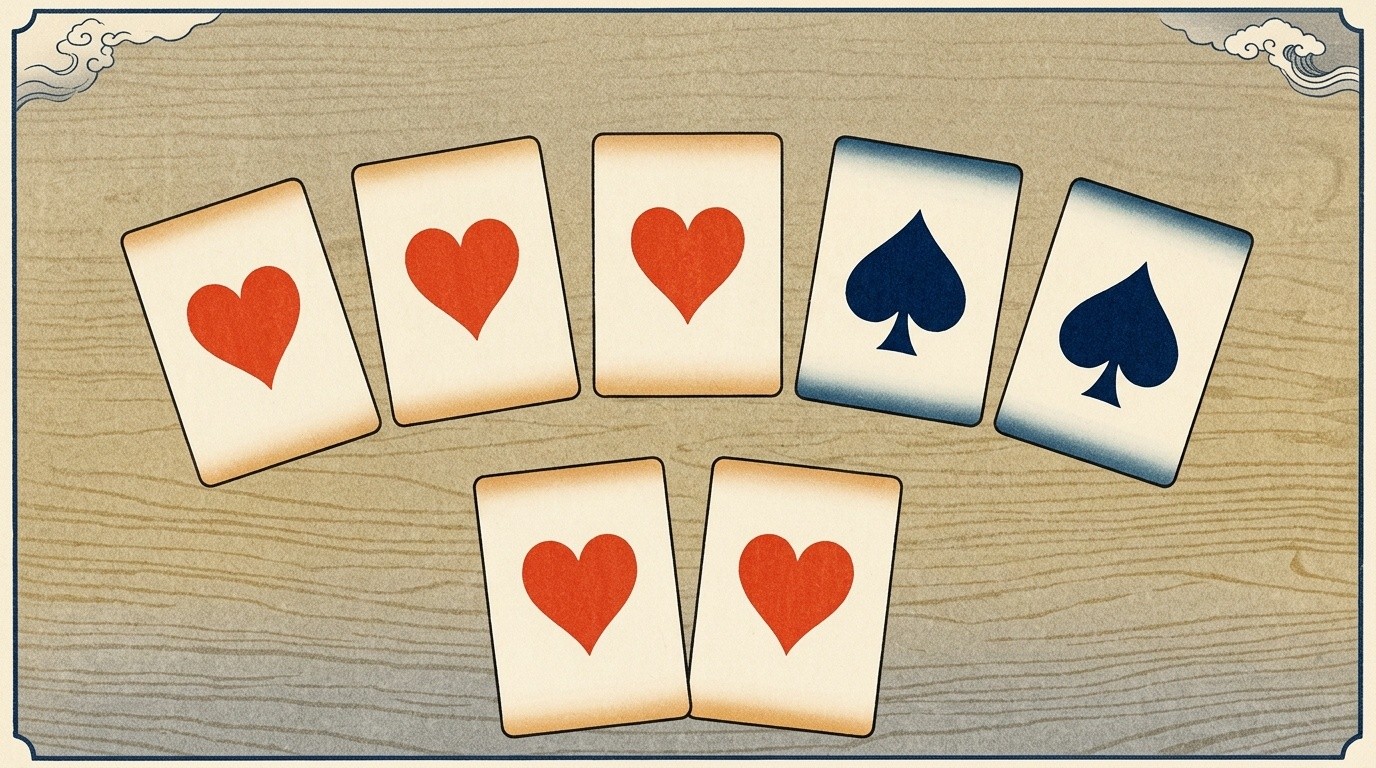
A flush is a combination of 5 cards of the same suit.
It beats six combinations: high card, pair, two pair, set, trips, and straight.
It loses to four combinations: full house, quads, straight flush, and royal flush.
The strongest flush always includes an ace.
A flush draw is strengthened by 9 outs to a made combination.
The "rule of 2 and 4" lets you quickly calculate the chance of hitting a flush.
What a flush is in poker
A flush is a combination of 5 cards of the same suit. For example, A♥️2♥️ on a flop of 5♥️7♥️9♥️ makes the flush A♥️9♥️7♥️5♥️2♥️. If the same-color ranks run in sequence, then the player has made a straight flush.
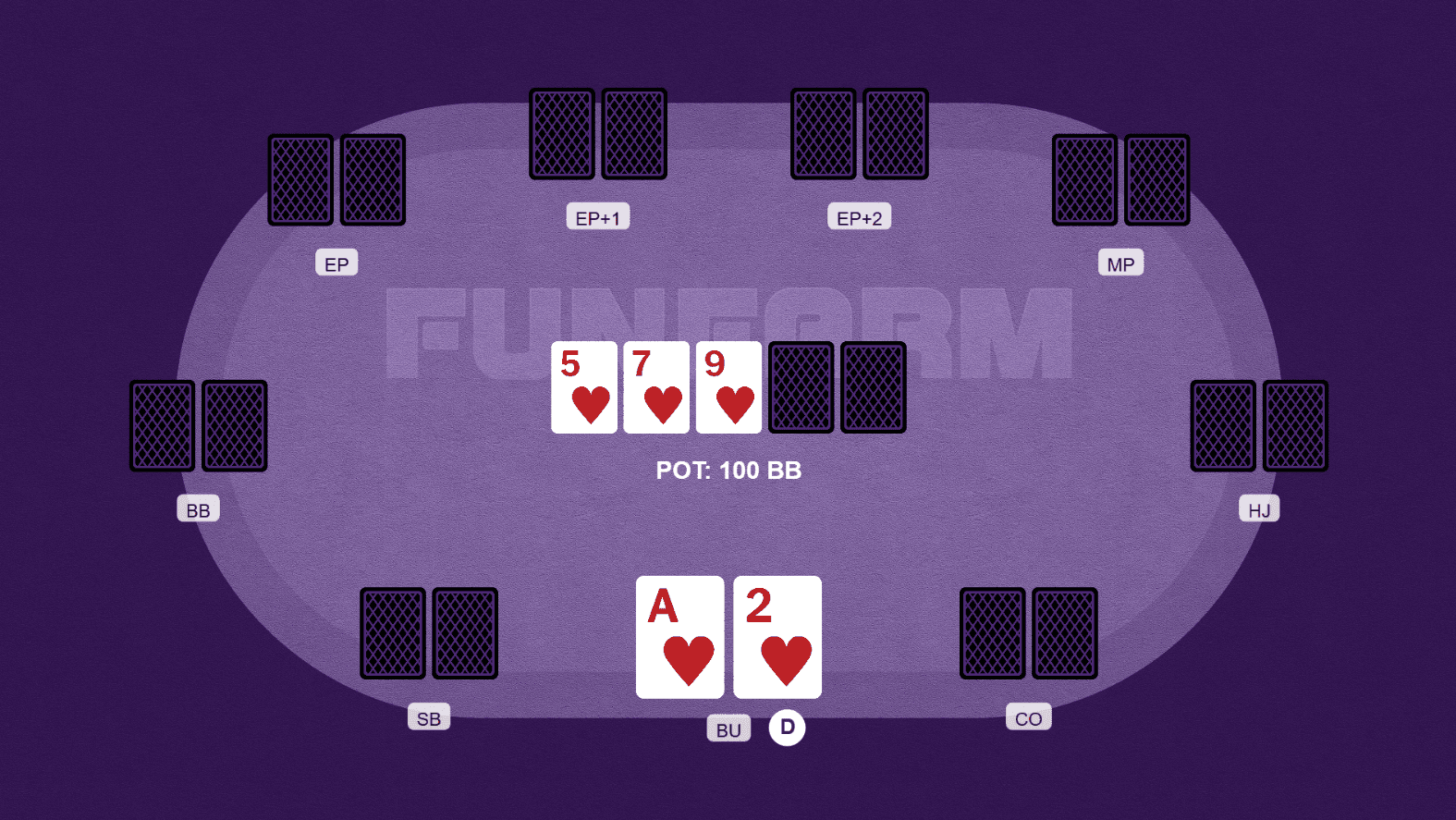
All suited combinations with an ace have the potential to hit the nut flush, so they're singled out into a separate group in starting-hand charts
Let's say T♣️9♣️ on a board of 8♣️7♣️6♣️ gives the straight flush T♣️9♣️8♣️7♣️6♣️. The combination A-K-Q-J-T of the same suit makes the strongest combination in poker — the royal flush.
In the classic hierarchy, the flush ranks sixth in strength. It beats: high card, pair, two pair, set, trips, and straight. The flush loses to: full house, quads, straight flush, and royal flush. In "hi-lo" games, the flush is not counted when determining the weakest combination. That's why low suited combinations can win both halves of the pot.
How to determine the higher flush
In no-limit hold'em and Omaha, several people can make a flush at the same time. It's all thanks to the rule with the community cards on the board. The winner is determined by the highest rank of the combination. For example, Liv was dealt A♠️9♠️ preflop. Igor got K♠️T♠️. The shared board looks like Q♠️8♠️2♥️6♠️3♥️. Both opponents made a flush, but Liv takes the pot. A♠️Q♠️9♠️8♠️6♠️ is stronger than Igor's K♠️Q♠️T♠️8♠️6♠️.
If the highest rank of the combinations is the same, then the next strongest card is compared. Suppose Liv entered the hand with T♠️9♠️, and Igor — with 8♠️7♠️. The flop came A♠️2♠️5♠️. The players hit a flush on the flop. The strongest card for both opponents is A♠️, so the remaining ranks are looked at. Liv's next card — T♠️ — is higher than Igor's 8♠️. So Liv wins.
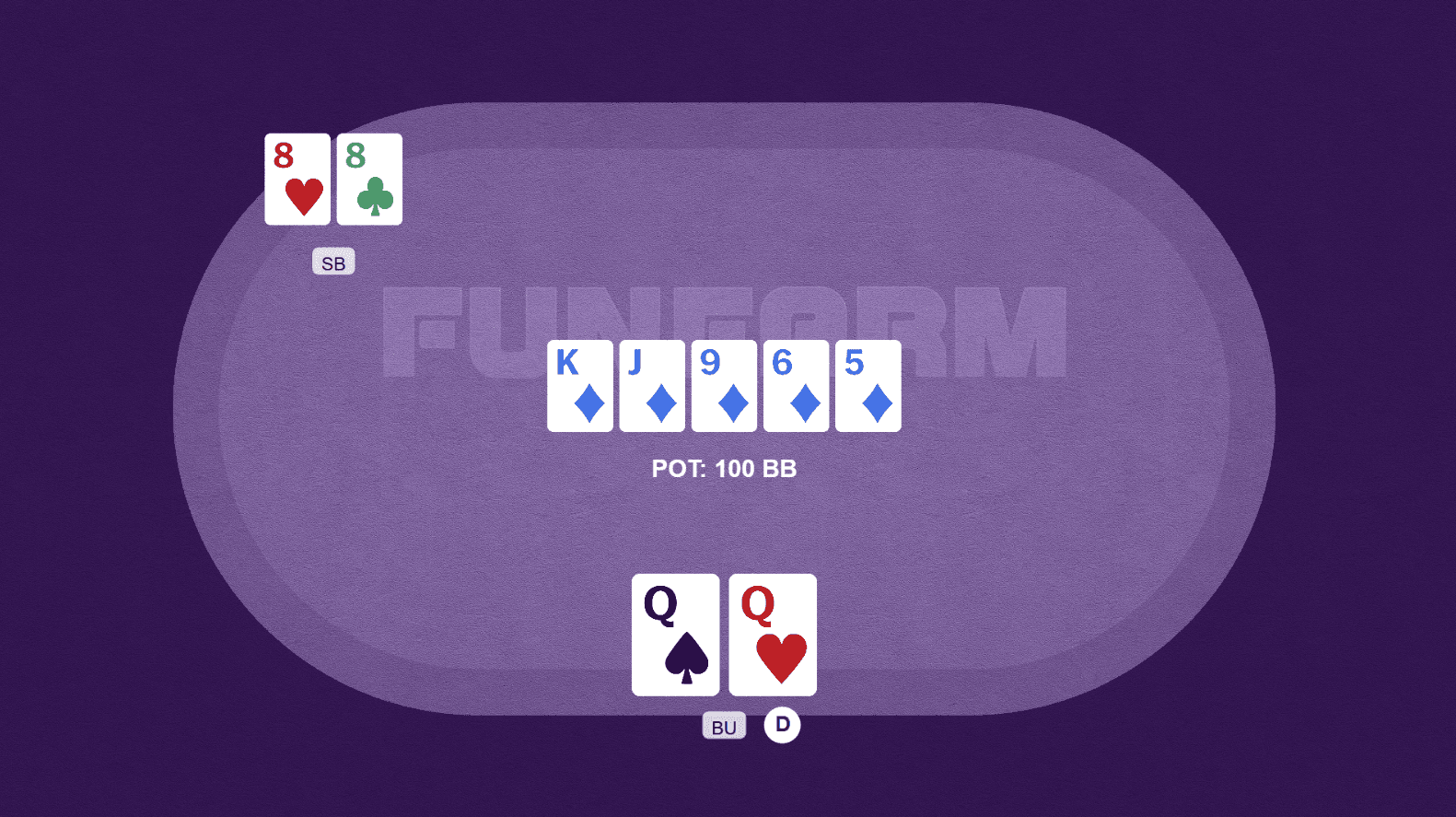
In hold'em and Omaha, suited boards are often called monotone
Sometimes a flush is formed exclusively by the community cards on the table. In that case, the players' starting hands don't matter. Example: Liv made a raise with Q♠️Q♥️, Igor came in with a call holding 8♥️8♣️. By the showdown, the table had: K♦️J♦️9♦️6♦️5♦️. The opponents made identical flushes and split the pot. A queen or an eight of ♦️ in the starting hand would have brought victory to its holder.
The strongest suited combination is called the "nut flush." It includes an ace. For example: A♦️8♦️ on a flop of 9♦️6♦️2♦️ makes the nut flush.
In draw poker and seven-card stud, opponents can make flushes of different suits. In that case, the winner is determined by the highest card of the combination. There is no hierarchy of suits in poker.
Flush draw — odds and strategy
A flush draw in poker is a combination of four cards of the same suit. The combination is one rank of the same color short of being complete. For example, Q♠️J♠️ on a table of 8♠️6♠️3♦️ gives the player a flush draw. One of the nine remaining spade cards in the deck will help complete the flush.
The probability of making a flush from the flop to the river is 35%. The "rule of 2 and 4" lets you quickly calculate the chance of improving. To figure out the probability of completing the combination over two streets, multiply the number of outs by 4: 9 x 4 = 36%. The chance of hitting the needed card on one street is calculated by multiplying by 2: 9 x 2 = 18%.
Advanced players also take into account the possibility of getting a backdoor flush. Let's explain with an example. Suppose a player entered the pot with A♥️K♥️. The community board was laid out as 2♠️7♦️T♥️. If the turn and river of the same color come to the three heart cards, then the backdoor flush becomes a full combination. The probability of hitting a flush with three ranks is about 4%. In calculations, a backdoor flush is usually reduced to an additional out for improvement. For example, in a hand with A♥️K♥️, the player is given a top pair by 3 aces and 3 kings. That's 6 outs in total. The backdoor flush gives 1 more out. As does a backdoor straight.
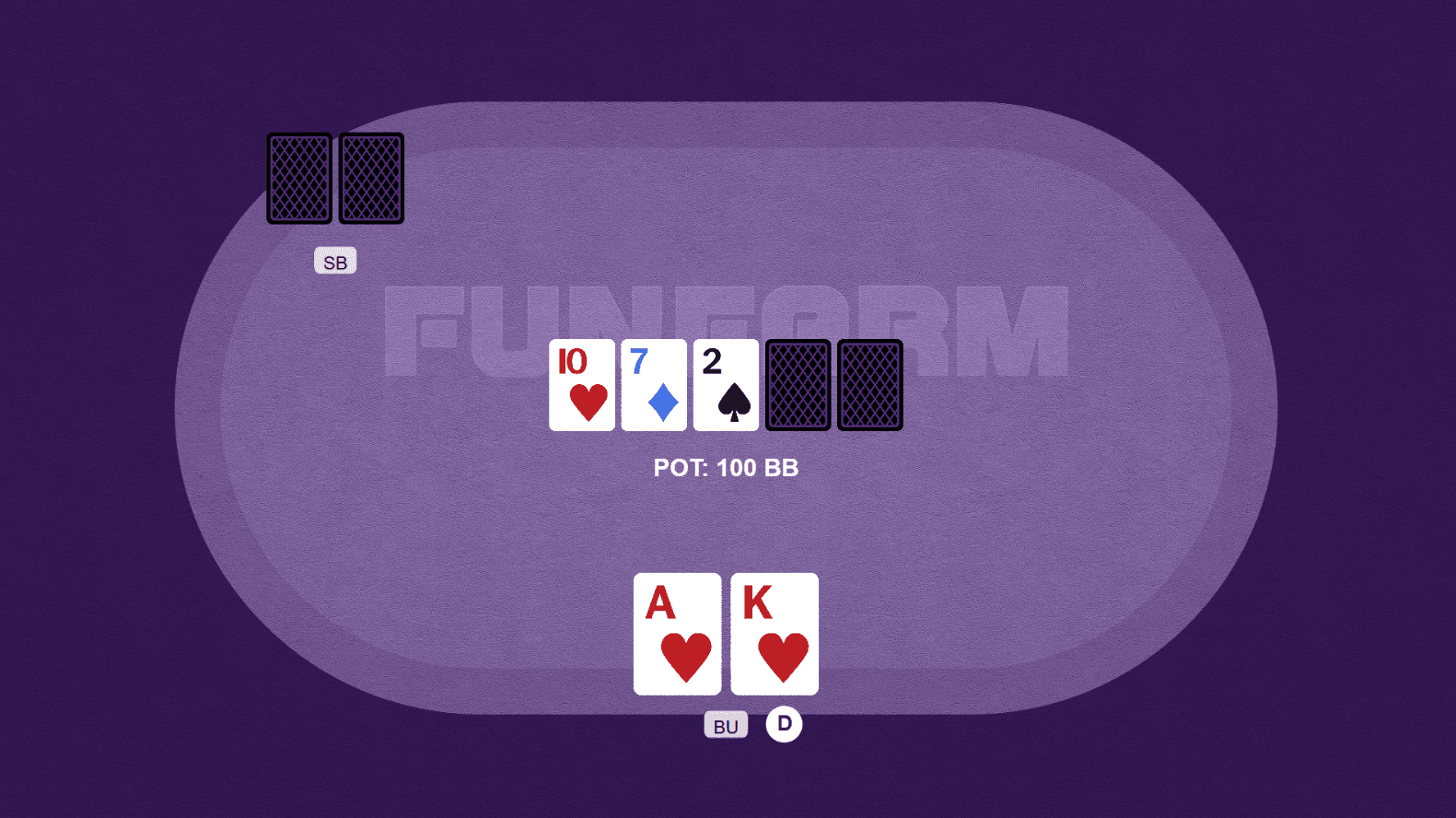
Backdoor draws create good conditions for two-street bluffs
Let's also mention combo draws. Sometimes situations arise where a player can get either of two combinations: a straight or a flush. Powerful combo draws have 15 outs to improve. A flush draw in poker can also be accompanied by a gutshot. Together they give 12 outs. Combo drawing hands let you act very aggressively.
In most hands, it's profitable to build the pot with a flush draw. If the needed card comes, the player gets a lot of chips. The chances of pushing opponents with better hands out are also high. Taking the opponents' money without a made combination is a good outcome for the hand. An additional plus of an aggressive line with a flush draw: it's harder to read. A passive strategy rarely works, even if the needed card comes.
How to play a flush on different streets
The flush is one of the strongest combinations in poker. With it, a player should build the pot. The basic strategy for playing it implies aggressive betting. Let's break down playing with a flush on each street.
Flop. The chance of hitting a flush on the flop is 0.85%. If the top combination has come after all, you need to make value bets. Straightforward bets will let you extract value from worse combinations. For example, a player made a raise with K♣️T♣️ and got the board 6♣️4♣️2♣️. On a low monotone flop, sets and medium overpairs will answer with a call. Any hands with A♣️ won't leave the hand either. Choosing a passive line and a check carries risks. Often the opponent will take a free card. A turn with a fourth ♣️ will minimize the possibility of extracting value and will prompt the opponent to fold their hand to any bet.
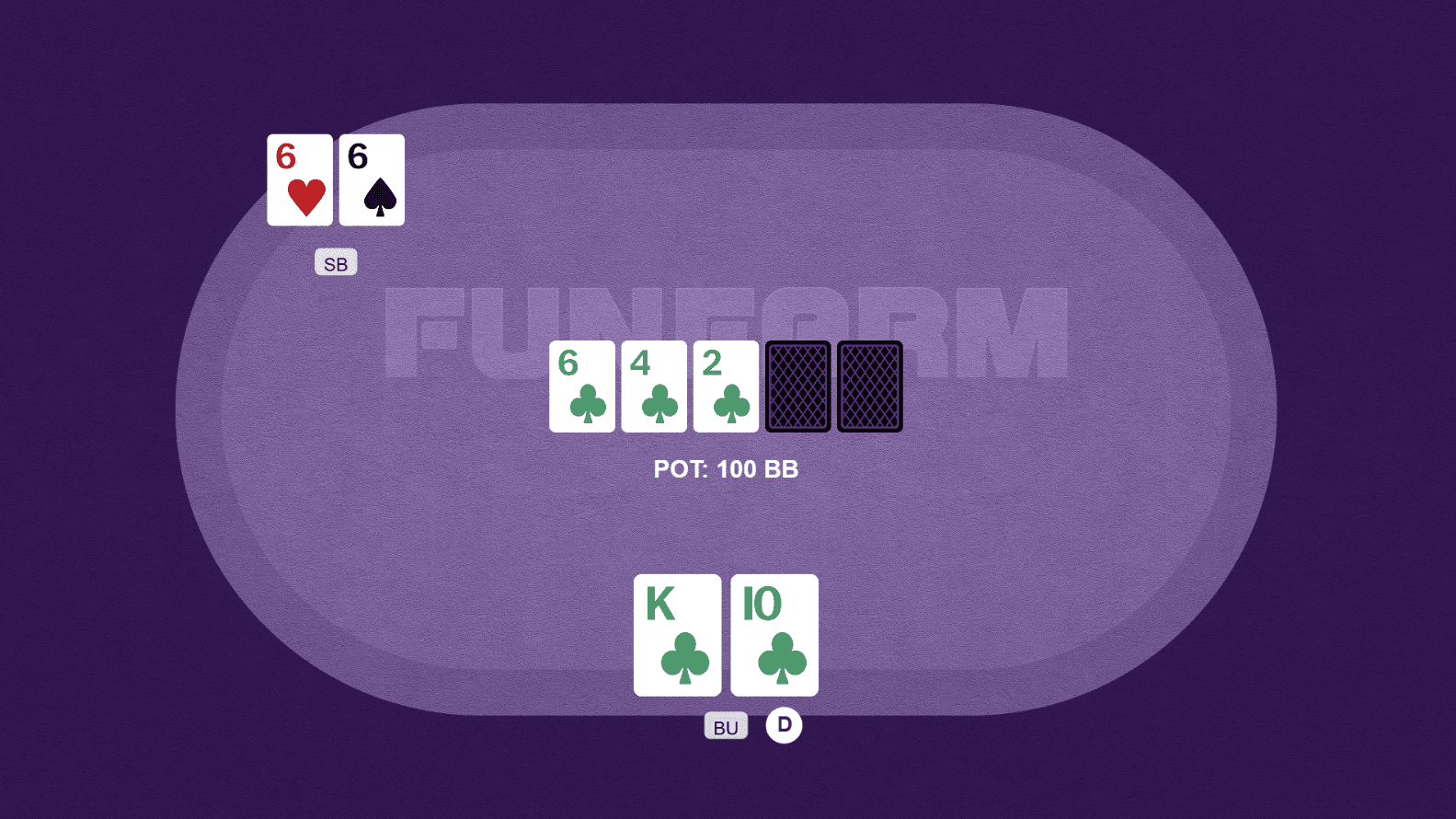
A strong combination from the flop is no reason to give opponents free cards. Make bets to build the pot and protect your flush
Turn. The plan of action depends on the specific card. If a pairing of one of the board's ranks comes, then it may give the opponent a full house or quads. Choosing to control the pot with a plan to extract value on the river will be a good decision. A fourth card in suit will turn a flush without an ace into a dubious combination. Only an opponent with a nut combination will answer a bet. Don't extract value from yourself.
River. On a safe river, keep betting. With the nut flush, an overbet will sometimes work. You can give aggressive opponents the chance to make a bluff. Statistics from a tracker will help point out the right situation and opponent. In most situations with a flush, we're ready to play for the stack. Two flushes in poker is a rare event and the probability can be neglected.
Typical mistakes with a flush
A flush is a strong combination and wins most hands. However, it doesn't guarantee absolute success. Players regularly make bad decisions with the top combination in hand. Let's break down the common mistakes.
Slowplay. Strong combinations in poker come rarely. So players try to extract the maximum from the situation. A flush from the flop often provokes a dubious slowplay. At best, the player extracts less value from the opponent if they skip a bet. At worst — they give a chance to hit a full house or quads for free. A fourth suited card on the board will also lower the chances of earning. An obvious flush will be read even by a not-so-bright opponent.
Ignoring the math. To win at the poker table, you need to make rational decisions. Often the correct action will be suggested by the math. Don't call your opponent's large bets with a flush draw without the appropriate implied odds. The "check/call, check/call, donk bet" line won't work against a thinking opponent.
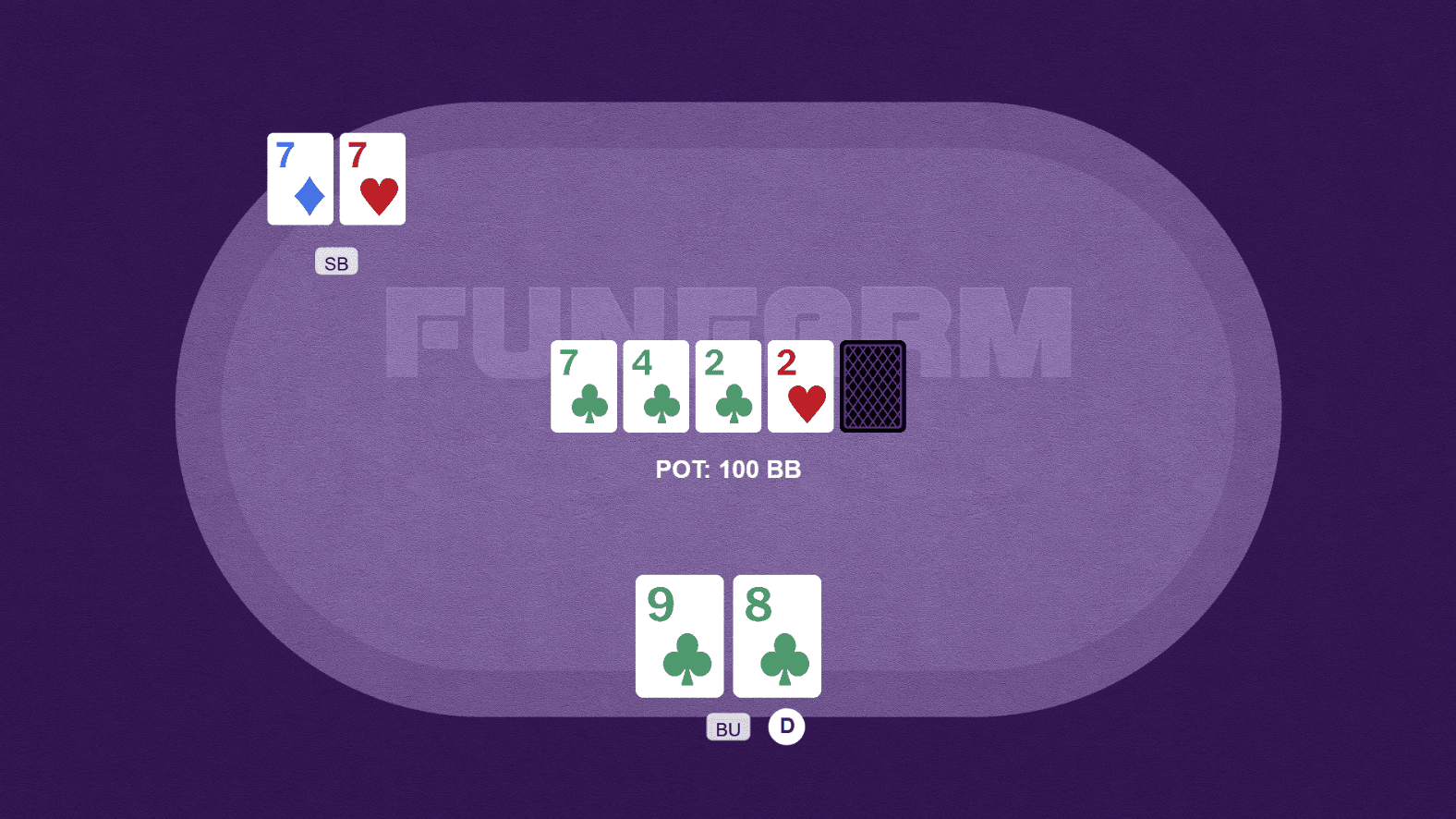
In 20% of cases a set will become a full house or quads on the river. That's why it's important to make large bets on the turn
Overrating the strength of the combination. Some players don't react to changes in the situation at the table. Suppose a player entered the hand with 9♣️8♣️. The flop 4♣️7♣️2♣️ gave them a flush. Almost always they have the best combination. The player makes a bet, the opponent answers with a call. On the turn comes 2♥️. The new card could have strengthened the opponent. The original aggressor bets again, the opponent makes a raise and they both go all-in. The full house 7♥️7♦️7♣️2♣️2♥️ takes the pot. More cautious play could have reduced the flush holder's losses.
How to learn to play poker
Over the long run, all players get the same number of flushes, straights, and other combinations. However, winners play them more effectively. In winning situations they extract more, in losing ones they lose less. To make better decisions, you need systematic training. FunFarm offers it.
We recommend that beginners go through the FF Start program. It will allow you to get basic knowledge about tournament poker. The course covers: the math, adapting to different types of opponents, strategy in the late stages of MTTs, and short-stack play. A trainer helps consolidate the theory. We invite graduates of the program to FF Player Path. The advanced course lets you reach a steady income from $1,200 over 8 months of training.
FAQ
If both have a flush — who wins?
When two players make a flush, the pot is taken by the holder of the highest suited rank. For example, player A got K♥️Q♥️, player B — J♥️T♥️. On the flop 6♥️4♥️2♥️ both opponents made a flush. However, the hand will be won by the holder of K♥️Q♥️, because K♥️ is higher than J♥️.
What is a nut flush?
A nut flush is the best possible suited combination on the board. Usually a nut flush is guaranteed by a hand with a suited ace. Example: A♠️5♠️ on a flop of 8♠️4♠️2♠️ makes the nut flush.
What is a flush draw in poker?
A flush draw is a combination of four cards of the same suit. It's one rank of the same color short of being a complete combination. A draw to a flush is strengthened by 9 outs. Example: Q♦️9♦️ on a flop of A♦️8♦️6♠️. Completing the combination on the turn or river will be made possible by: 2♦️, 3♦️, 4♦️, 5♦️, 6♦️, 7♦️, T♦️, J♦️, K♦️.
Is it profitable to slowplay a flush draw?
In most cases slowplay will do harm. With a made combination it's more profitable to bet right away. Attempts to trap the opponent often lead to difficult situations on the turn or river.