What Is "Fold Equity" and How Does It Make a Bluff Profitable?
In poker, we constantly find ourselves in situations where we don't have a made hand. We missed the flop, didn't improve on the turn, but the pot is already big enough — we want to take it down. It's exactly in these moments that the main question arises — do we have a way to win without going to showdown?
A conversation about bluffing in tournament poker is always accompanied by the term "fold equity." This mathematical metric helps us not to guess, but to assess when aggression is justified, how many folds we actually need, and which opponent decisions we're trying to provoke with our bet.
In this art
icle, we'll break down what fold equity is in simple terms, how it relates to bet size, opponent types, board structure, and pot odds, and most importantly — how to use it in practice so that bluffing stops being chaotic and starts working for us.
What "Fold Equity" Is in Simple Terms
Fold Equity (hereinafter fold equity) is the probability that an opponent folds their hand in response to our bet or raise.
It's important to nail down a key point right away: fold equity is not a guarantee of a fold and not a promise of a result. It's the probability with which our aggressive move works and the hand ends without a showdown*.
* A showdown is the moment at the end of a hand when the remaining players in the hand reveal their cards to determine the winner of the pot.
When we bet with an unmade or weak hand, we usually have two sources of winning:
1. The opponent folds — we take the pot immediately
We won not because we have a stronger combination, but because the opponent decided that continuing was unprofitable or uncomfortable.
2. The opponent calls, but we improve and win later
This is already a story about a semi-bluff: when we have chances to improve — for example, to a flush or straight — and we're ready to keep up the pressure because we still have outs to win, but not against taking the pot here and now.
Fold equity relates more to the first point. But it's precisely this one that's often the main driver of profit in bluffs — we can win pots even when our hand will almost always lose at showdown.
Why do we need this understanding in practice? If we don't think about fold equity, our bluff often turns into emotion: "we missed — let's bet," "we need to do something," "the board is scary — he'll surely give up."
But if we think about fold equity, logic and control appear, and most importantly, questions whose answers will let us win chips over the long run:
which hands the opponent can fold right now
how often this will happen
what bet size is needed to make him make a mistake
whether it's even worth spending chips in this spot.
It's in this sense that fold equity makes a bluff profitable — we win not because we guessed, but because we created a situation where it's mathematically hard for the opponent to continue.
The Connection Between Fold Equity and Bet Size
In the heads of beginning players there's a myth — "the bigger the bet, the better the bluff." In tournament poker this misconception is especially dangerous because the chips on the table aren't equal to money in your wallet.
We have a stack, the stage of the tournament, different motivations for short and deep stacks — and all of this affects how often the opponent is actually ready to fold.
In practice it's not so complicated. There's a simple logic:
The more we bet, the more often the opponent has to fold for our bet to at least not be losing.
This connection is expressed by the formula:
Fold Equity = Bet / (Bet + Pot)
Bet — our bet size
Pot — the pot before our bet
Result — the share of folds that makes our bet profitable
Let's look at how fold equity is formed using two simple examples. First situation: we're in a hand where the pot contains 20 chips. Our bet is 10 chips.
In this case fold equity equals:
FE = 10 / (10 + 20) = 10 / 30 = 0.33 → 33%
That is, if the opponent folds more often than 33%, our bet becomes profitable, even if we don't have a made combination to win.
Another situation: there are 20 chips in the pot, and our bet equals 20 chips.
In this case fold equity equals:
FE = 20 / (20 + 20) = 20 / 40 = 0.50 → 50%
We bet twice as much — and now we need the opponent to fold every second time. And here's where tournament reality begins — by no means all opponents are capable of folding that often.
Factors Affecting Fold Equity
Fold equity doesn't exist on its own. It's not an abstract number or a property of a specific bet. It always comes together from context: who's sitting across from us, how the hand develops, what cards are on the table, and how much pressure we actually create with our action. Below we'll break down the key factors in more detail.
Opponent Type
The first and most important factor is exactly who is making the decision against our bet.
Cautious players are much more often ready to give up a marginal hand. They don't like playing big pots without confidence and tend to overestimate the strength of aggression. Against such opponents fold equity is higher.
Aggressive players, who don't like to give up without a fight, are the complete opposite. They often call not because they're calculating odds, but because they want to see out the hand. Against them the influence of fold equity is minimal, and any bluffs require either a very precise situation, or are excluded from the strategy altogether.
Bet Size Relative to the Pot
Too small a bet rarely creates discomfort. It's easy for the opponent to click call, even if he has doubts. Such a bet may knock out a very weak range, but will often be unconvincing against medium-strength hands that want to see how the hand ends at showdown.
On the other hand, a small bet has lower fold equity requirements. The less we bet, the fewer folds from opponents we need over the long run.
Too large a bet, on the contrary, sharply raises the requirements for folds. We risk a large number of chips and force the opponent to fold a significant part of his range. If he isn't able or willing to do this, the bet becomes losing.
Important to remember: the bet should match the goal we're pursuing and match the mathematical logic of the hand. The bet should look significant and logical, but not excessive for the goal we're pursuing.
Number of Players in the Hand
Fold equity drops sharply with each additional participant in the hand.
In a one-on-one game we're fighting against one range and one decision-making logic. In a multiway pot everything is different — the probability that someone hit the board, improved, or simply isn't ready to fold increases many times over.
Even if one of the opponents is ready to fold, the second one may continue — and our entire calculation collapses. That's exactly why bluffs and semi-bluffs are far more effective in one-on-one pots.
A simple rule for tournament poker: the more players in the pot, the more cautious we are about aggression without a made hand and the more we strive for more honest play.
Board Structure
The texture of the board directly affects what hands the opponent can have and how comfortable it is for him to continue.
Dry, high boards often connect poorly with calling ranges. On such textures the opponent has many empty hands and weak pairs, which means fold equity is higher.
Connected and draw-heavy boards work the opposite way. When there are many potential straights and flushes on the table, the opponent has more reasons to continue, more chances to improve, and more psychological willingness to watch the board develop to the end.
On such boards fold equity decreases, especially if we're playing against several opponents or against players who like to realize equity.
Initiative and Line of Play
Fold equity is closely tied to how logical our line looks.
When we were the aggressor preflop, kept up the pressure on the flop, and logically bet further, our line is perceived as consistent. It's easier for the opponent to believe in the strength of our hand and decide to fold.
But if we played passively for a long time, checked, called, and then suddenly make a big bet on a later street, trust in such an action is lower. The opponent more often asks himself: "What strong hands would play this way?" — and tends to pay off the bet.
Initiative by itself doesn't guarantee success, but it increases fold equity because it makes it easier for the opponent to interpret our actions.
How Fold Equity Relates to the Opponent's Pot Odds
When we talk about fold equity, we're actually talking about what decision we're offering the opponent. And this decision almost always comes down to one question:
Is it profitable for the opponent to continue the hand from the standpoint of math and logic?
Pot odds are usually explained from the perspective of the player who calls. But for us, as the aggressor, they work the other way around: we choose a bet size that makes calling unprofitable.
Simply put — we construct a situation in which the opponent has to pay too much for his odds. This is exactly where pot odds and fold equity come together into one working concept.
Let's look at the situation with a concrete example with two ways of developing.
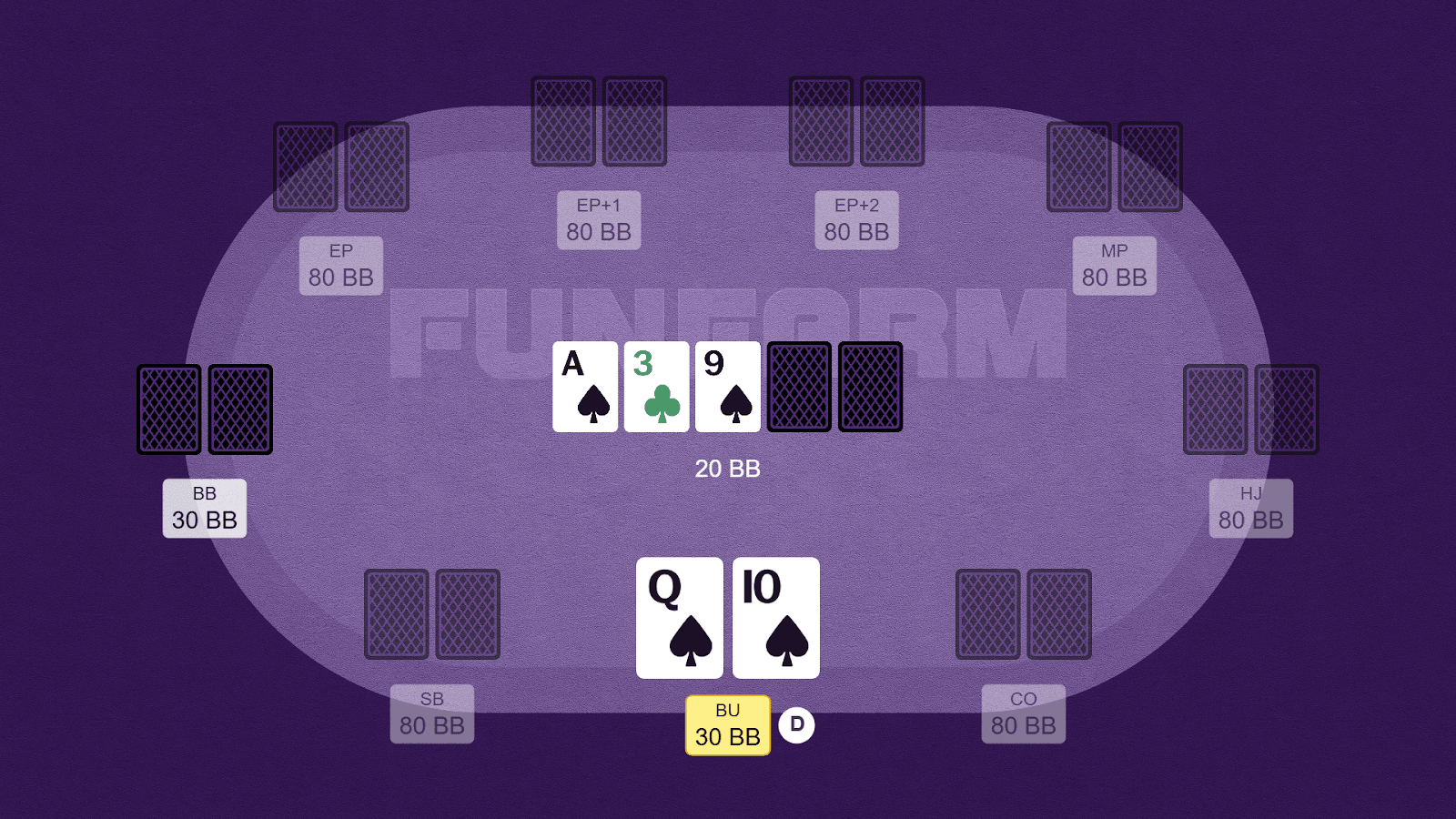
Preflop we called a 3-bet on the BU against an opponent on the BB. There are 20 BB in the pot. Our stack is one and a half times the size of the pot. We don't have a made combination in our hand, but we have a clean flush draw.
Let's immediately count our equity* to the flush. To do this we need to multiply the number of our potential outs by four.
In the case of a flush draw — that's 9 outs (13 cards of one suit in the deck minus 2 in our hand and 2 on the table).
9 x 2 = 18%
To account for one more street, we multiply by two again — we get 36%.
18 x 2 = 36%
Now let's unpack the concept of fold equity — against what bet it will be profitable for us to call, and against what it won't.
* Equity is the share of the pot we're entitled to in a specific hand, based on the probability of winning it by showdown.
Option #1
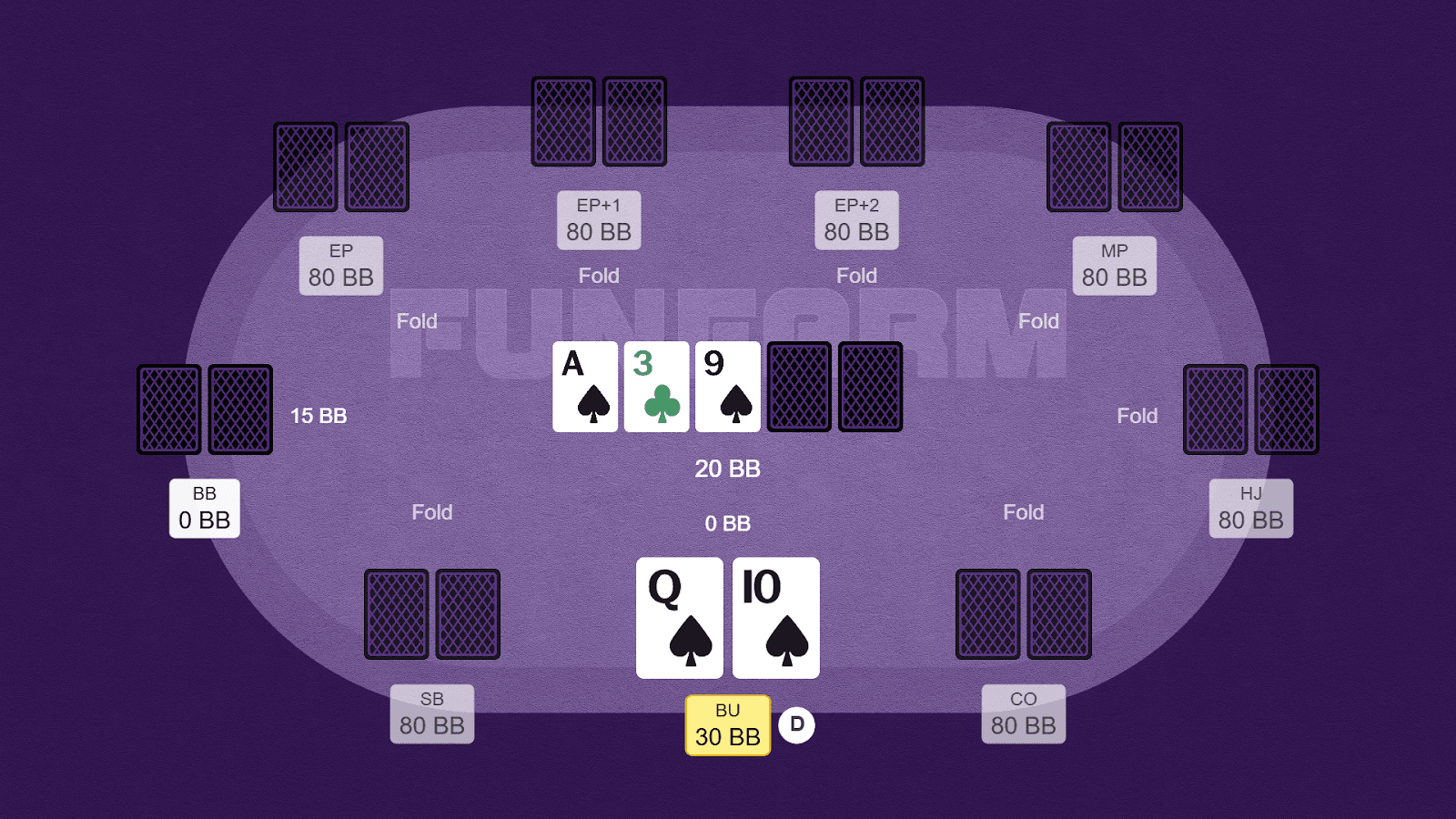
Let's imagine that the opponent has 15 BB left. He bets everything — we need to add the same amount to the pot.
The pot after the call will be 50 BB. So, 15 / 50 = 30%.
36% is more than 30% — which means in such a situation it's profitable for us to call with a flush draw. The opponent didn't have enough fold equity to knock us out of this hand.
Option #2
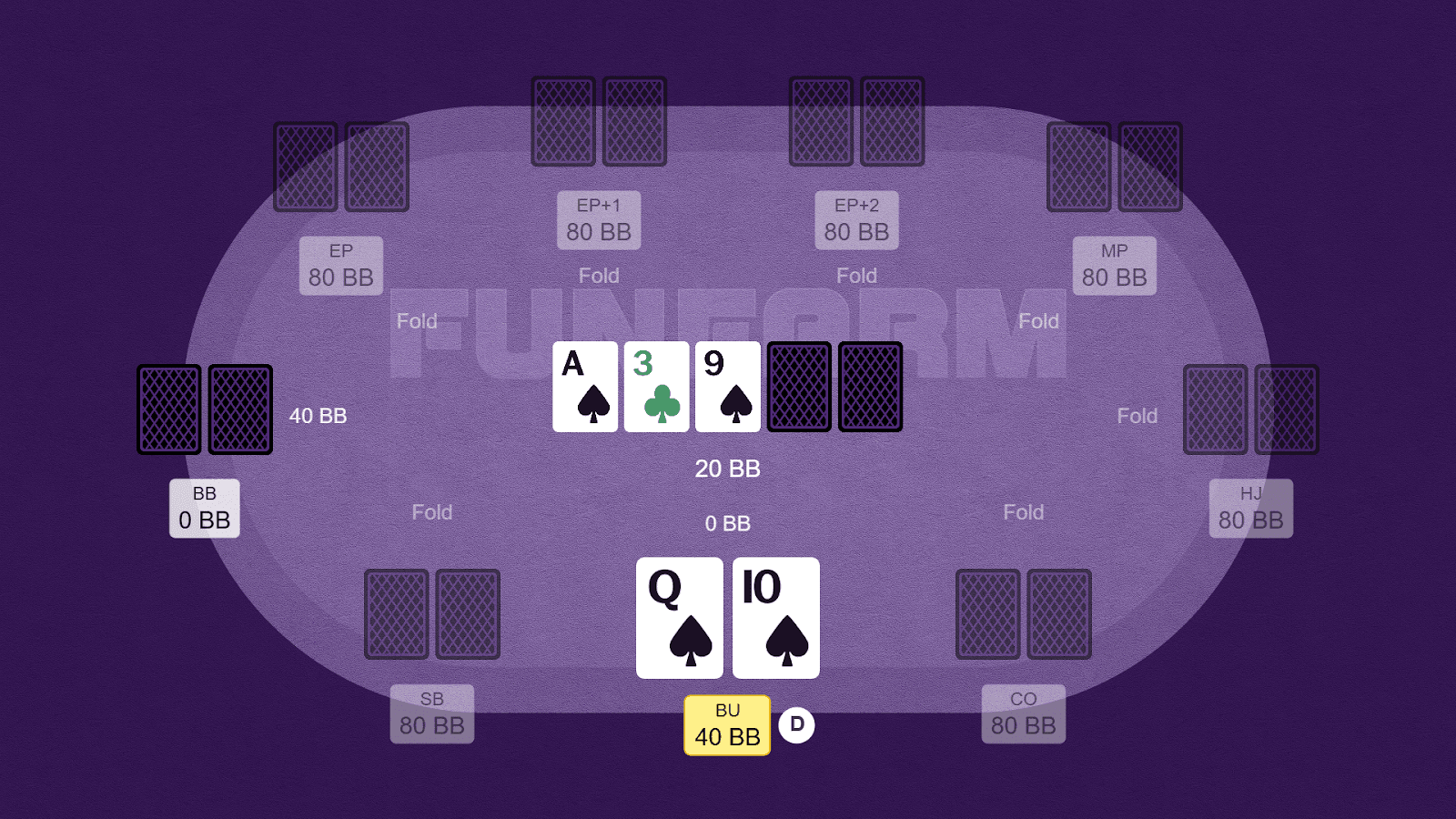
Let's imagine that the opponent has 40 BB left, and he decides to go all-in for 2 pots.
Now the situation has changed: we have the same flush draw, the pot after the call will be 100 BB. So, 40 / 100 = 40%.
36% is less than 40% — which means in such a situation we're forced to fold, and the opponent, with the help of the bet, didn't let us realize our potential, based on the fold equity value.
Typical Mistakes When Working With Fold Equity
The mistakes here are almost always the same and arise when assessing the situation by feel rather than by structure.
1. Overestimating Folds
The most common trap: we're confident the opponent will fold because that's correct by logic. But poker is set up so that people aren't obligated to play correctly — therefore it's important to consider the opponent's playing style.
In practice the opponent will call just to see the board even with a not-so-strong hand — this is especially characteristic of aggressive players.
In this case we start betting in situations where there aren't enough folds to justify the risk.
How to check yourself: if we can't honestly name which specific part of the range the opponent will fold, then most often we're simply hoping for luck.
2. Ignoring the Board
Even if the opponent is cautious, the development of the board can change fold equity.
There are flops that look favorable for our hand — for example, a dry board with an ace, where we have top pair with top kicker. We start to build the pot on the flop, but on the turn comes a card that changes the balance of power — for example, on a board A♠️3♣️9♠️ a 3♥️ falls, i.e. the board pairs.
The nut potential of the board has changed — now the opponent may have trips. And that means we need to continue the hand more carefully, taking the changes into account.
How to check yourself: if the board has many potential combinations, we should be ready for fold equity to be lower than it seems.
3. Excessive Sizing
We want the opponent to be scared — and we bet more than necessary. The problem is that the bigger the bet, the more fold equity we need. That is, we're inflating the requirements for the situation ourselves.
What often happens:
we bet big in a spot where the opponent would have folded to a small size anyway,
we bet big in a spot where the opponent will never fold, and we simply lose extra chips.
The correct logic for beginning players: we should choose a bet size that knocks out the needed range of hands and at the same time doesn't make the bet an expensive mistake.
Conclusion
Fold equity is a risk-assessment tool that helps us understand whether it's even worth spending chips in a specific situation.
If you want not just to occasionally bluff successfully, but to build a stable, profitable strategy over the long run, it's important to study such topics not in fragments, but as a system.
It's exactly this approach to learning and understanding the game that we develop at FunFarm. Submit an application to the fund to grow in poker together with us.
FAQ
Does every bet have fold equity?
Yes, every bet has both pot odds for the call and fold equity. The practical point of a bluff bet only appears when the opponent is capable of folding, the board and the line give him reasons to give up, and the bet size puts pressure on the right hands.
Why do small bets sometimes work better than big ones?
Because a small bet needs fewer folds to be profitable. And often a small bet knocks out exactly what we need to knock out — missed hands, overcards without a hit, etc. A big bet, on the other hand, is an attempt to knock out the middle of the range already, and it requires the opponent to be able to let go of pairs and not cling to the pot.
Does fold equity work against amateurs?
It works, but only against those who are capable of folding. There are amateurs who enter hands wide but quickly give up without a hit. Against them fold equity is often high, and a bit of aggression brings many small pots.
And there are amateurs who don't like to fold — against them fold equity drops sharply, and we shift our strategy toward value — we bet more often and bigger when ahead, and try less to outplay the opponent with bluffs.
Read next
The Poker Chair: A Complete Guide to Choosing One for Long Sessions and Protecting Your Back
Omaha Hi-Lo: How to Win Half the Pot (or All of It)
How to Bluff Correctly in Poker: A Complete Guide