What is ICM in poker and how it affects MTT strategy
In tournament poker, we regularly find ourselves in situations where the standard logic of "I'm ahead, so I should play" stops working. We might have a strong hand, good equity, and favorable pot odds* — yet calling or pushing* still turns out to be a mistake over the long run.

*Pot odds — the ratio of the pot size to the bet you need to call.
*Push — betting your entire stack (all-in).
Most often, such mistakes happen near the bubble* or at the final table, when the cost of busting rises sharply. Players keep thinking in terms of chips, even though the real decision should have long been made in terms of money.
*Bubble in poker is the stage of a tournament when one or several players still need to bust before the money begins.
This is exactly where the concept of ICM in poker comes in. It explains why situations of equal strength require different decisions at different stages of a tournament, and shows exactly how the value of our stack changes depending on the payout structure and the opponents' stacks.
In this article, we'll break down what ICM is, how it works in practice, and why, without understanding it, it's impossible to make consistently profitable decisions in tournament poker over the long run.
As you may have noticed, we've used several poker terms that may be unclear to you in the early stages of learning poker. To understand them better, we recommend turning to our glossary.
And now, to the topic.
What ICM Is
ICM (Independent Chip Model) is a mathematical model that lets you estimate the monetary value of your stack in a tournament.
It's important to fix the key point right away: ICM does not evaluate the strength of your hand or the probability of winning the hand. It evaluates how much your chips are worth in the context of the tournament.
In a cash game, everything is linear: one chip equals one monetary unit. In a tournament, this connection breaks down. The value of chips becomes nonlinear and depends on the payout structure, the distribution of stacks, and the stage of the tournament.
A loss can mean busting, which means losing all your future expectation. At the same time, a win does not give a proportional increase in stack value.
This leads to a key consequence: in tournaments, we cannot evaluate decisions only through the probability of winning the hand.
Sometimes the right decision is to forgo the chipEV decision in order to keep your place in the tournament while waiting for a more profitable pay jump.
We cover the difference between chipEV and ICM in more detail in the article about the stages in tournament poker. Head over and check it out.
The ICM Formula: How to Calculate Stack Value
Formally, ICM is calculated through the expected monetary value:
ICM EV $ = probability of 1st place × 1st-place payout + probability of 2nd place × 2nd-place payout + … + probability of n-th place × n-th-place payout
At first glance, this formula looks like standard expected value, but in tournaments it takes on a special meaning. We're not just evaluating the chance of winning the hand — we're evaluating how the current distribution of stacks affects our chances of taking each payout position.
Let's look at a specific example. There are 5 players left in the game with the following stacks:
— 100,000
— 60,000
— 45,000
— 30,000
— 15,000
Payout structure:
— $2,000
— $1,500
— $1,000
— $500
— $200
If you look only at the number of chips, it might seem that the player with 100,000 should receive several times more than the others. But ICM shows a different picture: their advantage is capped by the top payout — they cannot win more than $2,000, even if they hold half of all the chips.
To evaluate the real value of each stack, the model:
Determines the probability of each player taking each place
Multiplies these probabilities by the corresponding payouts
Sums up the result
In practice, this means that:
— the big stack is undervalued relative to chipEV
— short stacks are overvalued
— the value of each additional chip decreases
From this follows the key ICM rule:
We should call an all-in only when it increases our $EV over the long run
If a call gives a zero or near-zero expectation, it's better to avoid it. The reason is that the risk of busting almost always costs more than the potential chip gain.
That's exactly why in tournaments you often have to give up even situations where we're the favorite. ICM forces us to take into account not only the probability of winning but also the consequences of losing — and that's exactly what makes the model a key decision-making tool.
How Much a Chip Is Worth in a Tournament

Let's look at a simple example:
— 10 players at the table
— buy-in $10
— prizes: $50 / $30 / $20
At the start of the tournament, 1000 chips ≈ $10. But after reaching the money, the situation changes. Even a short stack guarantees a payout, which means its value is already higher than at the start.
Now the reverse situation: you win the tournament and get all the chips. There are now 10 times more of them, but the maximum win is $50.
This means that:
— stack growth is not proportional to money growth
— each additional chip is worth less than the previous one
This effect is called "diminishing chip value." And it's exactly what underlies all ICM decisions.
Let's imagine a situation: you have 60% equity against the opponent's range.
In a cash game, this is an obvious call. In a tournament, it all depends on the context. If a loss means busting, and there's a player at the table with a smaller stack who could bust before you, then a fold may be the more profitable decision.
The reason is that ICM takes into account not only the probability of winning the hand but also the consequences of losing.
A loss here means losing all of your future $EV. A win is just an increase in your stack, but not proportional to the increase in money.
ICM on the Bubble and at the Final Table
The influence of ICM shows up most vividly at the key stages of a tournament.
1. Bubble
On the bubble, maximum pressure falls on the medium stacks.
— short stacks fight for survival
— the chip leader can apply pressure
— medium stacks are forced to play cautiously
This is exactly where situations most often arise in which you need to fold even strong hands in order to keep your position.
2. Final Table
At the final table, the cost of a mistake rises even more.
The difference between adjacent payouts can be enormous, and any wrong decision directly affects the final result of the tournament.
At this stage, play becomes maximally sensitive to ICM, and ranges narrow significantly.
ICM Pressure: How to Take Pots Without a Showdown
ICM not only restricts but also creates opportunities.
A player with a big stack can apply pressure on opponents because their risk of busting is significantly higher.
This leads to the fact that:
— medium stacks fold more often
— calling ranges narrow
— aggression becomes more effective
Thus, ICM creates a situation where chips begin to work as a tool of pressure, rather than just a resource for playing hands.
Drawbacks of ICM

Despite its effectiveness, ICM remains a model with limitations.
1. It doesn't account for player skill level
ICM assumes that all players are equal in skill. In practice, this isn't the case. A strong player can realize their edge in future hands, which means their stack is potentially worth more than the model shows.
2. It doesn't account for future situations
ICM evaluates only the current moment. It doesn't take into account future blinds, possible profitable spots, or table dynamics.
This can lead to overly cautious decisions if you consider the model without context.
3. It ignores position and the structure of the hand
A 10bb stack on the button and in early position has different in-game value, but ICM doesn't take this into account. The model works at the level of chip distribution, not specific in-game situations.
On the other hand, these factors are not objective reasons to ignore the influence of ICM at the most critical stages of a tournament. So our advice is: it's better to account for ICM than not to.
ICM Calculators
Since precise ICM calculations are practically impossible to do by hand, players use specialized software to analyze hands and build strategy.
1. Flopzilla
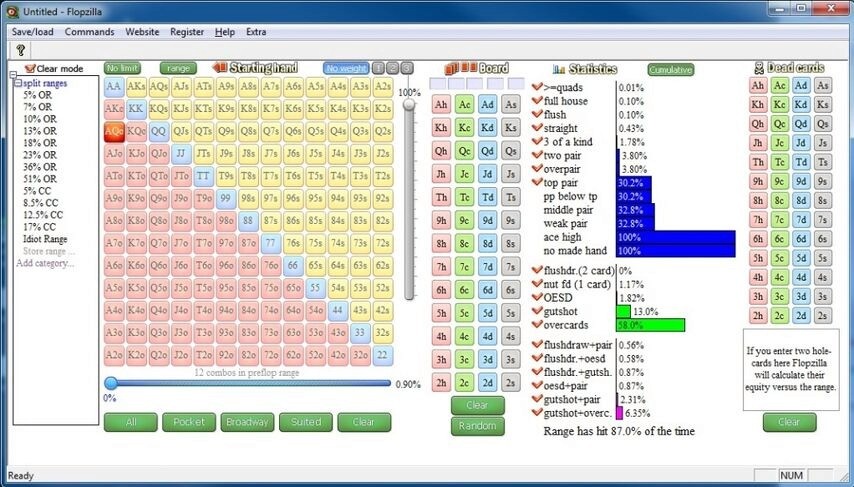
You can find it here.
Cost: $25 for a lifetime license.
This is a tool for analyzing equity and working with ranges. It lets you model hands, set up hands, boards* and see how different ranges interact with each other on each street.
The main value of the program is developing thinking in ranges*. The player stops perceiving the situation through a specific hand and starts analyzing ranges, their intersections, and structure.
This directly affects the quality of decisions: it becomes easier to understand which hands continue, which fold, and how equity is distributed across different lines of play.
*Board in poker is the community cards on the table, which are dealt face-up for all players.
*Range in poker is the set of all possible hands a player can act with in a specific situation.
2. Holdem Resources Calculator (HRC)
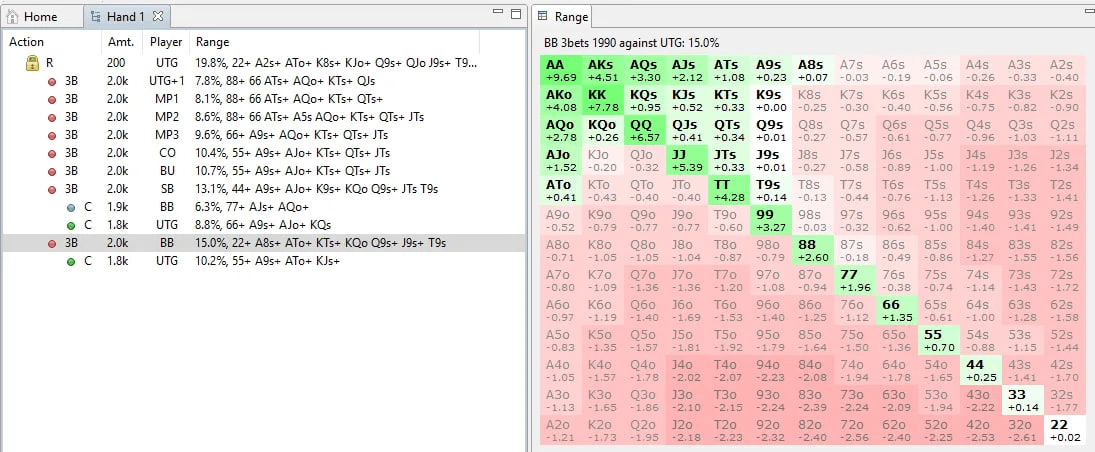
You can find it here.
Cost: from ~$15 per month depending on the plan.
A trial version is available.
This is one of the key tools for tournament players, focused on analyzing decisions with ICM in mind.
The program lets you calculate optimal push/fold ranges, analyze hands on the bubble and at final tables, as well as model various tournament scenarios taking into account the payout structure and stacks.
The main advantage of HRC is that it works specifically with tournament logic. Unlike universal equity calculators, here decisions are viewed through the prism of $EV, not just chipEV.
Regular work with HRC helps you understand exactly how ranges change under ICM pressure and where a player loses money by making standard decisions outside the tournament context.
3. ICMIZER
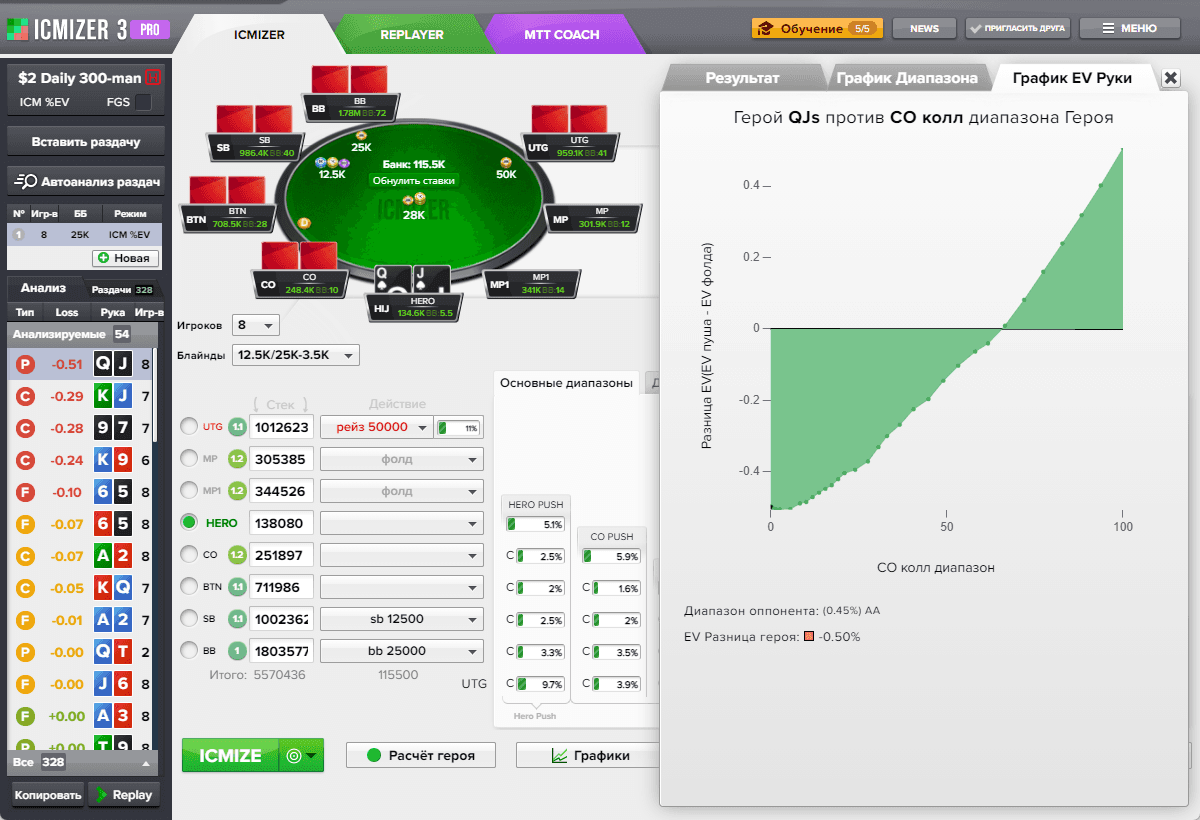
You can find it here.
Cost: $18 per month, $37 for three months, $100 for a year.
A free trial version is available — 7 days with full access to all features.
This is a specialized tool for tournament players. It lets you analyze push/fold decisions with ICM in mind and identify mistakes in the hands you've played.
The program automatically suggests optimal actions, which helps you develop correct tournament thinking faster and reduce the number of costly mistakes.
Conclusion
ICM in poker is the foundation of all tournament strategy. It changes the way you think: we stop evaluating hands through hand strength and start evaluating them through their impact on the final result.
This requires a deeper approach to the game, where every decision is considered in the context of the entire tournament structure, not a single hand.
Over the long run, it's exactly this kind of thinking that lets you minimize costly mistakes, use pressure more effectively, and make more precise decisions in difficult situations.
To learn the subtleties of understanding ICM, submit an application to FunFarm and start your professional path in poker together with us.
FAQ
What's the difference between cEV and $EV?
chipEV is expected value in chips. It shows how many chips a decision brings on average. $EV is monetary expectation, which takes into account the payout structure and ICM.
In tournaments, these values often diverge. A decision can be profitable in chipEV but unprofitable in $EV if the risk of busting is too high. That's why in MTTs priority is always given to $EV.
Can you calculate ICM precisely during play?
No, precise ICM calculations are too complex to perform in real time. Even for a small number of players, you need to account for a large number of scenarios, which makes manual calculation impossible.
In practice, players use ICM calculators away from the game to analyze typical situations and form a correct understanding. During the game itself, decisions are made based on this experience and intuition.
When is ICM most important?
ICM has the strongest influence on the bubble and at the final table, when the difference between payouts becomes significant.
On the bubble, players start to avoid risk because busting means being left without any prize money. At the final table, each position has its own price, and a mistake can cost a significant part of your potential winnings.
Why do you sometimes need to fold strong hands?
Because in tournaments, what matters is not only how often you win the hand, but also what happens if you lose it.
If a loss means busting, and there are shorter stacks at the table that could bust earlier, then a fold can preserve your $EV.
Why do you sometimes need to fold AA according to ICM?
At first glance this seems like a contradiction: AA is the strongest starting hand, and in most situations it should be played aggressively. However, in tournaments the decision is determined not by hand strength but by how it affects $EV.
If the situation develops such that losing the hand means busting, and there are shorter stacks at the table, ICM can make even AA not profitable enough to call.
The reason is that even with AA you don't win the hand 100% of the time. If the risk of busting costs more than the potential addition to your stack, a fold becomes the more profitable decision over the long run.
Read next

# What Is ABI in Poker and How to Calculate It ABI (average buy-in) is one of the key metrics for any tournament player. It shows the average buy-in level at which you play, and it helps you assess whether your bankroll matches the stakes you've chosen. ## How to Calculate ABI The formula is simple: add up the buy-ins of all the tournaments you've played and divide that sum by the total number of tournaments. **ABI = (sum of all buy-ins) / (number of tournaments)** For example, if over a session you played: - 10 tournaments with a $5 buy-in - 5 tournaments with a $10 buy-in - 5 tournaments with a $20 buy-in Then your calculation looks like this: - (10 × $5) + (5 × $10) + (5 × $20) = $50 + $50 + $100 = $200 - Total number of tournaments: 10 + 5 + 5 = 20 - ABI = $200 / 20 = $10 So your average buy-in is $10. ## Why ABI Matters ABI helps you: - **Manage your bankroll.** Knowing your ABI, you can determine how many buy-ins you have in your bankroll and whether you're playing within proper bankroll management limits. - **Track your progress.** A rising ABI over the long run shows that you're moving up in stakes. - **Analyze your results.** ABI is needed to correctly calculate ROI and other key metrics. Keep an eye on your ABI and make sure it matches your bankroll and your skill level — that's the foundation of a stable game over the long run.

Where can you play poker legally in Russia? (Sochi, Kaliningrad, Altai, Primorye)

Relocation to Montenegro for a poker player: pros and cons