C-bet in Poker: What Is It and Why Is It Useful?
Learn a winning C-bet strategy in poker from scratch. We break down the right bet sizes, suitable situations, and beginner mistakes when c-betting on the flop.

Mastering the c-bet strategy is a fundamental skill that separates a strong player from a beginner. In this article, we'll break down why you need the c-bet, how to use it correctly, and in which situations it's most effective.
C-bet (Continuation Bet) is a bet on one of the betting rounds that continues the aggression started on the previous street.
In poker, the c-bet is the main tool of aggressive play: it lets you take pots without a showdown, realize your initiative, and control the flow of the hand.
When we make a c-bet, we follow this logic:
Our range is stronger than the opponent's
🠗
We want to put money into the pot
The main functions of a c-bet:
Put money into the pot.
Take the initiative and consolidate control over the hand.
Protect your equity*, i.e., not let the opponent realize their advantage on future streets.
Gain fold equity*, i.e., force the opponent to fold under the pressure of the bet.
Increase the size of the pot.
*Equity — the probability of your hand winning at showdown against the opponent's range.
*Fold equity — the probability that the opponent folds their hand under the pressure of the bet.
Basic c-bet strategy in different types of spots
Before making a c-bet, you need to:
Assess the type of spot. Who is calling us? Is the opponent in position or out of position? Are we against a single opponent or playing a multiway pot? Who was the aggressor preflop?
Compare the ranges of the players in the hand. Who has more strong hands on this board? What is our equity and the opponent's?
After analysis, we can conclude which action would be optimal for the further course of the hand.
Let's break down the four main situations you'll most often face in practice, and look at how to act in each spot.
Situation #1: we opened with a raise, and a player in the blind called
This case demonstrates how position affects a hand's profitability over the long run. What exactly is our strategic advantage?
1. We can build the pot, because our range is on average stronger by equity than the caller's range.
2. We can control the flow of the hand, because the last word on each street is always ours.
Main characteristics of the spot:
Are we in position or not? | In position |
Who's ahead by range? | Us |
How often will we bet? | ~ 100% of the time |
How often does this spot occur? | 20-25% of all hands |
Approximate pot size on the flop? | ~ 5.5 bb |
Recommendations:
— C-bet on practically all board textures
— Frequency close to: ~100%
— Standard bet size: 1/3 of the pot — this is enough to apply pressure and not lose many chips.
Example hand:
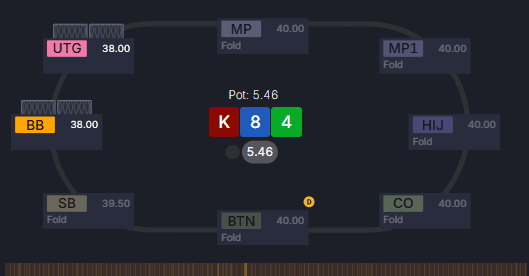
Situation: we opened from an early position and got a call from the big blind. This structure suits us more, since our range contains more top pairs and overcards, while the opponent often has nothing to continue with.
With a ⅓-pot bet we'll often end the hand, and if not, we'll be able to apply pressure on the following streets across many runouts*.
* Runout — the sequence of cards dealt onto the table after the flop — on the turn and river. These cards affect the strength of the players' hands and can change the winner of the hand.
Situation #2: we opened, and a player in position called
In spots against a caller in position, we don't have the advantage we had in the first situation. What do we need to focus on when talking about the logic of the hand?
1. The opponent makes their decision after us, sees our actions, and can control the pot more effectively.
2. The calling range is stronger than a player in the blind. It includes broadway combinations*, suited connectors*, low suited aces*, and low pocket pairs (from 22 to 88).
Broadway combinations — cards from ten to ace that can make top straights (for example, KQ, QJ).
Suited connectors — sequential cards of the same suit that can make straights and flushes (for example, T9s, 98s).
Low suited aces — aces with a card 2–9 of the same suit.
3. Equity is distributed roughly 50/50. Our hands don't have a clear advantage on the flop, so c-bets need to be made more selectively.
Main characteristics of the spot:
Are we in position or not? | Out of position |
Who's ahead by range? | 50/50 |
How often will we bet? | ~ 50% of the time |
How often does this spot occur? | ~ 4% of all hands |
Approximate pot size on the flop? | ~ 6.5 bb |
Recommendations:
— We c-bet only with the part of the range that has a chance to improve on the turn. Usually these are gutshots, overcards, and draws.
— We c-bet with the value range* and extract value with weaker hands.
— C-bet frequency is around 50%.
* Value — the part of a player's hand range with which the player bets to extract chips from the opponent's weaker hands.
Example hand:
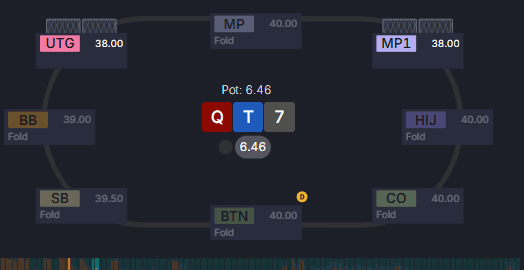
Situation: we opened from UTG and got a call from a player on MP. The other players folded.
In this case, poker calculators suggest c-betting 40% of the time, because the opponent's range is comparable to ours, and we'll rarely see a fold. Besides, we can often face resistance with a raise and it will be difficult to play out the following streets out of position.
Situation #3: we opened, a player in position called, and another opponent entered the hand (for example, from the blind)
When three or more players are in the hand, we find ourselves in a multiway pot. What dangers and advantages are present in this variety of spots?
1. Our equity is now distributed not across two players, but across three, so the average hand strength decreases.
2. Pressure is harder to apply, because both opponents can defend against bets.
3. The positional advantage is preserved relative to one player — the opponent in position acts last and controls the flow of the hand.
In such hands you need to play more honestly and carefully, giving priority to hands with good equity and made combinations that can win at showdown*.
Showdown* — the revealing of cards after the betting to determine the winner of the hand
Main characteristics of the spot:
Are we in position or not? | Out of position |
Who's ahead by range? | 50/50 |
How often will we bet? | ~ 40% of the time |
How often does this spot occur? | ~ 4% of all hands |
Approximate pot size on the flop? | ~ 7 bb |
Recommendations:
— We reduce the betting frequency: we bet roughly 40% of the time.
— We choose hands with good equity or made combinations: strong pairs, made straights or flushes, as well as promising draws — gutshots and flush draws.
— We don't slowplay* strong hands: even if we have a top pair or a set, you shouldn't just check. These hands need protection and can earn more chips on the turn and river. And with such an action we also don't let opponents see the next cards for free in the hope of making the nuts*.
* Slowplay — a strategy where a player with a strong hand doesn't make an aggressive bet, but checks or calls to lure the opponent into the pot and get more chips later.
* Nuts — the strongest possible combination on a given board, which cannot be beaten.
Example hand:
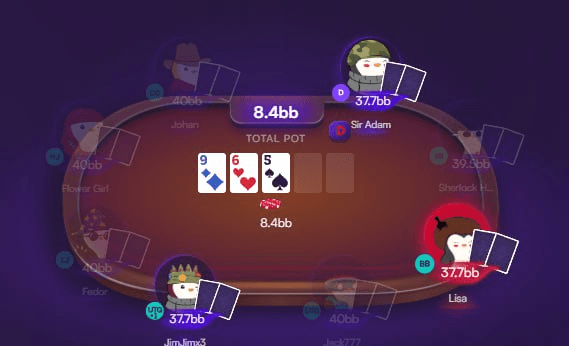
Situation: we opened from UTG, got a call on the button and a call from the BB. On the flop comes a drawy board 9♦ 6♥ 5♠.
In such a situation, both opponents can have straight draws, flush draws, and already made straights. Even a pair of aces in our hand may already have little chance of continuing to play three barrels.
Here our strategy is to bet only with hands that can confidently continue the hand on the following streets.
What is a drawy board? Read about it in the article on the main types of boards.
Situation #4: the opponent opened with a raise, we 3-bet, the opponent called
Let's orient you on the terms. A 3-bet is a bet made after someone has already raised before us. What is the strategic goal of this bet?
1. We want to isolate one opponent so as not to end up in a multiway pot and to more easily realize our range advantage.
2. We want to force the aggressor to fold stronger hands.
3. We want to increase the size of the pot with a strong hand.
You can read more about 3-bet pots in this article (leave a link).
In our situation, the opponent puts up resistance and calls — what can this mean?
1. Our range is often stronger. We 3-bet, showed the strength of our hand. The opponent called and didn't increase the size of the pot with a raise against our bet — there's a high probability that they defended a weaker range. By equity on most textures we are ahead.
2. We want to force the aggressor to fold stronger hands. Into the range of a player who called, we can place low pocket pairs, suited connectors and broadway, suited Ax hands.
Main characteristics of the spot:
Are we in position or not? | In position |
Who's ahead by range? | 80/20 |
How often will we bet? | ~ 100% of the time |
How often does this spot occur? | ~ 4% of all hands |
Approximate pot size on the flop? | ~ 14 bb |
Recommendations:
— Use a wide c-bet (up to 100%) on most board structures.
— A small bet — ~33% of the pot — works especially effectively
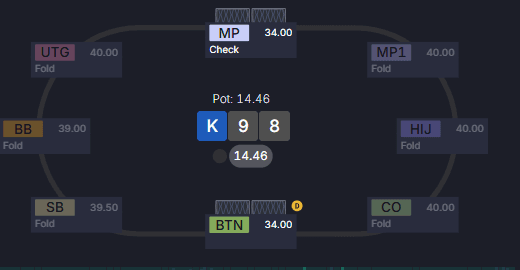
Situation: the opponent opened from MP, we 3-bet from the BTN and got a call. In this case, the calculator suggests playing a 100% bet on the flop with various sizings — from 25% to 33%.
The opponent's range indicates that they have no premium hands in their range, and we can get a fold already on the flop, even without a made combination.
C-bet size
In MTT tournaments, a small sizing* is most often used — ~33% of the pot. We'll now describe the advantage of such a strategy by laying out a few points:
* Sizing — the size of the bet that a player chooses in a specific hand in poker.
"Apply pressure without committing too many chips"
A bet of roughly a third of the pot is universal and allows the aggressor to control the hand without risking too large a stack.
"Allows you to increase the betting frequency in typical spots"
A small sizing is convenient for an active strategy: we can c-bet on practically all textures when it's appropriate. This is important for a beginner: it's easier to stick to the rule "we bet almost always," without thinking about complicated exceptions.
"We commit little, we get a lot"
This point is justified because even with a small bet the opponent feels pressure and doesn't control the flow of the hand. Even if we didn't make a combination, the chance of taking the pot when we're in position is higher.
A simple mathematical tip
For a bluff to be profitable, it's important to understand how often the opponent should fold their hand. We offer a formula by which the profitability of a bet relative to the opponent's potential fold is calculated.

Examples:
— Bet of 1/3 of the pot → fold frequency ≈ 25%
— Bet of 1/2 of the pot → fold frequency ≈ 33%
— Bet of the whole pot → fold frequency ≈ 50%
Important to understand! If your hand has at least minimal equity on the flop, the real profitability of the bet is higher than pure fold equity shows. The hand can improve on the turn and river and outdraw the opponent's strong hit — if they have one.
This simple example helps to understand why a small sizing is often justified over the long run.
Find even more poker math basics in this article.
When should you not make a c-bet?
However effective a tool the c-bet is over the long run, you need to apply it correctly. Let's draw some interim conclusions based on the situations we described above.
When is a c-bet inappropriate?
1. We have no equity advantage. For example, if we opened from an early position, the opponent called on the CO or BTN, and we see the board on the flop — 987. What's our logic?
The opponent is in position and connected better with the board by range — we have no advantage, it's better to play from a check. In such cases a check allows us to play a smaller pot on average.
2. We don't want to increase the size of the pot. In some spots, our goal is to control the size of the pot, not to create pressure. For example, the final table, and we're playing against a stack that covers us.
A check in such cases allows you to carefully manage the pot and keep options on the turn and river.
3. Multiway pot and playing out of position. In pots with three or more players, our average equity decreases, and the pressure of a c-bet becomes less effective. When we're out of position, it's harder to control the pot and react correctly to opponents' actions.
In these spots a check is often more sensible.
Mistakes beginner players make on the flop
However, players who don't master the basic concepts of poker regularly make mistakes that reduce the effectiveness of their play on the flop. Let's dwell on the main ones:
1. Betting too infrequently. Beginners often underestimate the strength of the c-bet and bet too rarely. As a result, they lose the opportunity to realize the initiative and take pots without a showdown.
2. They don't understand the type of spot. Some players use the same strategy regardless of position, the number of opponents, or the board texture. For example, they bet as often against a single caller from the blind as against a player in position or two players in a multiway pot. Over the long run, this leads to losses.
3. Wrong choice of sizing. Beginners often make bets that are too small or too large, without thinking about the goal of the bet and the strategy on future streets.
You have a chance not to make these mistakes starting today. We've told you about the advantages of the c-bet strategy, about how to use position, range, and equity to control the hand and apply pressure on opponents. This knowledge will give you an advantage over many of the players you meet at the tables.
Ready to continue learning with us?
You've learned the basic information about the continuation bet in poker. Got the desire to study the question in more detail? Submit an application to FunFarm via the link, become part of our team, and our coaches will help you understand the topic more deeply:
1. Which boards are suitable for frequent and rare c-betting? You'll learn to determine the board texture and understand when frequent bets are profitable, and when it's better to play cautiously with specific hands.
2. How to adjust to different opponents? We'll show how to take the opponents' playing style into account and adjust the frequency and size of the c-bet.
3. How does the c-bet strategy change depending on the tournament stage? You'll learn to adapt your play for the early, middle, and late stages, as well as the final table, taking into account stack sizes, pressure, and game dynamics.
Having mastered these skills, you'll be able to play aggressively and profitably, control the pot, and minimize the mistakes that most beginner players make.
FAQ
How do I know that I'm making too many c-bets?
Most often, making a c-bet on the flop is not a mistake. But if opponents often call you, and you feel that you're committing too many chips with hands that have no chance of developing — that's the first signal. Another sign is when you often find yourself in difficult situations on the turn and river, because you continued betting out of inertia.
Do you need to change your c-bet strategy against different types of players?
Yes. The opponent's style affects not only the frequency, but also the sizing of each c-bet. Against players who like to fold, you can more often use small c-bets and widen your bluffing range. Against loose players who don't like to give up, it's better to reduce the frequency of bluffs and bet only with a made hand.
Why does even a correct c-bet sometimes lead to a loss?
A correct decision doesn't guarantee a win in a specific hand — it guarantees profit over the long run. The ability to make +EV decisions is the foundation of professional play, even if the result in a particular situation turned out to be unlucky.
Is it important to have a ready plan for the turn already on the flop?
Yes. A good c-bet starts with understanding what you'll do on the following streets — bet a second barrel, check, go into pot control, and so on. Join our team so that you always have a plan for every hand.
Read next
Cash or MTT: which discipline to choose for steady poker earnings

How to Choose a Poker Room in 2026: A Complete Guide for Beginners

Tilt in Poker: How to Stop Losing Money to Emotions