Stack in Poker: How the Number of Chips Affects Your Strategy
In this article we'll break down what a stack is in poker, what types there are, how short, medium, and deep stacks differ, what an effective stack is, and why it's precisely this that determines many decisions at the table.

The same hand can call for completely different decisions depending on the number of chips. For example, pocket fives at 100 BB deep often become a good candidate to play in hopes of making a strong hand and winning a big pot. But with a 15 BB stack, this same hand requires a totally different approach, since there's significantly less room to maneuver.
Many beginning players evaluate only the strength of their cards and pay almost no attention to stack size. Because of this, they use the same strategy in situations that require completely different decisions. Over the long run, mistakes like these lead to lost chips, poor bet sizing choices, and incorrect risk assessment in big pots.
Stack size affects virtually every aspect of the game. It determines starting hand ranges, the ability to put pressure on opponents, and the choice between a standard raise and shoving all-in.
In this article we'll break down what a stack is in poker, what kinds there are, how short, medium, and deep stacks differ, what an effective stack is, and why it specifically determines so many decisions at the table. We'll also look at how stack size affects tournament strategy and what mistakes players most often make when managing their chips.
What is a stack in poker
A stack in poker is the total number of chips or money a player has at the table. In tournaments, all participants start with the same number of chips, and then stack size changes depending on the results of hands.
The same starting hand can be played in completely different ways depending on the number of chips in front of a player.
For example, suited 8♠7♠ with a 15 BB stack often turns out to be too weak to continue playing. But with a 150 BB stack, such a hand is capable of bringing a big win thanks to the chance to make a strong hand and get paid off by an opponent.
That's exactly why experienced players always evaluate not just the cards, but also the stack size.
To evaluate a stack, professional players almost always use big blinds.
For example:
10,000 chips at blinds of 50/100 is 100 BB
those same 10,000 chips at blinds of 500/1000 is now just 10 BB
The number of chips is the same, but the strategic situation differs radically.
Stack size affects practically every decision at the table:
starting hand ranges
bet sizing
the ability to bluff
the likelihood of playing for stacks
the choice between a shove* and a standard raise
postflop depth
*A shove (from the English "push") is a bet of your entire stack (chips). This move is also called all-in or going for broke.
That's why understanding how stacks work is one of the basic building blocks of tournament strategy.
Short and deep stacks
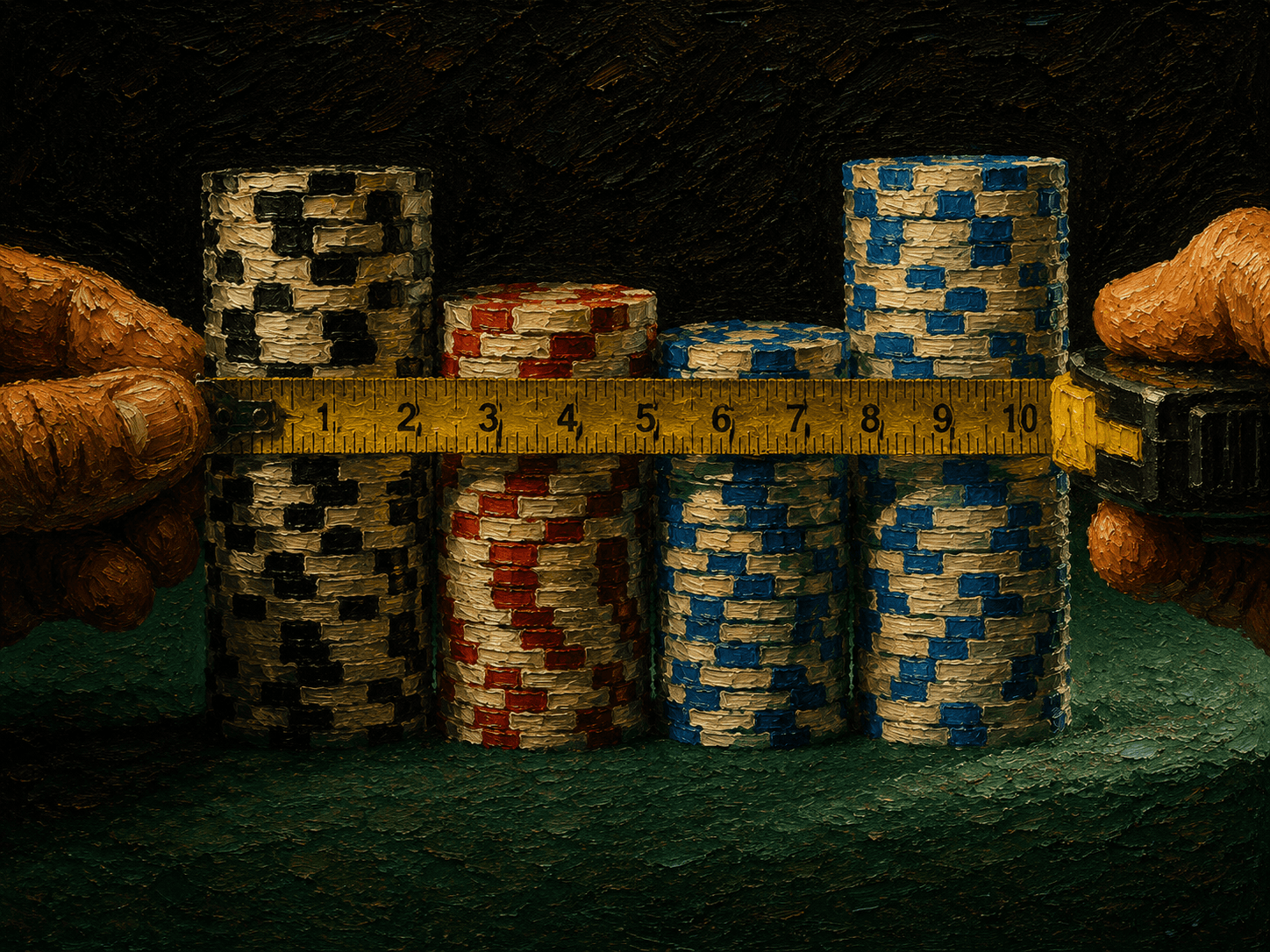
Stack size determines the tools available to a player. The fewer chips left behind, the simpler the strategy becomes. And vice versa — deep stacks open up more opportunities to maneuver.
1. Short stack
A short stack is usually considered a stack of less than 20 big blinds.
With this number of chips, the value of complex postflop play decreases significantly. A mistake on one street can cost a substantial part of the stack, so many decisions are made before the flop even comes.
As the stack shrinks, strategy gradually shifts toward push/fold. The player increasingly makes a decision between two options:
shove all-in;
fold.
The choice of starting hands and position becomes especially important.
For example, with a 12 BB stack, opening with suited connectors* like 7♠6♠ rarely turns a profit anymore. But the value of strong aces, pocket pairs, and Broadway combinations* increases.
*Suited connectors are a starting hand made up of two cards of the same suit that are sequential in rank. For example, 6♠5♠ or 9♠8♠.
*Broadway is a straight from Ten to Ace (T-J-Q-K-A). "Broadway" cards also refer to cards from ten to ace. Example usage: "I had two Broadway cards in my hand, so I called the raise."
The shorter the stack, the less room for creative decisions and the greater the importance of mathematically correct ranges.
2. Mid stack (medium stack)
A medium stack is usually considered a stack of 20 to 60 big blinds.
This is the most common stack size in modern tournaments. The player still retains the ability for full-fledged postflop play, but must already account for the risk of a rapid stack reduction.
At this depth, the following are especially important:
pressure on the blinds
smart use of position
controlling pot size
adapting to opponents' stack sizes
A mid stack requires a balance between aggression and caution. The player can't mindlessly get involved in big pots (which we don't advise doing in principle, ever), but at the same time isn't yet forced to switch to a push/fold strategy.
3. Deep stack
A deep stack is usually called a stack of 60 big blinds or more.
It's precisely with these stacks that poker reveals itself most fully.
The chance appears to use the entire arsenal of strategic tools:
multi-level bluffs
complex hands played across multiple streets
thin value bets
pressure through pot sizes
In addition, the value of so-called speculative hands* increases significantly.
*Speculative hands are hands with low starting equity but with the potential to improve into strong combinations postflop. Their value lies in the ability to make a strong hand when they hit the flop. Such hands usually include low pocket pairs, connectors, and gappers.
Pocket pairs like 5♠5♦ or suited connectors 8♠7♠ rarely win the pot right away. But with deep stacks, they're capable of making very strong hands and winning a big pot from stronger starting hands.
That's exactly why deep stacks allow you to play significantly wider and more varied.
What is an effective stack in poker
The effective stack is the size of the smallest stack among the players involved in a particular hand.
Suppose you have 200 BB and your opponent has 40 BB. Despite the fact that you have 200 big blinds, in this hand you're actually only playing for 40 BB.
The reason is simple: your opponent can't lose more chips than they have. If you shove all-in for 200 BB, the opponent can only call with their 40 BB. The rest of the chips simply don't take part in the hand.
Therefore, the effective stack in this example is 40 BB.
The effective stack is exactly what determines:
the maximum pot size
the likelihood of playing for stacks
the choice of starting hands
bet sizing
postflop strategy
Many beginning players make the mistake of focusing only on their own stack. However, strategy needs to be built specifically around the effective stack, since it's exactly what determines the real level of risk in a particular hand.
How stack size affects poker strategy
Stack size changes not only the number of available chips, but the very approach to the game.
1. Starting hand ranges
The deeper the stack, the more hands become profitable.
For example, with a 100 BB stack we can open small pocket pairs or suited connectors, counting on making a strong hand and winning a big pot.
With a 15 BB stack, such hands lose a significant part of their value. Simply put, we don't have enough stack to realize our equity* postflop.
*Equity is our share of the pot, corresponding to our chances of winning at the given moment.
That's why short stacks more often bet on the strength of the starting hand, while deep stacks bet on the hand's potential and the ability to realize an edge after the flop.
If you want to learn more about which hands you should open in different stages of tournaments, we recommend reading our article on this topic. Click the link.
SPR and pot depth
In modern poker theory, the SPR (Stack-to-Pot Ratio) metric is actively used. It shows the ratio between the remaining stack and the pot size after the flop.
A low SPR means the stack is small relative to the pot.
In such situations, strong hands are often ready to play for stacks as early as the early streets.
A high SPR creates more room to maneuver. Players have to treat even strong hands more carefully, since there are several streets of betting ahead and a large volume of potential decisions.
Bet sizing
Stack depth also affects the choice of sizings. In tournaments, stack size constantly decreases relative to the blinds.
Even if a player doesn't lose hands, their stack gradually depreciates due to the growth of the mandatory bets.
That's why it's important to track not only the number of big blinds, but also the M-factor metric proposed by Dan Harrington.
The formula looks as follows:
M = Stack / (small blind + big blind + antes per orbit)
The metric shows how many full orbits a player can survive without playing any hands.
M-factor table
M-factor | Zone | Recommendations |
More than 20 | Green | Full-fledged strategy, wide set of tools |
10–20 | Yellow | Increased aggression, active fight for the blinds |
5–10 | Red | Looking for profitable push/fold situations |
Less than 5 | Critical | Need for an urgent double-up |
As the M-factor decreases, the player has to make more aggressive decisions.
One of the common mistakes of beginning players is waiting exclusively for premium hands. In practice, the stack often shrinks faster than the ideal starting hand arrives.
That's why, when entering the red and critical zones, it's more important to use fold equity* and pressure opportunities against opponents in a timely manner.
*Fold Equity is the additional probability of winning a hand that a player gains because the opponent will fold in response to their bet or raise.
Common mistakes in stack management

Stack size affects strategy so strongly that mistakes in evaluating it lead to serious losses over the long run. The most common of them look like this.
1. Ignoring the effective stack. The player focuses only on their own stack and forgets to account for the opponent's stack size.
2. Playing deep ranges with a short stack. Attempts to play speculative hands at 15–20 BB often lead to a negative expectation*.
*Expected value (EV) is the average result of a particular action in the long term. It shows, on average, how profitable or losing a bet or decision in a hand will turn out to be.
3. Excessive caution. Many players wait too long for a strong hand and let their stack slip into the critical zone.
4. Misunderstanding the impact of SPR. Even strong hands require a different approach depending on stack depth and pot size.
Conclusion
The better a player understands the impact of stack size on ranges, bet sizing, and the structure of a hand, the more profitable decisions they'll be able to make over the long run.
Apply to FunFarm, and we'll teach you how to put your stack to good use.
FAQ
1. What is a stack in poker?
A stack is the number of chips or money a player has at the table at the current moment in time. In tournaments, the stack constantly changes as the blinds grow and hands play out.
2. What is an effective stack in poker?
The effective stack is the smallest stack among the players involved in a hand. It's exactly what determines the maximum pot size and the number of chips that can be played between opponents.
3. How do you calculate the effective stack?
You need to compare the stack sizes of the players in the hand and choose the smallest of them. If one player has 120 BB and another has 40 BB, the effective stack is 40 BB.
4. What stack is considered short?
In most cases, a stack of less than 20 big blinds is considered short. With such stacks, strategy gradually shifts toward push/fold, and the importance of postflop play decreases.
5. What is a deep stack?
A deep stack is usually called a stack of 60–100 big blinds or more. Such a stack size allows you to use complex lines of play, multi-level bluffs, and speculative hands.
6. Why do professionals count their stack in big blinds?
The number of chips on its own is not very informative. The same stack can be huge in the early stage of a tournament and critically small in the late stage. Big blinds allow you to objectively assess stack depth regardless of the stakes level.
Read next
RFI in poker or open-raise: how much should you bet preflop?
MTT Late-Stage Strategy
What is a dealer in poker and why is it needed