The Fear of Mistakes in Poker: The Dunning-Kruger Effect
The more you learn, the more you doubt yourself at the table? We break down the Dunning-Kruger effect in poker and explain why the "valley of despair" is a sign of growth, not failure.
Mistakes are an integral part of every poker player's development. But the fear of making them often becomes paralyzing: it gets in the way of acting, analyzing, and moving forward.
To stop fearing mistakes, you need to understand why we make them, how self-assessment works during the learning process, and why self-doubt is not a sign of weakness but a step toward professional growth.
Today we'll break down how the psychological Dunning–Kruger effect manifests in poker, what happens when confidence drops, and how to turn doubt into a tool for progress.
What the Dunning–Kruger effect is
In 1999, psychologists David Dunning and Justin Kruger proved that the people who know the least are most often the most confident in themselves.
The study began with a curious case: a man tried to rob a bank after smearing lemon juice on his face — he thought the juice would make him "invisible" to the cameras. When he was caught, he was genuinely surprised. That's how the researchers reached their conclusion: the lower the competence, the higher the self-confidence.
In poker, this effect shows up constantly. Let's break down how it manifests in the dynamics of a player's growth.
The peak of confidence: the illusion of simplicity
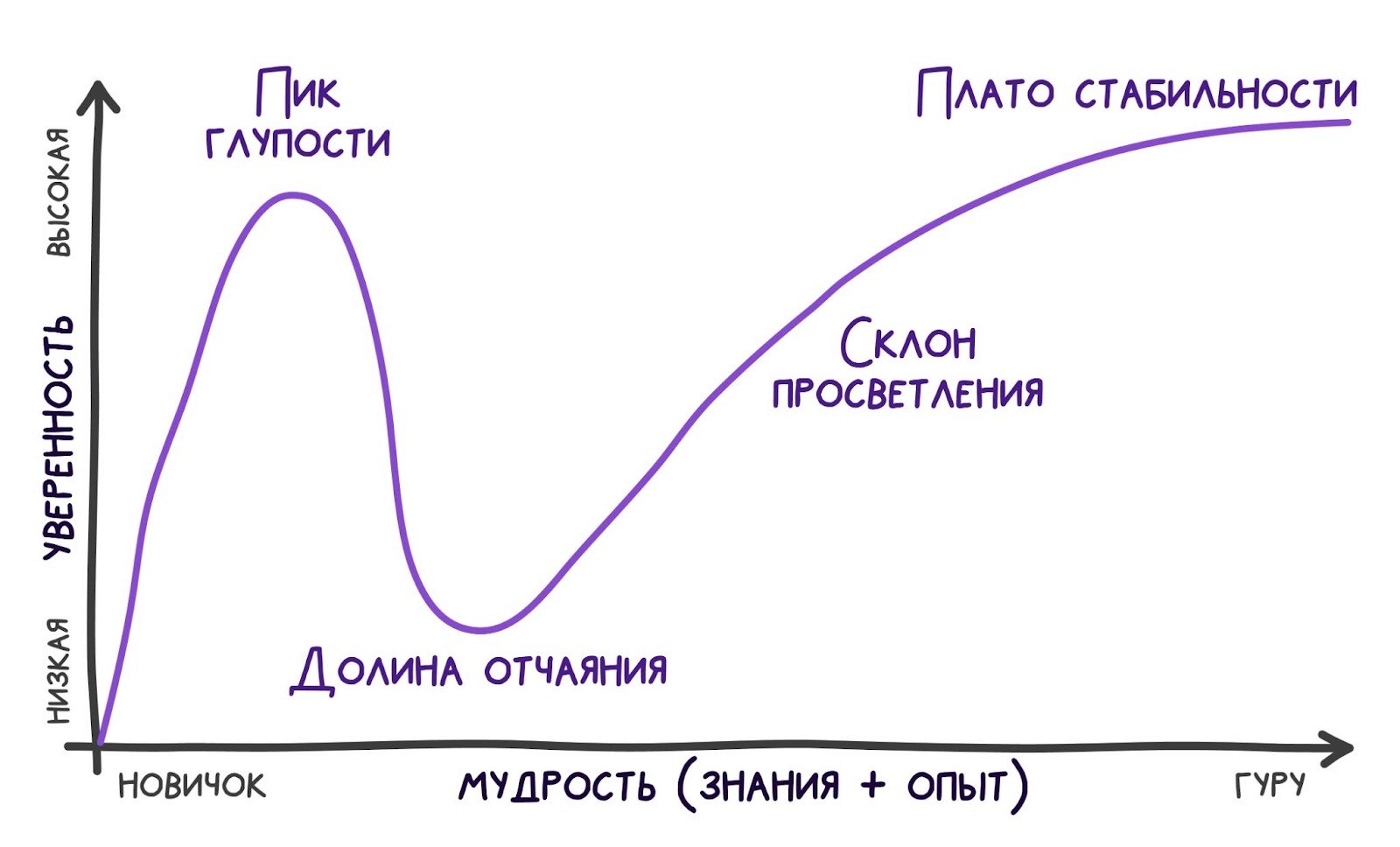
At the start, everything seems clear. A couple of good sessions, a few YouTube videos, the first wins — and you get the feeling: "I've already figured it all out."
This stage can be called the "peak of stupidity". The player feels confident but sees only the surface of the game. They win their first tournaments at low stakes*, call their opponents fish, and stop learning. Any loss is explained away as bad luck.
This is a natural, even useful stage — it's exactly what kindles excitement and interest. But if you get stuck in this state, progress stops. You can spend years banging your head against the ceiling of low stakes*, not understanding that the problem isn't luck but the illusion of competence.
* A fish is a term used for a weak player who makes systematic mistakes and plays without a clear strategy.
* Low stakes is the betting level at which people play for comparatively small amounts of money.
The valley of despair: when confidence collapses
The next stage is a sharp drop in confidence. The deeper you delve into poker, the more clearly you realize how little you know.
The phrase "I'm almost a pro" is replaced by:
— "I don't understand anything",
— "I play worse than before",
— "Poker, it seems, isn't for me".
It's painful, but completely normal. The player isn't degrading — on the contrary, they're starting to see the true complexity of the game.
The key here is to not quit. This is a stage of awareness, not failure.
What helps you get through the "valley of despair"?
— Maintaining a routine. You need to keep studying, even if it feels like there's no progress. It's there — it's just not noticeable yet.
— Getting feedback. Reviews with a coach and the team will help you distinguish a real slump from distorted perception.
— Recording achievements. Here it's important to write down what new things you've understood and which mistakes you've stopped making.
The slope of enlightenment and the plateau of stability
If the player doesn't give up, the climb begins. Knowledge gradually builds into a system, mistakes stop being scary, and confidence becomes calm and mature.
The player no longer reacts to every setback but analyzes it and moves on. This is the stage of enlightenment — when competence grows and self-assessment becomes realistic.
Then comes the plateau of stability — a state where the player sees their strengths and weaknesses but no longer wavers between "I'm awesome" and "I'm nothing" — they simply keep working systematically.
How to preserve progress?
Keep doubting — but constructively.
Develop weak areas — not just strong ones.
Compare yourself not to others, but to yourself three months ago.
How to cultivate discipline and resilience
For the fear of making mistakes to gradually fade, you need to move toward your goal every day, be persistent, and work in good faith. What psychological adjustments can help a player along this path?
1. Don't demand a perfect start from yourself
The brain fears big tasks. But if you start small — for example, "review three hands" — a dopamine cycle kicks in: action → result → pleasure → repeat.
2. Create a ritual for getting into work
Repeated actions (music, tea, a posture) create an association: "this context = training." This reduces resistance and helps you get engaged.
3. Write down what you're working for
When you feel lazy, the brain forgets the "why." A visible formulation of your goal brings back focus and energy.
4. Set concrete goals. "Review 3 hands", "find 1 mistake". The brain loves clarity — it gives a sense of control.
5. Share results and impressions with other players. When you tell others your insights or discuss hands, the knowledge sticks many times more firmly.
6. Allow yourself to make mistakes. A mistake isn't an indicator of weakness but a signal of growth. A player who can acknowledge and analyze it always wins over the long run.
Conclusion
Every professional goes through the illusion of knowledge, doubt, and enlightenment. The key is not to stop in the "valley of despair" but to keep going — step by step.
At the FunFarm poker fund, we help players not only build a game strategy but also become more disciplined, more persistent, and more confident in themselves.
Submit your application and turn the fear of mistakes into fuel for professional growth.
FAQ
Why does the fear of mistakes arise even among experienced players?
Even experienced players go through the "peak of confidence" and then the "valley of despair": the deeper they learn the game, the more clearly they see how much they still don't know. This is normal. The fear comes not from a lack of skill but from realizing the scale of the game — and that's a sign of growth, not weakness.
Isn't self-doubt a brake on progress?
No. Doubt is an indicator that you've begun to see the depth of the game. If you don't get stuck in self-criticism but use doubt as a signal for growth, it turns into a useful tool for development.
How often should you analyze mistakes?
Regularly — but without overload. A small, honest self-analysis after each session or every few sessions is better than rare "review marathons". This helps maintain stable thinking and gradually build confidence.
What should you do if, after a mistake, you want to start chasing your losses instead of just playing?
A pause is an important tool. If you want to chase your losses, it's better to stop, rest, and recover your resources. Emotional decisions often lead to new mistakes. You should return to the game only with a cool head and a clear plan.
Read next

How to maintain mental resilience during a long poker session

The Perfect Poker Setup: How to Choose a Monitor, Mouse, and Hardware for Maximum Profit

# Poker Software: A Complete Guide to the Programs the Pros Use