The "Blockers" Concept: How a Single Card Changes Everything
In poker, we almost never make decisions against a specific hand. We play against a range — the set of combos the opponent could have arrived at the current point of the hand with. And the higher the price of the decision, the more important it is to understand how many strong hands the opponent can realistically have.
The blocker concept helps you do exactly that: adjust the frequencies of hand combinations in your opponent's range* based on which cards are already guaranteed to be out of the deck.
In this article we'll cover:
what blockers are in simple terms
how blockers work preflop
how blockers are used postflop
how blockers relate to choosing hands for the 4-bet and to bluffing lines
typical mistakes that turn blockers into an excuse for bad decisions
how a beginning player can incorporate the blocker concept into their game
* A range of hands is the set of all possible starting hands a player could have in a given spot, based on their actions and position.
What blockers are in simple terms
A blocker is a card that is already guaranteed to be removed from the deck. In the most common case, it's in our own hand.
Because of this, the probability that our opponent can hold certain hands decreases, and the probability of certain cards coming on later streets decreases too.
The key point of blockers is always the same: they reduce the number of combinations your opponent can have. Which means they change the structure of their range and the frequency of the hands we care about — value*, strong draws, the nuts*, hands for continuing against a 3-bet/4-bet, and so on.
* Value is playing to extract profit from your opponent's weaker hands.
* The nuts is the strongest possible combination on the current board, one that can't be beaten.
You can learn more about 3-bets in poker in this article, and more about 4-bets in this one.
It's important to pin down right away a few key points about understanding the blocker concept:
1. A blocker doesn't guarantee your opponent doesn't have the hand in question. It rather "shifts" the probabilities — some hands become less likely, others relatively more likely.
2. Blockers work in tandem with ranges and the line. If we don't understand what hands the opponent has in the first place, a blocker turns into self-deception.
The simplest way to feel the power of blockers is to look at pocket pairs. For example, the hand QQ can be made in 6 ways. If we hold one queen, the opponent has only 3 combinations of QQ left, because only three queens remain in the deck.
The same works for high pairs. If we have A♠️K♠️, then only 3 aces and 3 kings remain in the deck, which means there are 3 combinations of AA instead of 6 — and 3 combinations of KK instead of 6.
That's the "blocker mechanic": we're not saying "he can't have AA," we're saying "AA shows up less often than it would without our ace."
Practical takeaway: when we choose aggressive decisions preflop — for example, a 3-bet or a 4-bet — hands with an ace/king are often useful not only because of their strength, but also because they reduce the opponent's share of the strongest continuations.
Blockers postflop
Postflop, blockers get more interesting, because ranges have already narrowed from the opponent's preflop actions, and the board's structure adds specific classes of hands — made hands, draws, top pairs, sets, and so on.
Let's break this thesis down with a concrete example.
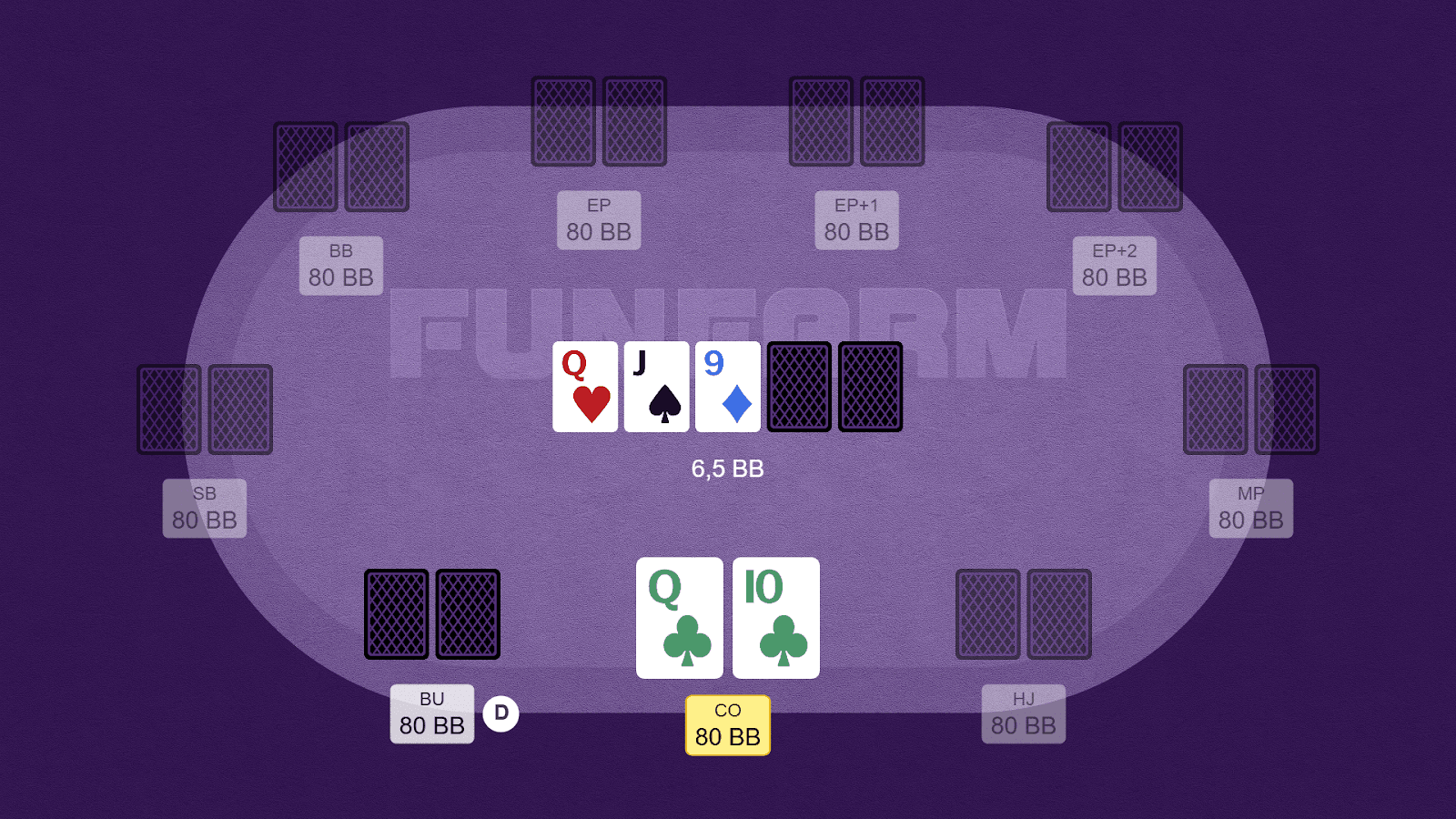
Preflop we have Q♣️T♣️. On the flop we see Q♥️J♠️9♦️. We've hit top pair and have an open-ended straight draw — a strong, dynamic hand. But on a board like this the opponent can have quite a lot of made hands, for example:
made straights: KT and T8 (suited)
stronger top pairs: AQ, KQ
two pair: QJ, Q9 (suited), J9 (suited)
open-ended straight draw with Tx
Now let's break down how blockers work here. The two main observations are:
1. We have T♣️. That's a good blocker to made straights and open-ended straight draws, because only three tens remain in the deck, so there are fewer combinations of KT/T8
2. Q♣️ reduces the number of combinations of AQ/KQ.
The main practical point: when we're deciding how often the opponent can have a strong combination, blockers shift the frequencies in our favor.
This doesn't automatically put us ahead, but it makes some of the nastiest parts of the range rarer, which means it affects our choice of line — for example, where we're more comfortable playing aggressively, and where it's better to control the pot.
Blockers and 4-bets: how to choose bluffing hands
When we 4-bet as a bluff, we're really solving two problems at once.
1. Keep a reasonable hand quality for continuing the hand. Even a good 4-bet doesn't always end the hand: the opponent might call, might shove.
So it's important for us to understand what we're doing against a call and against a shove for stacks: is the hand playable, is there any equity realization, isn't the 4-bet just burning chips?
2. Get a fold already preflop. We want the opponent to fold part of their 3-bet range and not realize their equity. The more often they fold, the more often we take the pot without seeing a flop.
And this is where blockers become a tool that helps solve both problems.
For example, if we have an A or K in our hand, we reduce the number of combinations at the top of the opponent's range — the hands they're most willing to continue aggressively with.
This makes the bluff 4-bet mathematically "cleaner": the probability of running into a strong hand goes down, which means the share of situations where the opponent is forced to fold or to call with weaker hands grows.
At the same time, it's important not to overrate the effect: a blocker is not a license to 4-bet bluff. If the opponent is stubborn and unlikely to give up to a 4-bet, or, for instance, opens narrowly and therefore is more likely to have a strong hand, then blockers stop being the decisive argument.
Let's give an example situation.
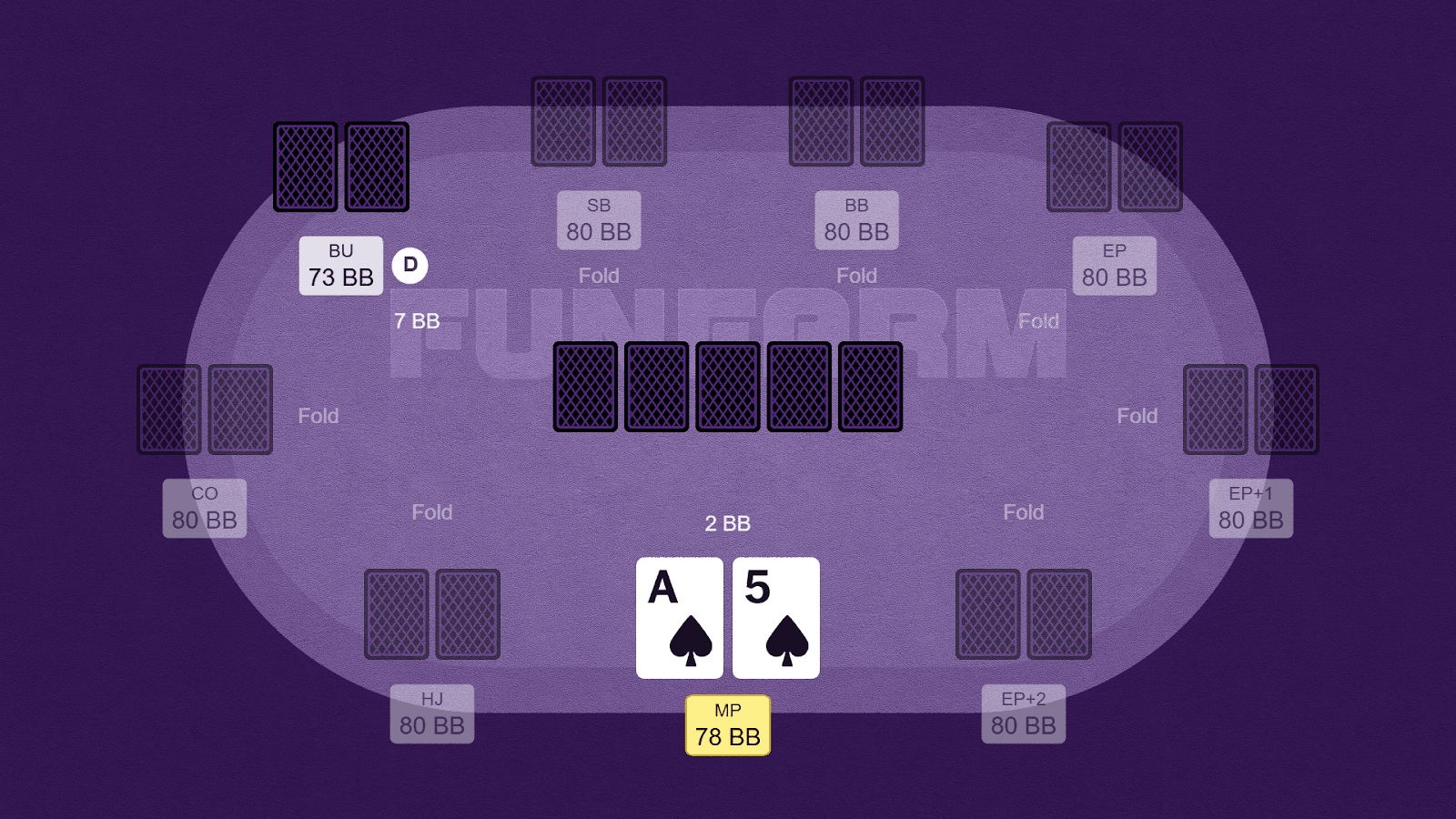
We open from MP with A♠️5♠️. BTN 3-bets — 7bb. Assumption about the opponent: BTN plays the 3-bet relatively aggressively — has not only nut hands but also suited broadways and weak aces. This is a classic type of opponent against whom blockers work well.
Our hand is a great fit for a 4-bet bluff because:
there's an ace, which reduces the frequency of AA/AK and other strong ace hands in BTN's range
the hand has poor playability postflop, because we're out of position and it will be harder for us to make decisions
The main thing — it's a better fit for a bluff 4-bet than, say, 9♠️8♠️ without a blocker, because the goal of the 4-bet here is to take the pot preflop through fold equity.
The logic of the play: if BTN really does continue narrowly, then a 4-bet with A♠️5♠️ wins not through the strength of the hand but through the fact that the opponent is often forced to fold their lower/middle 3-bet range, and the frequency of the nastiest continuations — for example, a 5-bet shove — becomes lower because of our blocker.
How flush blockers work
Flush blockers look like the most vivid example of the blocker concept in action, because on the river ranges often become more polarized.
When a flush completes, the opponent's line — especially a big bet — usually represents two big categories:
value — flushes (and sometimes other nut hands, if they're possible on the specific texture)
bluffs or thin value — hands that struggle to get to showdown by checking, but that can try to push part of our range out.
If we have a card of the relevant suit in our hand, we reduce the number of flushes the opponent can actually have. This doesn't eliminate flushes entirely, but it shifts the distribution: the value portion becomes rarer, and the relative share of bluffs grows.
Hence the key principle: the best flush blockers are the ones that block value specifically.
A suited ace is usually stronger than a middling card of the suit, because it cuts into the top flushes, which more often choose a big sizing for value. A middling card of the suit sometimes blocks more "random" flushes, but doesn't always block the combinations that actually bet big.
How blockers work in practice
For blockers to actually influence strategy, we need a clear thought process. Below we've put together a working sequence of steps you can apply in a real game.
1. Build the opponent's range across the whole line
It's important to reconstruct the logic of the hand: what position the opponent is in, how they form their range preflop, what part of that range continues on the flop, which hands get to the turn and river given the bet sizes and the board structure.
For example,
if the opponent defends the big blind against a button open, their range is wider and contains more suited hands
if they 3-bet from the small blind against CO, their range is narrower and more often contains strong broadways and pocket pairs
if on the flop they bet big on a dry texture, we filter out some weak hands, and so on.
2. Identify the key parts of the range
Once the range is roughly outlined, we ask ourselves a more specific question — which hands are critical for us right now?
Depending on the hand these could be: the nuts and strong value (flushes, straights, sets), medium value (top pairs, second pairs), strong draws, and bluffs.
For example, on the river after a big bet we're usually concerned precisely with the top of the opponent's range. If we're considering calling the bet, we care about the ratio — how much strong value he has and how many bluffs he has.
And if we ourselves want to bluff, we care about — which hands he'll most often call with and which hands he'll fold.
Only after this do we move on to analyzing blockers.
3. Analyze what exactly we're blocking
Now the key question arises — which of the opponent's combinations become fewer because of our cards? What matters here isn't the card itself, but its effect on the structure of the range.
For example, the river completes a flush. If we have the ace of that suit, we reduce the number of nut flushes but, possibly, also reduce some of the bluffs, if the opponent bluffs with missed draws of that suit.
The task is to figure out — are we cutting the value portion of the range or the bluffing portion? This is fundamentally important. Sometimes a card looks like a good blocker, but in practice it cuts down the opponent's bluffs and thereby makes our call worse.
4. Adjust the decision
Only after the three previous steps does the blocker start to work in the decision.
There are four typical scenarios:
1. The blocker strengthens our bluff
We block the opponent's strong value, and their continuing range becomes weaker. In such a situation the bet becomes more profitable.
2. The blocker strengthens our call
We block the opponent's strong hands and don't block their bluffs. The value/bluff ratio shifts in favor of bluffs — the call becomes better.
3. The blocker worsens the call
We block the opponent's bluffs. Even if we cut some value, but cut more bluffs in the process, the relative share of value rises — and the call becomes worse.
This is one of the most common mistakes: we're happy to have a "fitting card," not noticing that it removed exactly the hands that were supposed to be bluffing.
4. The blocker has almost no effect on the decision
Sometimes a card reduces frequencies insignificantly or cuts both parts of the range symmetrically. In such situations the blocker shouldn't become the deciding factor.
In sum: for blockers to actually be profitable, we always start with the range, not the card; we determine which parts of the range matter for the decision; we analyze what exactly we're blocking; and we adjust the decision rather than bending it to fit the presence of a pretty card.
Typical mistakes of beginning players
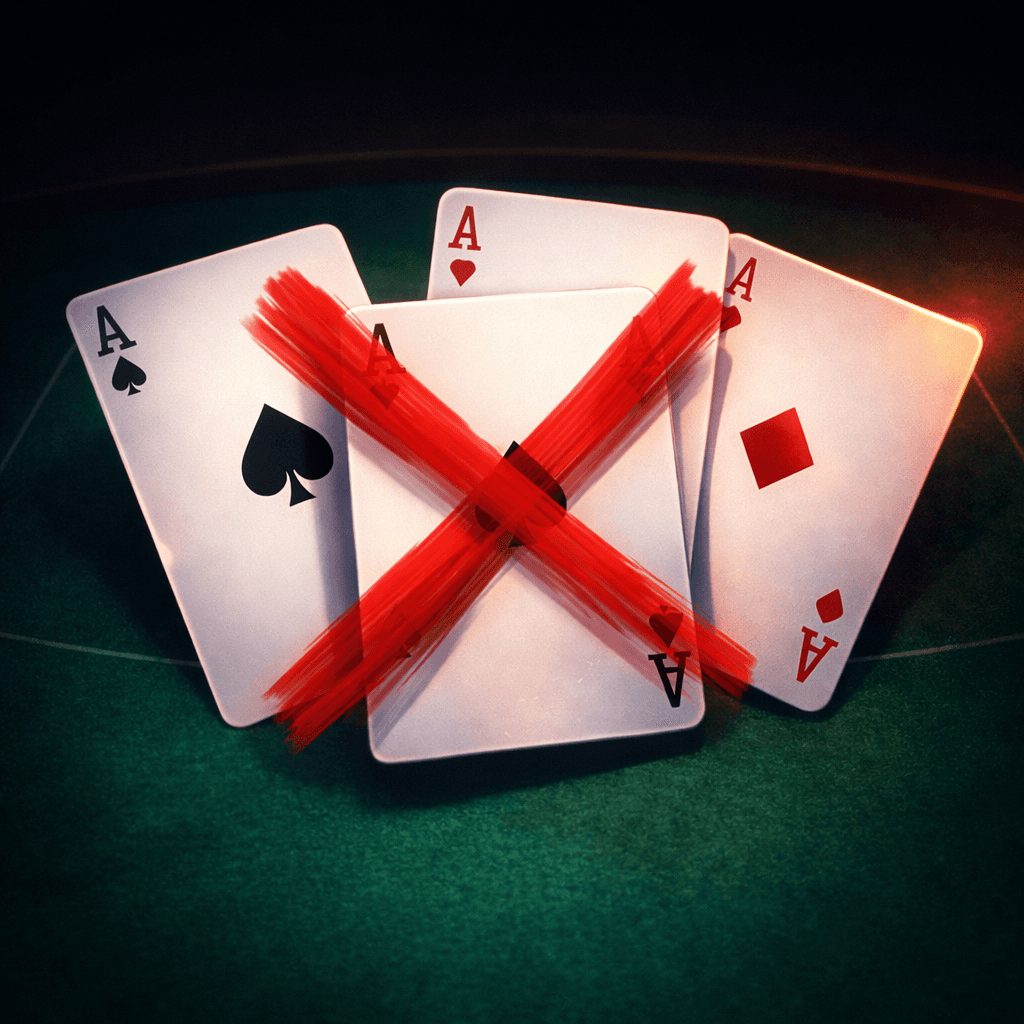
The blocker concept seems logical and clear: if we have a card that reduces the number of strong combinations the opponent can have, then our decision becomes better.
In practice it's more complicated. Mistakes with blockers are most often connected not with the math, but with how we interpret their effect within the range.
Let's break down the main traps in more detail.
1. Overrating the blocker
The most common mistake is to think that having a blocker "cancels" part of the opponent's strong hands.
A classic example: the river completes a flush, we have a card of that suit, and we automatically decide that the opponent has almost no flushes. From there — too easy a call against a big bet, or too aggressive a bluff.
But the correct logic looks different. A blocker reduces the number of combinations, but it doesn't cancel the structure of the range itself or the way the hand was played.
If by position and line the opponent has lots of suited hands, an aggressive line on the flop and turn, and bets big on the river, then even with a blocker their range can still remain saturated with value.
If without the blocker the call was borderline or bad, one blocker rarely turns it into a confidently profitable one.
2. Ignoring context and the opponent's style
Blockers are a tool of range-based thinking. They work better against players who build their ranges consistently, fold where they should fold, and polarize their lines logically.
Against tight and structured opponents, the blocker effect more often plays out mathematically correctly.
But if the opponent calls too wide, doesn't fold to 3-bets and 4-bets, can't fold medium hands, and plays chaotically, then reducing combinations in theory doesn't turn into a real fold in practice.
A blocker strengthens the strategy only when the opponent is capable of playing rationally. Against players who don't follow basic range structure, a blocker often becomes a secondary factor.
3. Blocking bluffs rather than value
This is one of the most subtle and underrated mistakes, especially on the turn and river. We often get happy about having a "fitting card" without asking the main question — what exactly are we blocking: strong hands or bluffs?
Imagine a situation on the river: the board completes a possible draw, the opponent bets big, and we're considering a call.
If we have a card that blocks part of his missed draws but doesn't block his value, then the relative share of bluffs in the range decreases — and our call becomes worse, despite having a blocker.
Before relying on a blocker, we need to understand which part of the range it reduces. If it cuts bluffs — that's an argument for folding, not calling.
4. Using blockers without building a range
The crudest strategic mistake is talking about blockers without having a clear picture of the opponent's range.
If we can't name which hands the opponent opens preflop, which they continue with on the flop, which ones get to the river, and with which hands they bet a given sizing, then talking about blockers becomes a formality.
A blocker is the finishing touch on an already-built range model. If there's no model, a blocker won't save the decision.
Conclusion
Blockers are a tool that helps us see the distribution of combinations in the opponent's range more precisely. Over the long run this shows up in concrete things — we choose more suitable hands for aggression, we better understand how many nut hands are actually possible, and we stop making expensive decisions based on a feeling rather than on range structure.
To get a better grasp of poker math and master the rational foundations of poker, apply to FunFarm — we teach players from all over the world to consistently make money playing poker.
FAQ
Is a blocker always a card in our hand?
Most often yes, because it's a guaranteed known card. But any card on the board is also a blocker: it too is removed from the deck and reduces the number of combinations.
Why are hands with an ace so important as blockers preflop?
Because they reduce the number of AA and KK to 3 combinations, and also cut a significant part of the opponent's strong combinations.
Can you build a bluff on a blocker alone?
No. First — ranges, the line, and the logic of the hand. A blocker is an amplifier that makes an already logical bluff better, but rarely turns a bad bluff into a good one.
Which is stronger: a blocker to a straight or a blocker to a flush?
It depends on the board and the line. On the river flush blockers are often more noticeable, because big bets often represent a flush. But on dynamic boards a blocker to a straight can be critical if it cuts exactly the made nuts.
How do you avoid confusing a "good blocker" and a "bad blocker" on the river?
We ask the question — what does the opponent bet for value, and what does he bluff with? If our card reduces the number of his value combinations — it's a good blocker for calling. If it reduces the number of his bluffs — it's a bad blocker, and the call often becomes worse.
Read next
What Is a Kicker and When It Decides Everything: Breaking It Down with Examples
Women in Poker: Top 5 Most Successful Female Players
# Variance in Poker: A Mathematical Explanation of "Bad Luck"