What is a starting-hand chart and why do you need it?
A complete guide to charts in poker. Learn how to "read" starting hand tables, make correct preflop decisions, and lay the foundation for a winning strategy.
A solid preflop game is the foundation of any poker player's strategy. If you know how to correctly choose starting hands to enter a hand, then making decisions on later streets becomes much easier and more effective.
In this article, we'll break down one of the key tools used by both beginners and experienced players — starting hand charts.
We'll cover:
what a chart is and why you need it
what a chart consists of and how to "read" it
which basic charts are used in poker for play at 9-max tables
which mistakes beginners most often make when working with charts.
A starting hand chart is a special table (a 13×13 matrix) that shows which hands are profitable to play and what action to take (raise, call, or fold) depending on your position at the table.
Why do you need charts?
They structure ranges. You know which hands are profitable to play from each position.
They reduce the number of mistakes and build discipline. A player makes fewer marginal decisions and more mathematically sound ones.
They speed up learning. They help you memorize ranges and hand categories faster.
How do you "read" a chart?
A chart looks like a matrix of 13×13 cells and is a visual guide to choosing starting hands (see below).
It displays all the combinations that exist in poker — 1326 in total. Of these, 169 are unique hand groups: pocket pairs, suited hands, and offsuited hands.
Each cell is a separate starting hand:
The diagonal of the chart — pocket pairs. In the poker community they're called pockets. Each pair has exactly 6 combinations. For example, pocket fours can be made up as:
4♣4♦
4♣4♥
4♣4♠
4♦4♥
4♦4♠
4♥4♠
All other pairs work the same way — from 22 to AA.
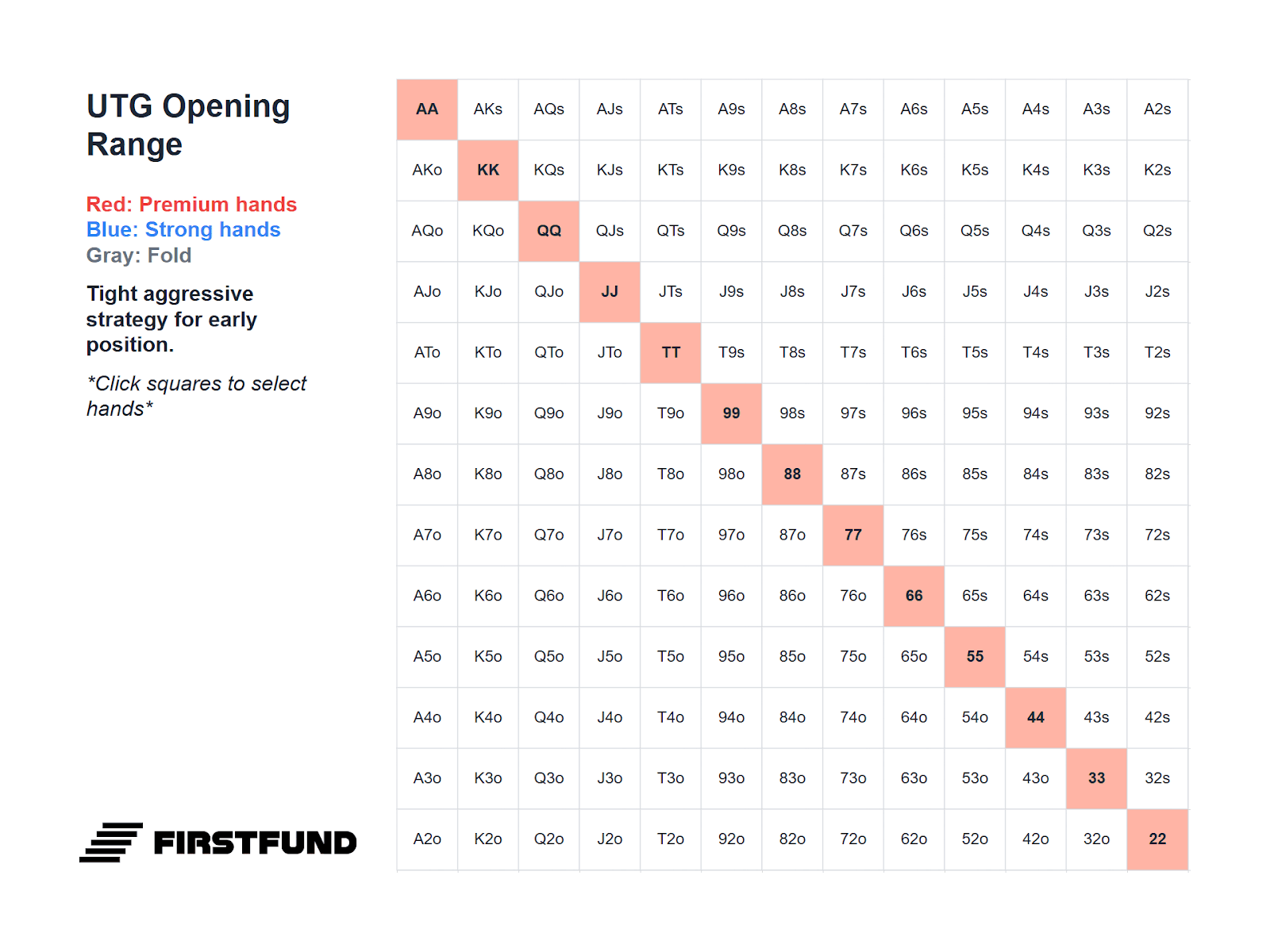
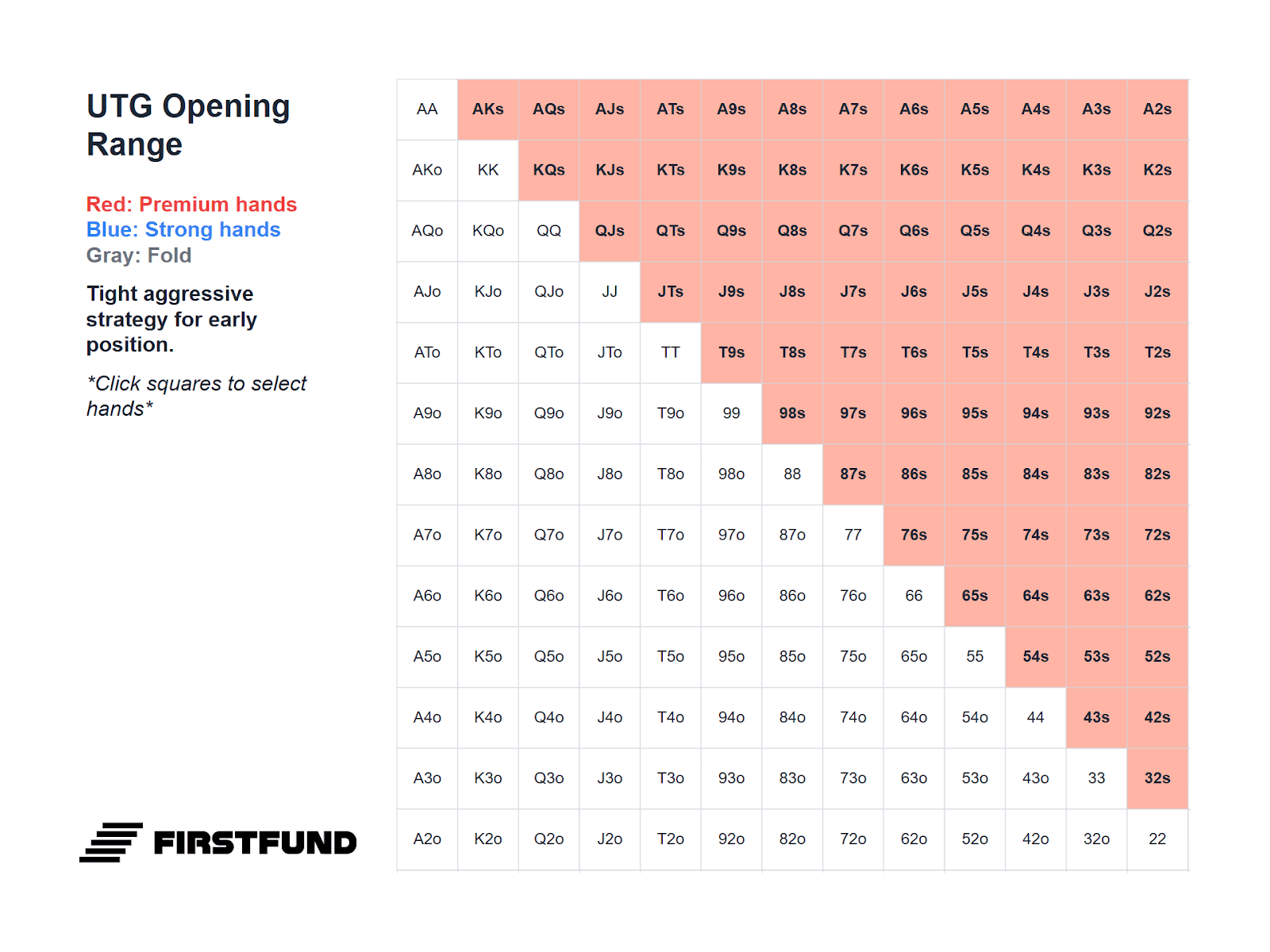
Above the diagonal — suited hands. In charts, such hands are marked with the letter "s". Each such combination has 4 possible variants by suit. For example, A5s can be:
A♣5♣
A♦5♦
A♥5♥
A♠5♠
The same rule applies to all other suited hands — from the strongest (AKs) to the weakest (32s).
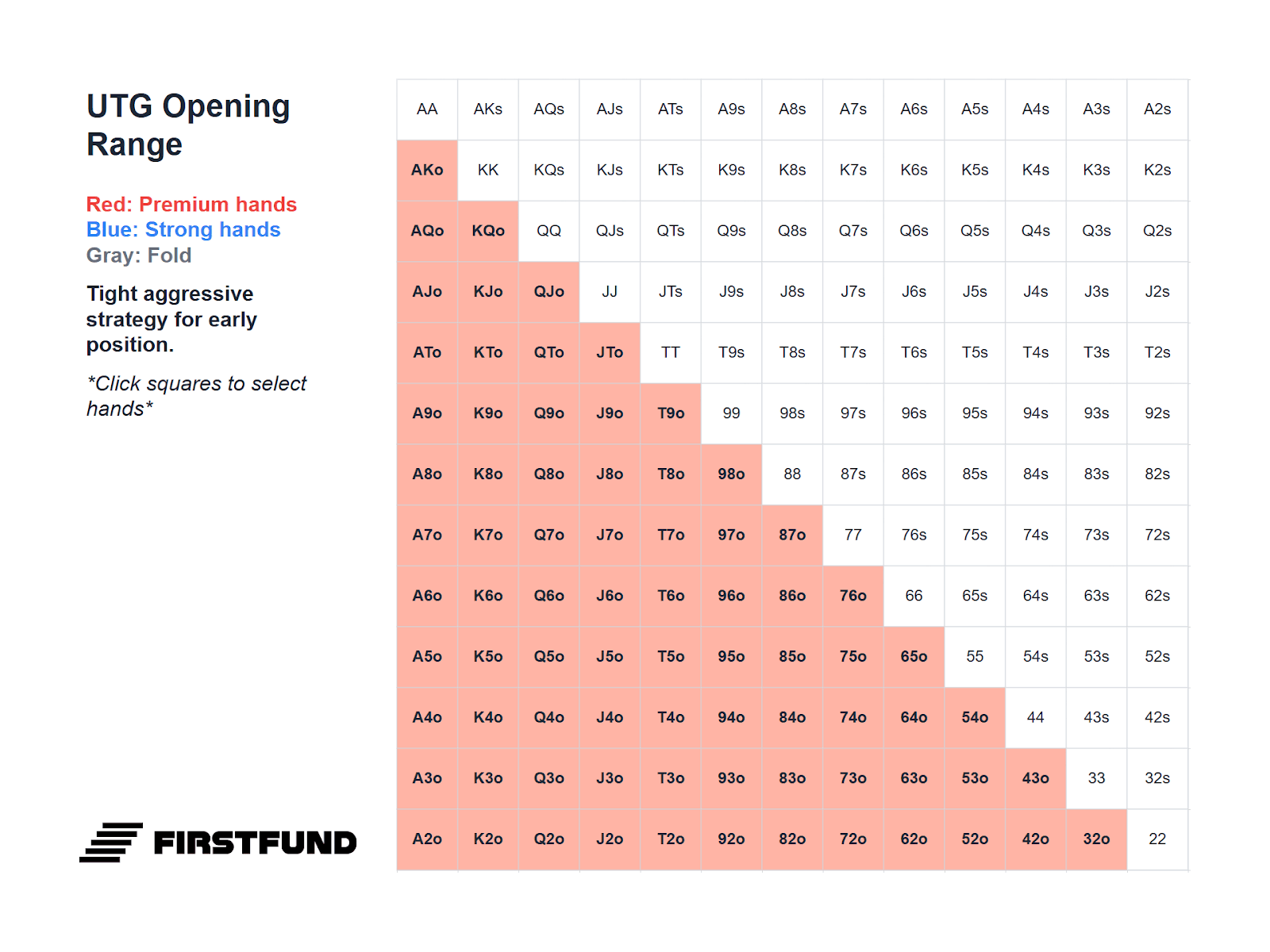
Below the diagonal — offsuited hands. In charts, such hands are marked with the letter "o". Each offsuited combination has 12 variants, because the cards can be of any suit, but different.
For example, JTo is:
J♣T♦, J♣T♥, J♣T♠
J♦T♣, J♦T♥, J♦T♠
J♥T♣, J♥T♦, J♥T♠
J♠T♣, J♠T♦, J♠T♥
12 combinations in total.
This difference in the number of combinations is the key reason why suited hands occur less often, while offsuited hands make up the bulk of all possible starting hands.
Let's take a look at what the main charts for preflop opening and big blind defense against early, late, and middle positions look like.
Basic starting hand charts for 9-max tables
In this tournament format, positions are divided into three groups — early, middle, and late. We covered positions in more detail in this article.
1. Early position (UTG, UTG +1)
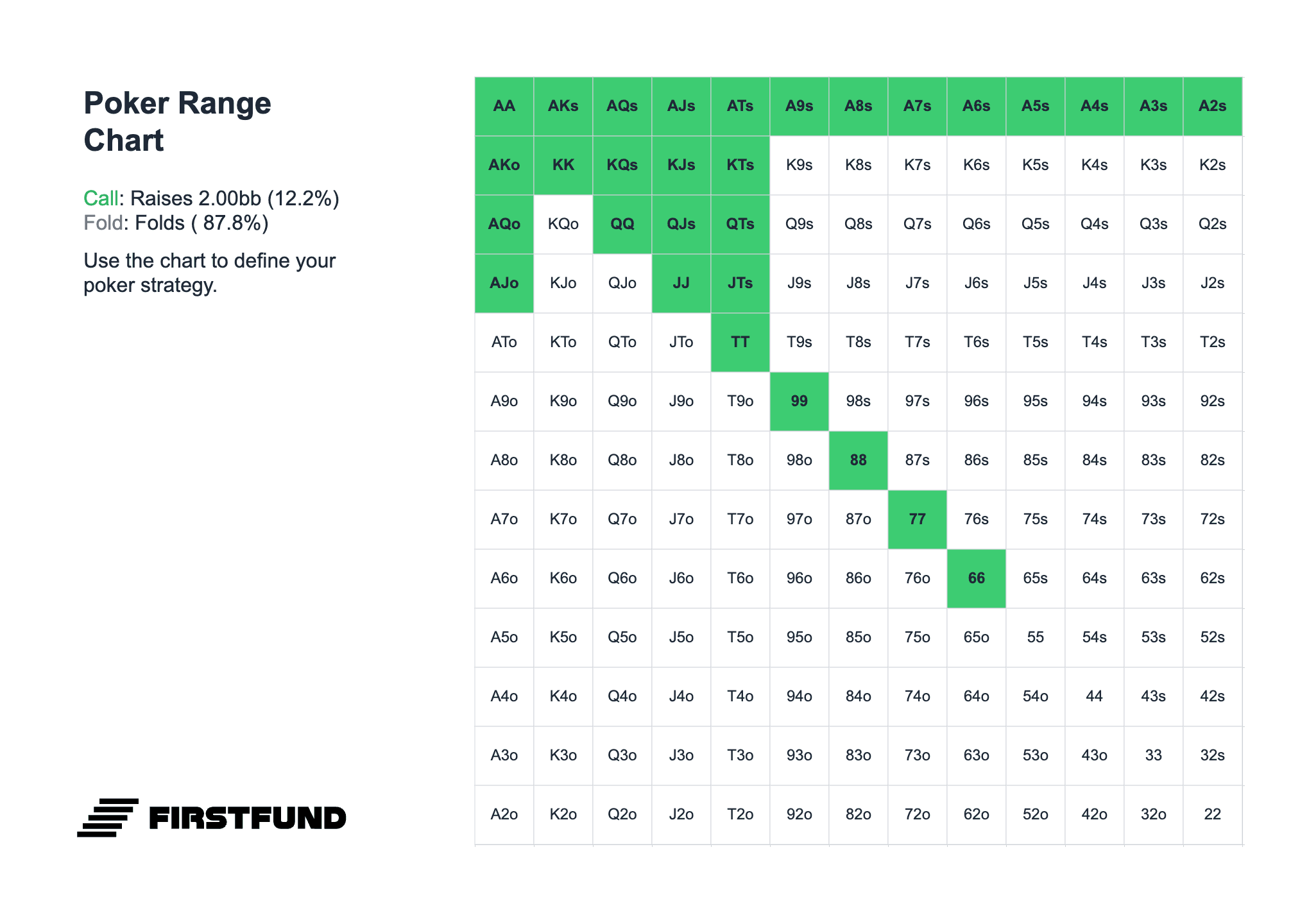
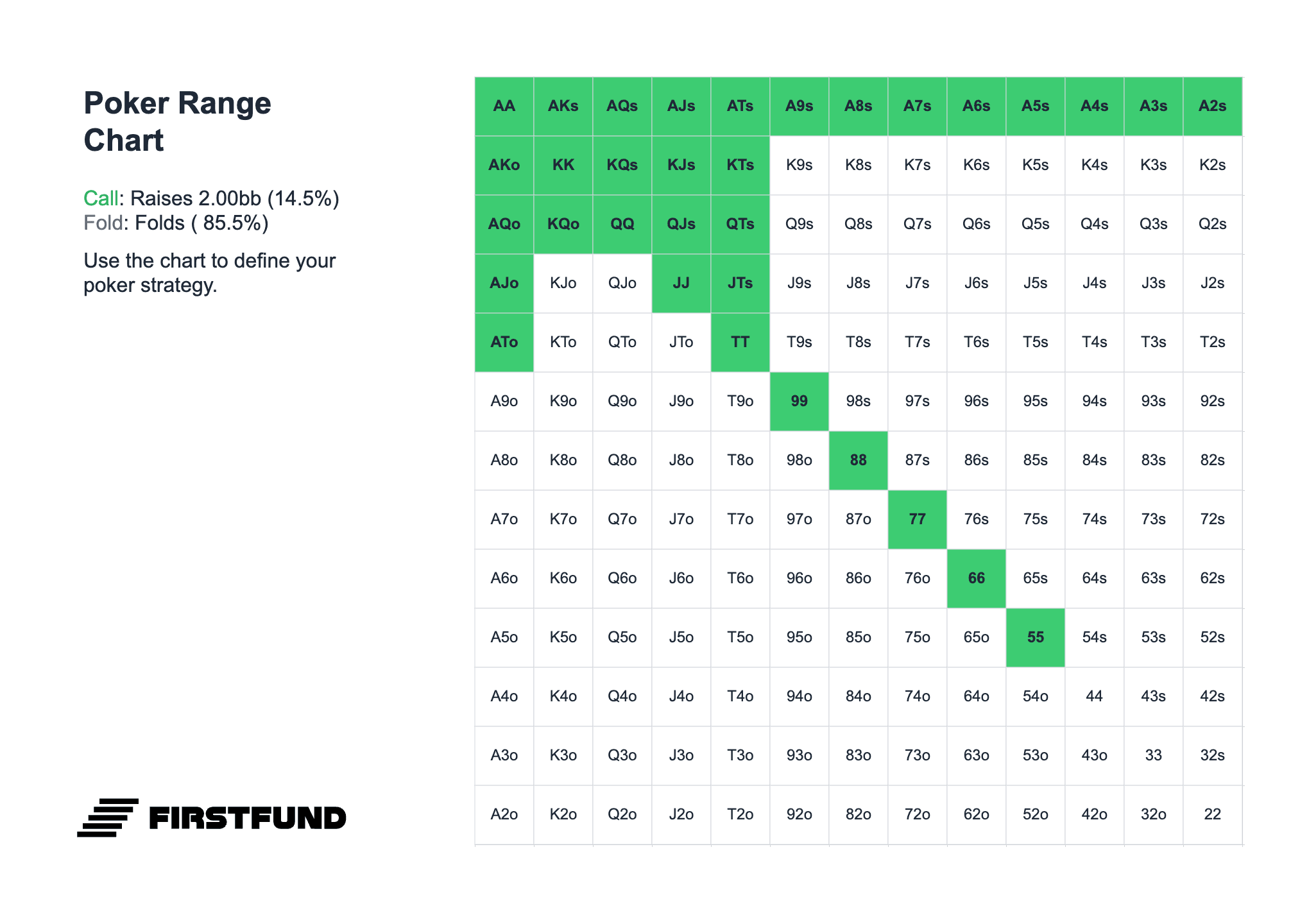
Here we open a fairly tight range — 10–15% of all hands.
Suited hands are above the central diagonal and are represented by suited broadways down to the ten line and the entire suited ace line. Below the diagonal are offsuited hands down to the ace-ten line. We open pockets from 55.
2. Middle position (MP, MP+2, Lojack, Hijack)
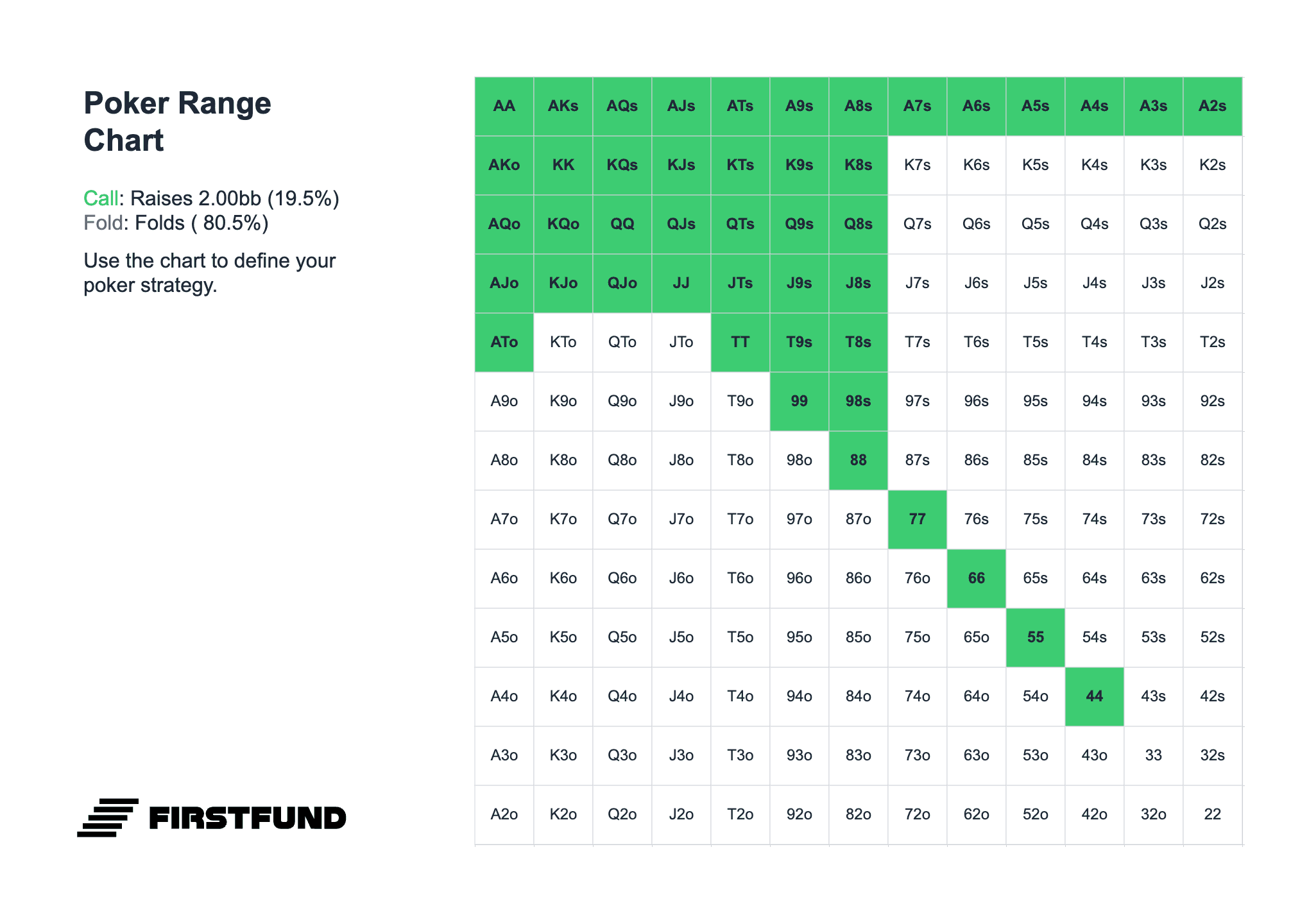
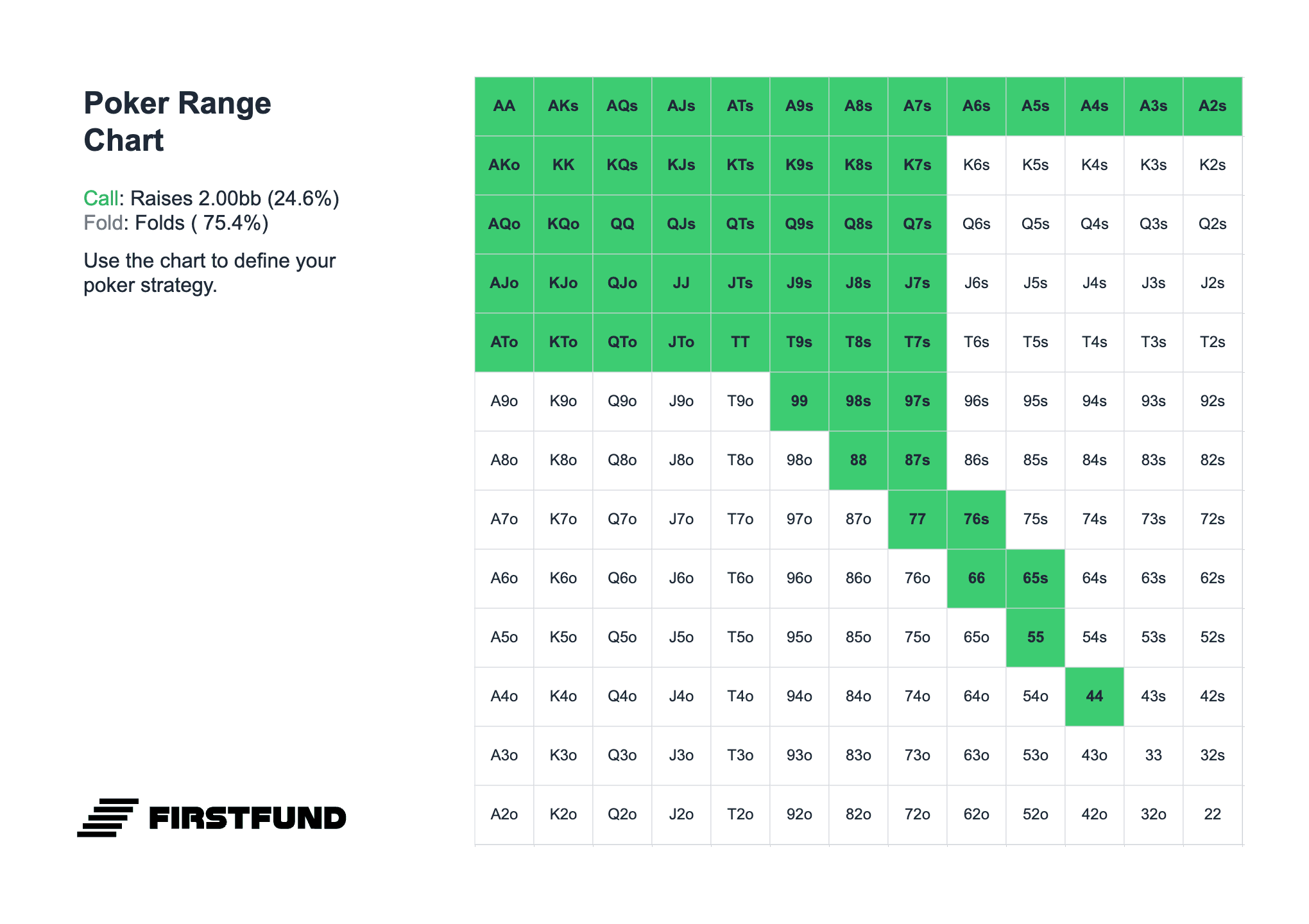
Here the range expands to 18–22% of all hands. You can notice that the range expansion affects the suited part of the chart more.
The reason: suited cards have greater potential for the nuts (a better chance of making a flush).
Low suited connectors appear in the range, the seven and eight lines of suited kings, but only the ace-ten suited line down to the jack. Pockets expand to 44.
Important: at 6-max tables the positions shift — early position disappears, and the count starts straight from MP.
3. Late positions (Cutoff, Button)
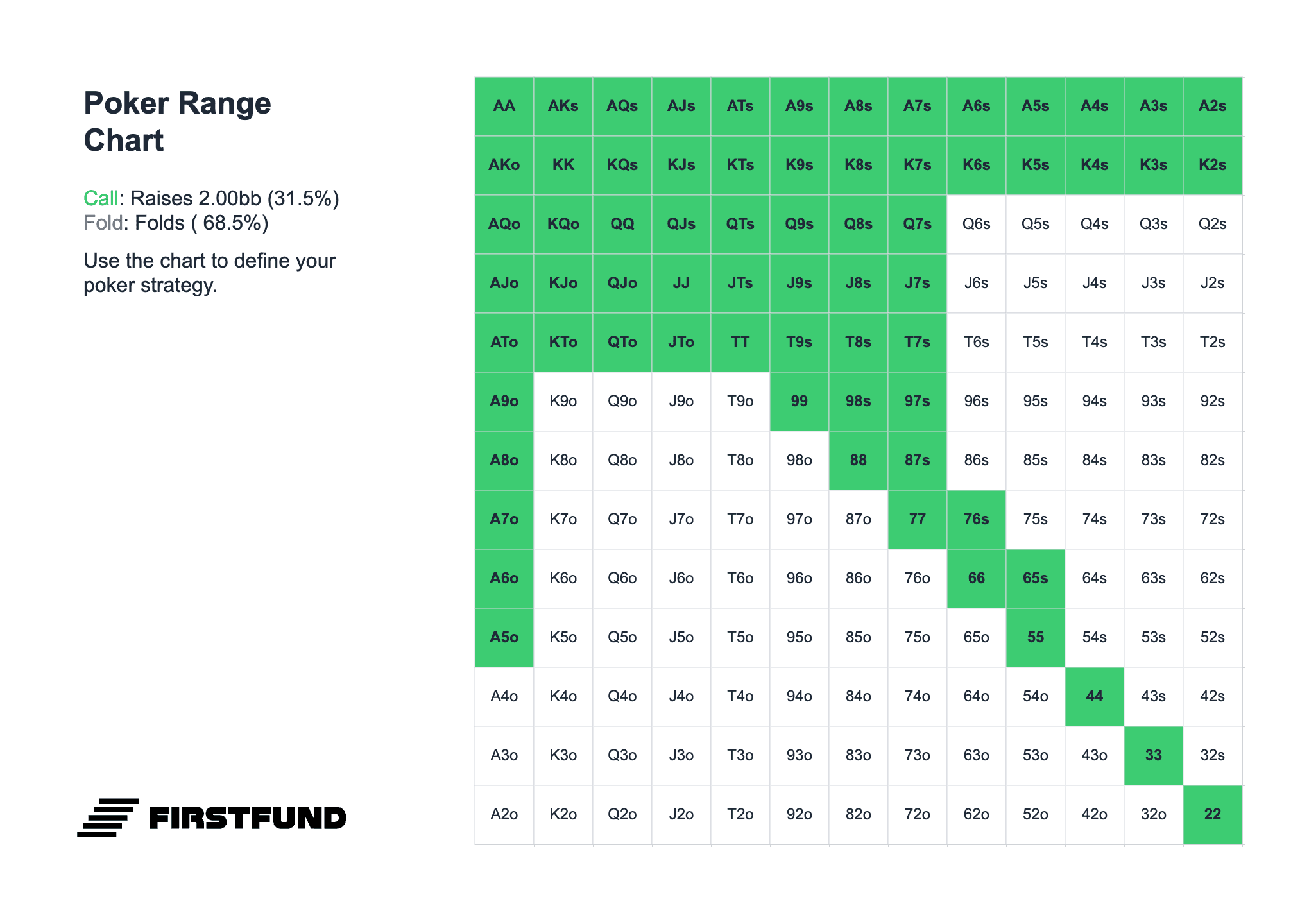
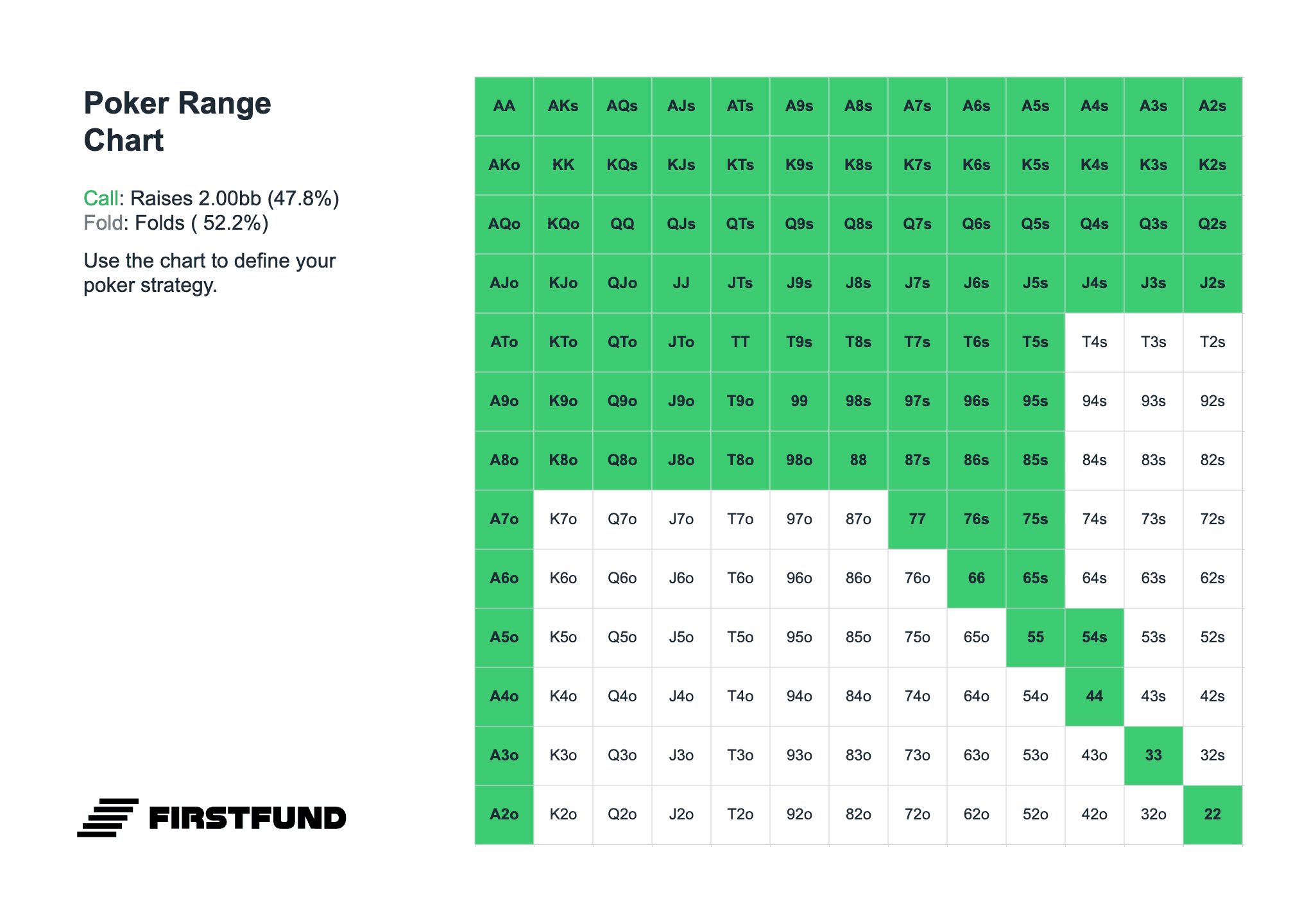
In late positions the opening range is the widest — from 30 to 50% of all hands.
The suited half of the chart has filled in almost completely, and the offsuited half has expanded down to the eight line.
BB defense against raises
This is an example of a chart in which our action will not be an open raise*, but a defense against an open raise.
An open raise is the first voluntary raise preflop, when all players before you have folded.
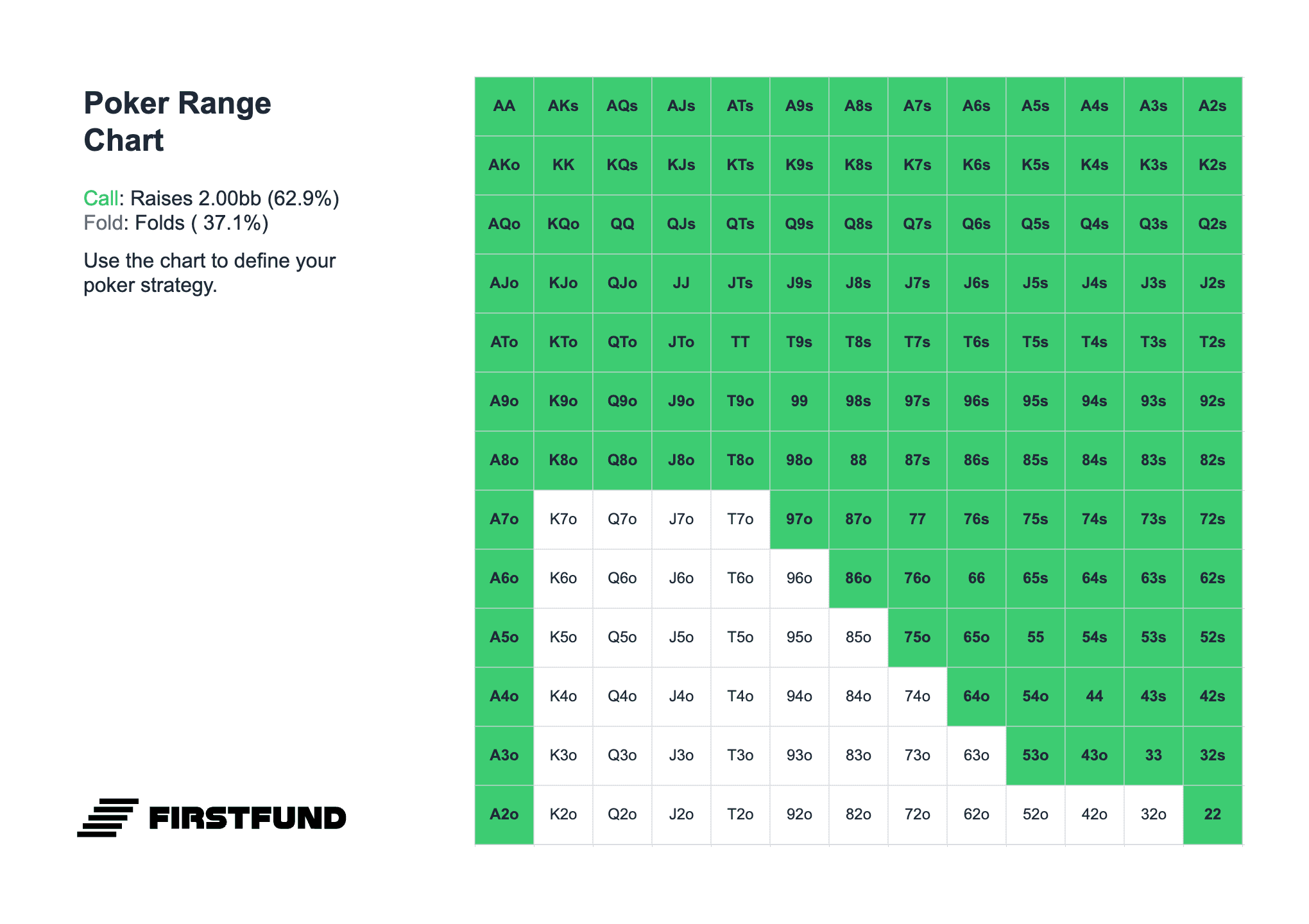
Against early positions — we throw away many offsuited combinations.
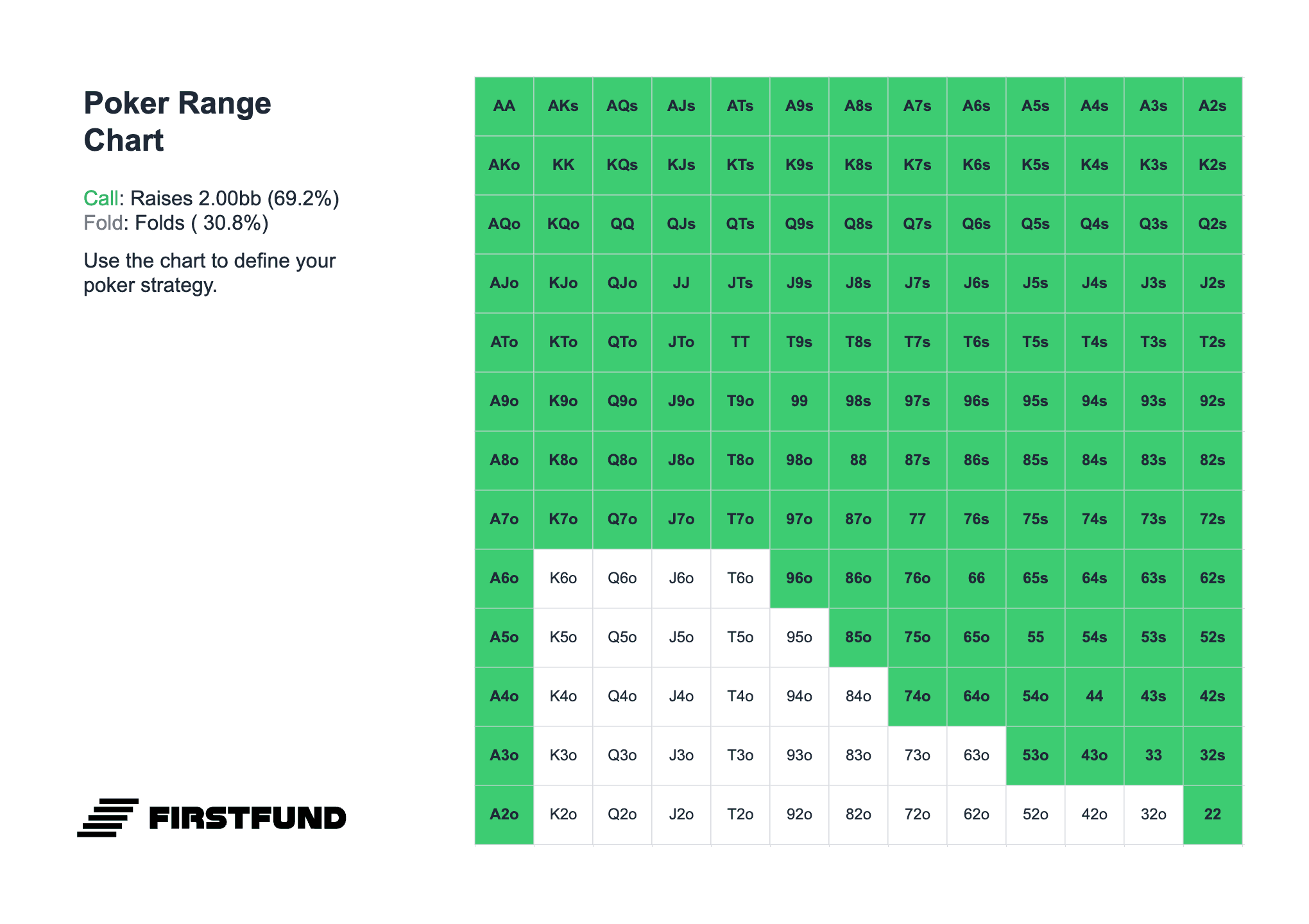
Against middle — the range is wider, but still limited.
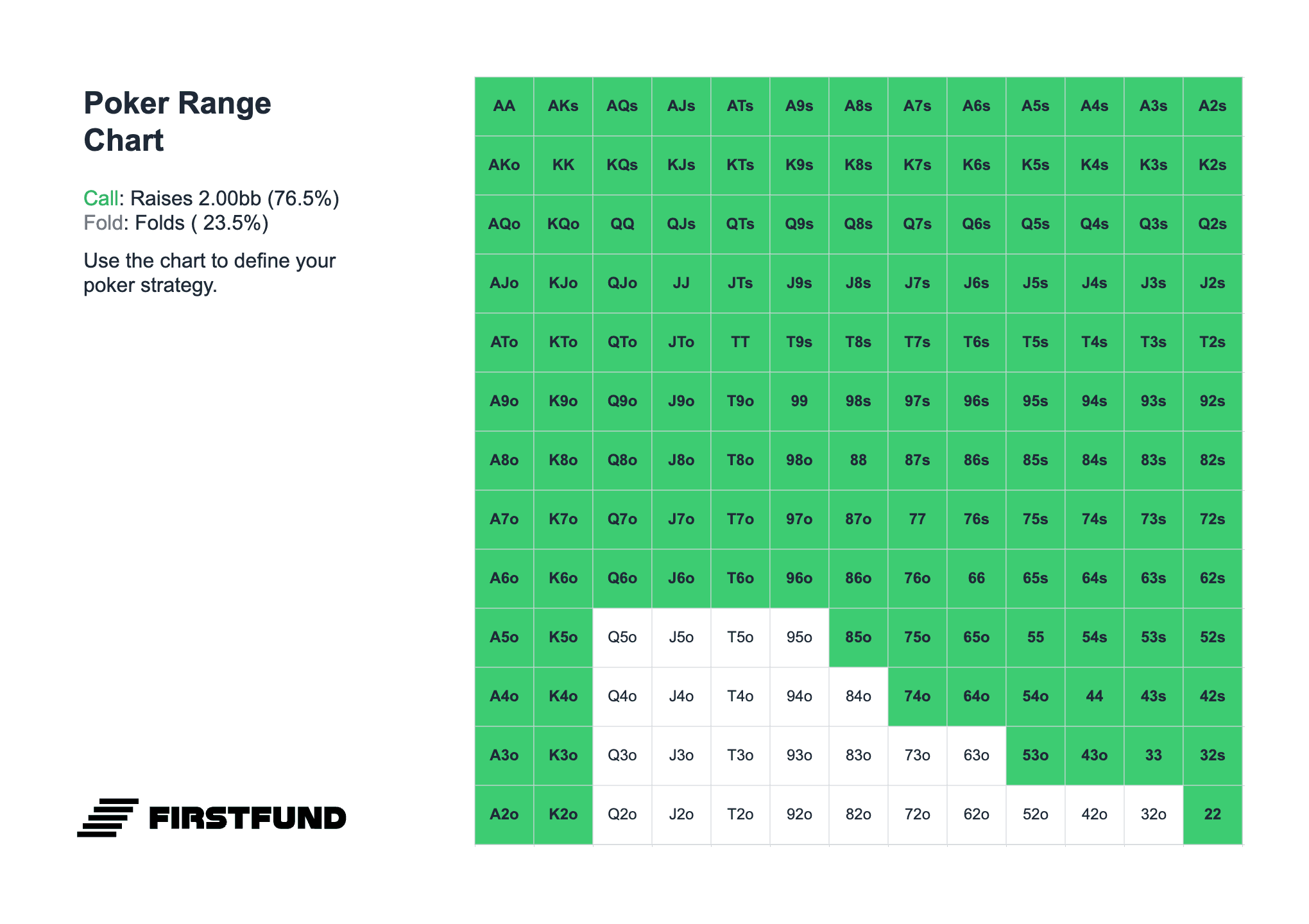
Against late — we defend very widely in the big blind.
Common beginner mistakes when working with charts
Even with a ready-made starting hand chart in front of them, beginners often make mistakes. This is because they take it too literally and don't account for other factors of the game.
Let's break down the most common mistakes that prevent effective use of charts.
1. Ignoring positions.
One of the most common mistakes is playing the same hands regardless of position. Beginners open with the same range on UTG and on the button, even though in reality the difference is enormous.
2. Defending the big blind too cautiously
Beginning players often throw away too many hands. As a result, they miss profitable spots for a call or a 3-bet. It's important to use the chart as a guide and to take playing style into account in order to defend effectively.
3. Charts are a foundation, not dogma
A simple example: in the early stages of tournaments chips are worth less, so it makes sense to defend wider and look for opportunities to grow your stack. In the late stages, defense and opening ranges can be adjusted a bit — play more carefully with small stacks or take into account opponents' styles in the late stages of the tournament, where there's a high risk of busting.
Remember that a chart gives you a basic understanding, but a skilled player always adapts to the realities of the table.
Want to use poker starting hand charts correctly and learn advanced concepts?
Apply to FunFarm to take your preflop game to the next level.
FAQ
Why are starting hand charts not a universal rule, but a guide?
Charts provide a basic matrix of hands and actions, but they don't account for the specific dynamics of the table, opponents' styles, stacks, and position. A good player uses the chart as a starting point and then adapts ranges to the situation at the table.
Should you rely on a chart when playing 6-max instead of 9-max?
You absolutely should, but charts for 9-max and for 6-max differ, because the table structure and dynamics change — more aggression, fewer players. If you play 6-max, you need to use specialized charts or adapt the basic ones by making ranges wider.
Does a starting hand chart help equally in tournaments and cash games?
Yes — charts are useful for both formats as a basic guide. In both cases it's important to take context into account rather than acting strictly by the table.
"I've learned all the charts" — what's next?
Regularly evaluate your results — track your hands, analyze hands, look at which hands win and which more often lead to losses. Use the chart as a starting point, but always ask yourself: "Why exactly did I play this hand?", "Should I adjust the range?". This kind of practice will help you develop flexibility rather than dependence on tables.
Read next
Card Sharps in Poker: Famous Names and Their Main Tricks

# WTSD, WWSF, and WONSD in poker: what these stats mean and how to use them

Stack in Poker: How the Number of Chips Affects Your Strategy