GTO for Dummies: What It Is and How to Apply the Basics Without Solvers
Almost every player who starts studying poker systematically sooner or later runs into the term GTO — Game Theory Optimal, the optimal strategy from a game-theory standpoint.
We hear that it's an "unexploitable" model, that the strongest regulars play it, that it's impossible to master without solvers — and in the end we either start overcomplicating our game or postpone the topic "for later".
In this article we'll break down:
what GTO is in simple and precise terms
how GTO differs from the exploitative approach
why GTO is considered an unexploitable strategy
how it generates profit over the long run
which basic GTO elements we can apply without solvers
how to build an understanding of GTO into real play at micro and mid stakes.
Our goal isn't to turn the game into a set of formulas, but to build a solid foundation. Understanding GTO basics makes us more resilient under pressure, protects us from gross mistakes, and helps us make decisions systematically rather than intuitively.
What GTO is in poker
GTO is a strategy that cannot be exploited. This means that an opponent can't profit from our deviations from the strategy, because there are none.
From a game-theory perspective, GTO corresponds to the Nash equilibrium: a state in which neither player can improve their result by changing strategy unilaterally. If both play optimally, any deviation worsens expectation.
It's important to understand: GTO is a defensive strategy. Its task isn't to maximize profit against a specific weak player, but to minimize our own mistakes, to give opponents no points to exploit, and to guarantee a minimal positive EV over the long run.
That's exactly why GTO is especially valuable against strong or unknown opponents, when we don't have enough information to make precise adjustments.
GTO and exploitation: which is more profitable

The two main strategies are —
1. Exploitative style
We use the opponent's mistakes and adjust to their specific tendencies. Exploitation yields maximum EV against weak players. But it carries a risk: if the opponent adapts, we become vulnerable.
For example, if they fold to a 3-bet 80% of the time, we 3-bet bluff more often. If they call too often — we cut back on bluffs and increase value.
2. GTO
We stick to balanced ranges and frequencies. Our value bets are accompanied by the right number of bluffs. Our calls correspond to pot odds and the minimum defense frequency.
This approach doesn't maximize profit against a specific opponent, but it makes us resilient against any type of opponent.
In practice, the most effective style is a combination of the two approaches. We build the foundation on GTO and layer exploitative adjustments on top of it.
Why GTO is considered unexploitable
When we say "unexploitable strategy", it's important to clarify what exactly we mean. It's not about always winning. And it's not about the opponent being unable to take a single chip from us.
It's about something else: with a correct GTO strategy, the opponent can't increase their expectation by exploiting some systematic mistake of ours — folding too much, bluffing too little, always betting one sizing, or, conversely, never betting in certain situations.
Imagine the perfect opponent: they know our frequencies on every street; they see where we deviate (overbluff, underbluff, overfold, overcall), and they instantly choose the best response specifically against our strategy.
In such a world, any asymmetry in our game becomes a lever against us. If we:
fold to bets a lot → they bet more often, even without equity
don't bluff enough on the river → they start folding everything that doesn't beat value
bluff too much → they call more often and our bluffs stop paying off
defend our blinds too rarely → they open wider and increase their expectation
That is, exploitation is always a response to a systematic mistake. And that's the point of GTO: it's built on balance, which means there was no "best response" that makes money specifically off our mistake.
What does "no way to increase EV" mean? If we play close to equilibrium, the opponent can do two things:
Also play close to GTO — then they won't be able to squeeze additional EV out of us, because we don't give them any pressure points.
Deviate — but any deviation of theirs doesn't increase their expectation against our strategy, and more often lowers their own EV.
The key principle of equilibrium is exactly this: a unilateral improvement is impossible. We can only "break" equilibrium together — when both players change strategy. If only one changes — they themselves take on the risk of becoming vulnerable.
What we can really apply without solvers
We're not required to calculate the Nash equilibrium by hand and build perfect mixes in every hand. But we can implement into our game the principles that underlie GTO strategy.
Our task isn't to copy the solver, but to build a structural logic of decisions that doesn't make us obvious, doesn't let opponents easily exploit us, and forms a stable base for further adjustments.
Let's break down the key elements you can apply already today.
1. Building preflop ranges
Preflop is the foundation of the whole hand. If ranges are built chaotically, postflop becomes constant improvisation.
The basic GTO principle:
the later the position — the wider the opening range
the earlier the position — the narrower and stronger the range.
But an important adjustment: a narrow range from early position isn't just premium hands. If we open from UTG exclusively with AA, KK, QQ and AK, we become predictable, easy to read, and vulnerable to pressure postflop.
A balanced range should:
include different types of hands (pocket pairs, suited connectors, broadways)
cover different board textures (high, middling, coordinated)
have playability after the flop
For example, the optimal opening range from early position — UTG — might look like this:
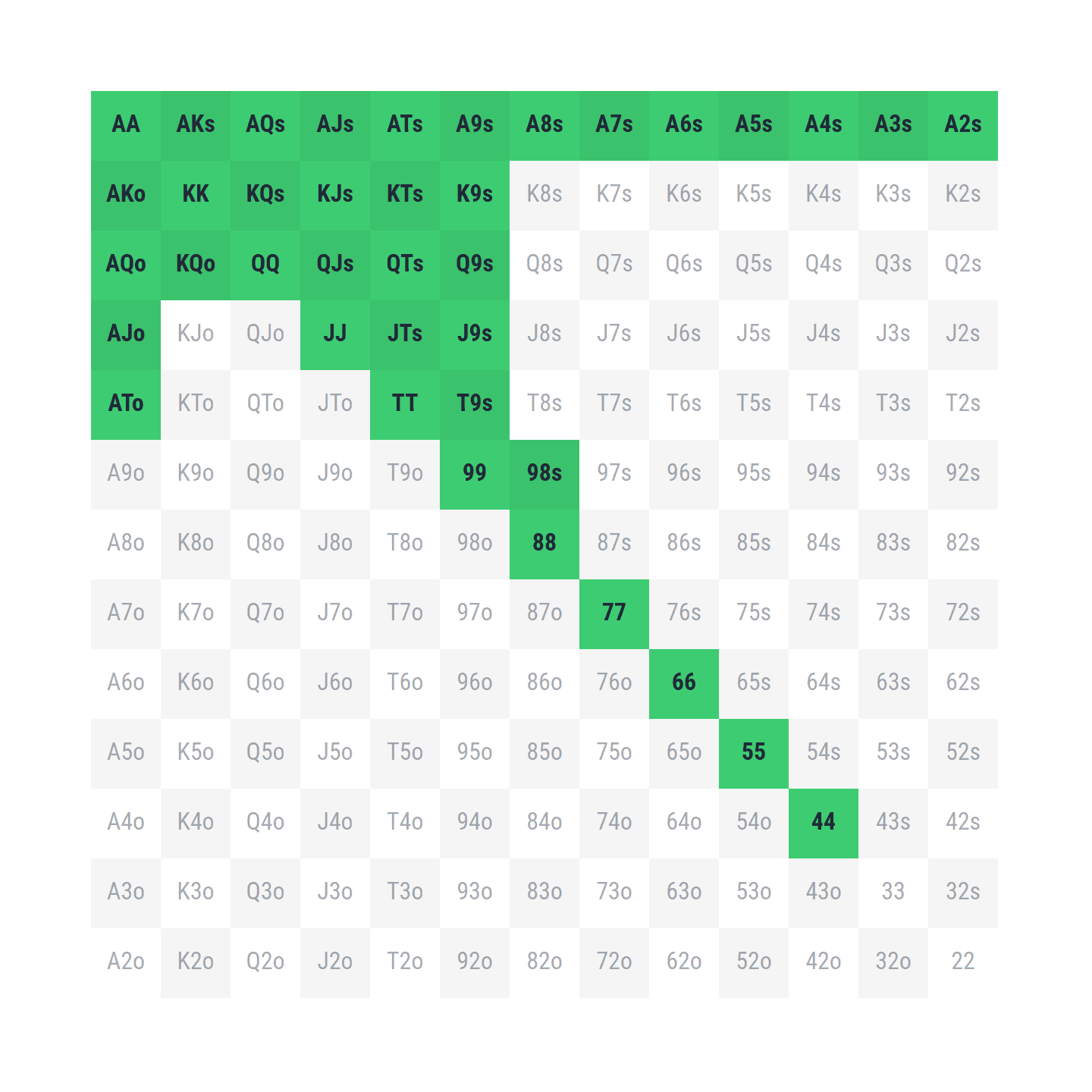
As we can see, here there aren't only the strongest hands, but also suited connectors that can make flushes and straights, low pocket pairs with set potential, and low suited aces, which have the ability to push out stronger aces from positions that are awkward to call from.
2. Understanding the concept of pot odds
Understanding pot odds is one of the most practical GTO tools. The formula looks like this:
Call size / (Pot + Call)
If the opponent bets 50% of the pot — say, there's 100 in the pot and they bet 50 — we need to call 50, and the pot with their bet will be 150.
50 / 150 = 33%.
This means we need at least 33% equity for the call to break even.
It's important to understand: if equity is higher — the call is profitable, if lower — it's unprofitable.
This calculation protects us from intuitive overcalls, doesn't let us fold hands with enough equity, and forms a mathematically correct continuing range.
We don't have to know equity down to hundredths of a percent, but understanding the thresholds — 25%, 33%, 50% — sharply increases the quality of our decisions.
3. Balancing bet sizes
The bet size determines how many bluffs we can include in our range so that our bluff is profitable over the long run.
The basic logic: a 50%-pot bet → about 33% bluffs; a pot bet → about 50% bluffs; a 150% overbet → about 60% bluffs.
Why is that? Because the bet size determines the opponent's pot odds, and therefore their defense frequency.
If we bet 50% of the pot, the opponent needs to win 25% of the time, which means 25% of our range can be a bluff.
Without solvers we can use a simplified model:
flop — many semi-bluffs (draws have equity)
turn — balance closer to 1:1
river — fewer bluffs than value.
This isn't a perfect model, but it protects us from two extremes: betting only value, and turning every hand into a bluff.
Conclusion
GTO is a logical system based on equilibrium, frequencies and math. We don't have to use solvers to apply the basics: understanding pot odds, observing the minimum defense frequency, balancing bluffs and value, and building adequate ranges.
Over the long run, it's exactly the systematic nature of our thinking that makes our game resilient and profitable. But we shouldn't forget that profitable play in tournament poker often depends on correctly adjusting to opponents' styles and on the ability to exploit the features of opponents' play for our own purposes.
If you want to grow in poker, you need not just to memorize charts, but to understand the logic of building strategies. That's exactly the approach we develop at FunFarm — not a set of disjointed tricks, but a holistic understanding of the game.
Submit an application to become part of our team.
FAQ
Is GTO an unbeatable strategy?
GTO is considered an unexploitable strategy in the heads-up format. This means an opponent can't increase their EV off our systematic mistakes if we adhere to optimal frequencies and balanced ranges. However, this doesn't mean we'll win every session or always have maximum profit. GTO protects us from losses against strong opponents, but it doesn't guarantee dominance in every specific hand.
Does a beginner need a solver?
At the initial stage a solver isn't needed. It's far more important to master the fundamental principles: preflop ranges, pot odds, basic defense frequencies, and the logic of balance. A solver is useful when we already have a structured understanding of the game and want to go deeper into the details. Without that base, working with a solver turns into mechanically copying solutions without understanding the reasons.
Can you play purely exploitatively?
Technically you can, especially against weak players with obvious systematic mistakes in their game. But without an understanding of the theoretical base it's hard to determine exactly where the opponent deviates from the optimum and by how much. In that case our adjustments become intuitive rather than mathematically grounded. Exploitation works most effectively when it's built on top of a stable GTO base.
Why isn't GTO always the most profitable style?
GTO is aimed at defending against exploitation, not at maximally punishing the opponent's mistakes. If an opponent makes serious deviations, a more aggressive exploitative strategy can bring more EV. That's why GTO is a foundation of stability, not a tool for maximum pressure on weak players.
Does GTO work in multiway pots?
A full Nash equilibrium is mathematically defined for two players. In multiway pots the situation gets more complicated, because the strategies of several opponents interact simultaneously. Nevertheless, the principles of GTO — range balance, correct defense frequencies, and understanding pot odds — remain applicable. We can't achieve a strict equilibrium, but we can minimize our own systematic mistakes.
Where to start learning GTO?
The best start is building correct preflop ranges and understanding positional advantage. Next you should master pot odds, in order to make mathematically grounded decisions. The next step is working with bet balance and understanding the value-to-bluff ratio. Only after that does it make sense to go deeper into studying solver analyses and mixed frequencies.
Read next
The "Blockers" Concept: How a Single Card Changes Everything
What Is a Kicker and When It Decides Everything: Breaking It Down with Examples

Women in Poker: Top 5 Most Successful Female Players