All-in in Poker: Rules, Strategy, and Situations for Playing Your Whole Stack
Almost every player sooner or later finds themselves in a situation where they have to risk their entire stack. Sometimes it happens preflop with a strong hand, sometimes postflop while playing a big pot, and sometimes because of a short stack in a tournament.

This is precisely why the all-in in poker is considered one of the key strategic decisions. This bet can instantly end a hand by forcing opponents to fold, or lead to a big win at showdown. But it can also cause the loss of your entire stack if a player makes the decision without assessing ranges*, equity*, and the pot structure — or simply because the opponent turned out to have a stronger hand than yours in a spot where folding was extremely difficult.
Beginning players often perceive the all-in as an emotional act — a show of confidence or an attempt to turn the hand around. In reality, this bet works differently. It's a tool used in strictly defined situations: when you need to realize a strong hand, protect a made hand, use fold equity*, or correctly play a short stack in a tournament.
In this article we'll break down what an all-in is in poker, how the rules of this bet work, what happens to the pot when several players go all-in, and in which situations going all-in is actually profitable. We'll also look at typical mistakes and explain how to correctly respond to an opponent's all-in.
*Range — this is the set of hands with which a player can take a certain action in a specific situation.
*Equity — this is the share of the pot that a player's hand lays claim to, taking into account the probability of winning the hand.
*Fold Equity — this is the additional expected value that a player gains thanks to the probability that the opponent will fold to his bet.
What an all-in is
All-in is a situation in poker when a player bets all of their chips into the pot. After this, they remain a participant in the hand until showdown, but can no longer make decisions, since they have no chips left.
It's important to understand that the ability to go all-in depends on the structure of the game. In poker there are several variations:
No Limit (NL) — no-limit format
Pot Limit (PL) — pot-limit
Fixed Limit (FL) — fixed limit
In no-limit games, for example No Limit Hold'em, a player can bet their entire stack at any moment — both preflop and on any postflop street. This is precisely why all-ins occur most often in this format.
In pot-limit games the bet size is limited by the current size of the pot. This means that a player can bet their entire stack only if it does not exceed the allowable bet size.
In limit games the bets are fixed. A player can end up all-in only when their stack is smaller than the established bet size.
Sometimes an all-in happens automatically. For example, if the bet size exceeds the number of chips a player has, they can only call for the amount they have left. In that case they are automatically all-in.
There's one more peculiarity worth remembering: if a player goes all-in not on the last street, they no longer participate in the further betting, but their hand stays in play until showdown.
What side pots are
When several players with different stacks participate in a hand, a situation with side pots — additional pots — arises.
The essence of the mechanic is simple: each player can win only the part of the pot that they paid for with their chips.
Let's look at an example.
Four players participate in a hand:
Player A — 50 chips
Player B — 100 chips
Player C — 200 chips
Player D — 500 chips
All players go all-in.
First, the main pot is formed. Each player contributes 50 chips. The main pot amounts to 200 chips.
Next, the first side pot is created. Players B, C, and D add another 50 chips each. The size of the pot is 150 chips.
Then the second side pot appears. Players C and D add another 100 chips each. This pot amounts to 200 chips.
Player D's remaining chips don't participate in the play, because no one can match them. At showdown the pots are distributed sequentially:
First the main pot is contested
Then the first side pot
After that the second side pot
Such a system guarantees that a player cannot lose more chips than they originally had.
When to go all-in

Despite its apparent aggressiveness, the all-in in poker is used in quite specific strategic situations.
1. Preflop with premium hands
One of the classic situations is going all-in preflop with strong starting hands.
Pocket AA, KK, sometimes QQ or AK are often played through aggression and can lead to an all-in before the flop even comes out.
However, it's important to understand: even with a strong hand, an open push* preflop isn't always profitable. For example, if a player immediately goes all-in with aces at a table with deep stacks, they often pick up only the blinds, without realizing the full potential of the hand.
Therefore, in most situations strong hands are first played through a raise, re-raise, and so on, and the all-in happens at a later stage of the betting.
*Open Push — this is a situation when a player is first to enter the hand, immediately betting all-in.
2. Protecting a strong but vulnerable hand
Sometimes a player has a very strong made hand, but the board structure makes it vulnerable.
For example:
a set on a drawy board
two pair against a straight draw
top pair on a texture with a flush draw
In such situations the all-in bet can be used as hand protection. The player increases the pot and at the same time deprives opponents of the opportunity to cheaply realize their outs.
Let's look at a concrete example
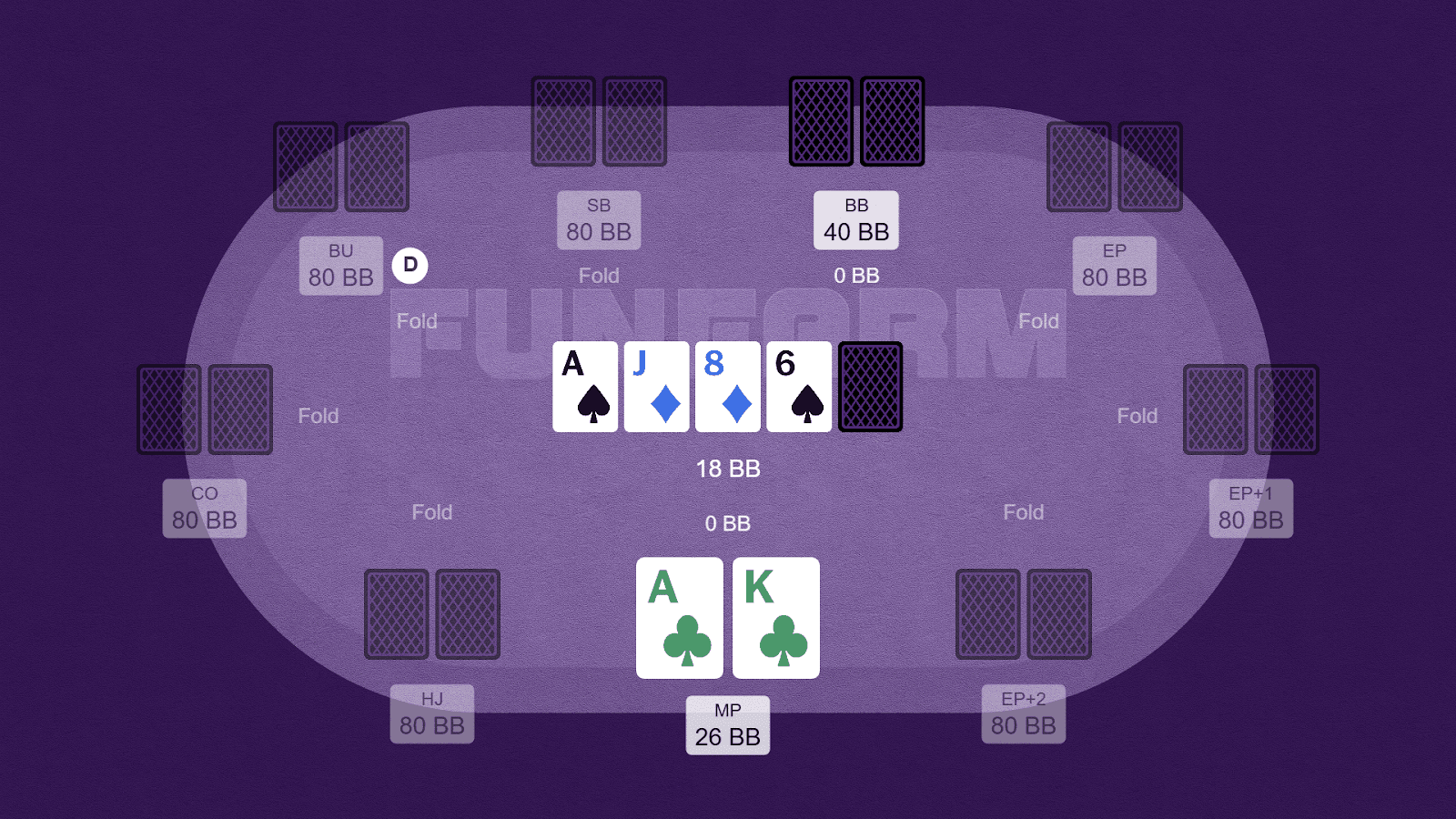
We have top pair on a board with two flush draws and possible straight draws. There are 18 BB in the pot, and we have 27 BB. Our decision is to play all-in. Why?
If the board were not so coordinated, we could try to split our stack size across turn and river bets, but in this case it will be optimal to play all-in in order to force the opponent to call with an unmade hand that has a high probability of improving on the river.
3. Semi-bluff with a strong draw
The all-in can be effective even without a made hand.
If a player has a strong draw — for example a flush draw or an open-ended straight draw — the push becomes a semi-bluff.
Such a bet has two ways to win the pot:
The opponent folds
The hand improves on later streets
Such a line is often used on the flop or turn, when there are already a lot of chips in the pot.
Again, let's look at an example:
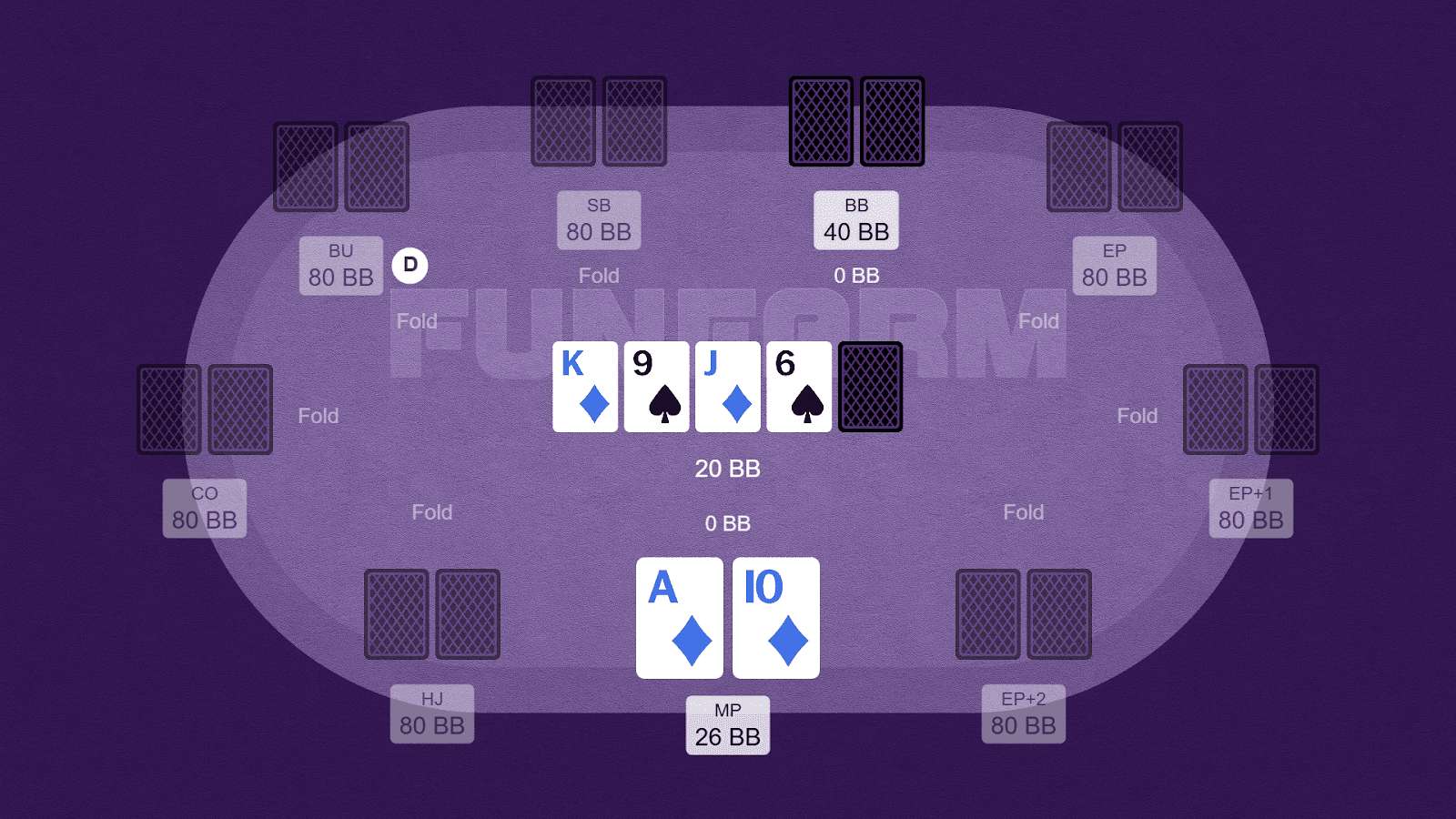
The same flop as in the last hand, but this time we have A♦️T♦️. In this situation we have the potential for the nut flush and a straight on the river, but we don't yet have a made hand.
Considering the pot size and our potential to develop, we can play all-in, assuming that the opponent might fold medium-strength hands (Jx, 9x) to such a bet, and if we get called, we have good chances to win on the river.
4. Short stack in a tournament
In tournament poker, all-ins occur significantly more often.
The reason is simple: as the blinds grow, players' stacks become relatively smaller. When the stack falls below 12–15 BB, full-fledged play through raises becomes impossible.
In such situations the push/fold strategy is used — the player either folds the hand or goes all-in preflop.
5. Pressure with a big stack
Sometimes the all-in is used as a tool of pressure.
For example, at stages of ICM pressure — on a tournament bubble and a final-table bubble — a player with a big stack can regularly push* against short stacks. Opponents fear busting before the money and fold their hands more often.
Such a strategy allows you to take pots practically without resistance.
*Push — this is an all-in bet, when a player bets their entire stack into the pot.
When you should not go all-in
Despite the fact that the all-in is a powerful tool for pressure and realizing equity, by no means is every situation suitable for playing for your entire stack. In some cases, an all-in bet doesn't increase a player's EV, but on the contrary leads to unjustified risk and loss of chips over the long run. To use the all-in effectively, it's important to understand when such a move becomes a strategic mistake.
1. Deep stacks
When playing at the table with stacks of, for example, 150–200 BB, an all-in on early streets is most often unjustified. In such situations a player risks a huge number of chips for a relatively small pot. In addition, we fail to extract from our strong hands the chips we could have taken with a smooth playout on each of the streets.
With deep stacks it's far more profitable to build the pot gradually. A player can extract additional profit across several streets of betting, getting calls from a wider range of hands.
2. Bluffing against unyielding opponents
The all-in as a bluffing tool works only when the opponent has enough hands that they're willing to fold. But if the opponent tends to call often and rarely chooses to fold, the bet loses its main function — creating pressure.
Against aggressive opponents, an all-in bluff turns into a costly mistake, because the probability of getting called is significantly higher.
In such situations the strategy should be the opposite. Instead of pressure through bluffing, it's more profitable to play strong hands as straightforwardly as possible, extracting value from their tendency to call often.
3. Lack of understanding of equity
The all-in is always a mathematical decision. Behind every push there should be an understanding of what equity the hand has against the opponent's assumed range and how profitable the bet is from the standpoint of the pot structure.
A player must take into account several factors at once:
the probability of winning against the opponent's range
the size of the pot and the required pot odds*
the number of outs and the possibility of the hand improving
the stage of the hand and the board structure
If these calculations are absent, the all-in turns into a random bet. In such a situation the player essentially relies on luck rather than strategy. In the short run such decisions can sometimes bring a win, but over the long run they almost always prove unprofitable.
*Pot Odds — this is the ratio between the size of the bet you need to call and the size of the pot, showing whether the call is profitable from a mathematical standpoint.
4. Tilt
One of the most common causes of incorrect all-ins is tilt — an emotional state in which a player loses control over strategy and starts making impulsive decisions.
After several lost pots or unlucky hands, a player may try to win everything back with one action. At such a moment the all-in seems like a quick way to fix the situation. In practice this almost always leads to even more serious losses.
A professional approach assumes the opposite: if a player feels that emotions are starting to influence their decisions, it's better to take a break and restore concentration. In poker, discipline and control over emotions play no less a role than knowledge of strategy.
How to correctly respond to an opponent's all-in

When an opponent goes all-in, a player has only two decision options left — call or fold. Unlike ordinary bets, here you can't make a small raise or try to control the size of the pot. Therefore, the decision to call must be made as carefully as possible and be based on several key factors.
1. The opponent's assumed range. A player must take into account the position, the opponent's style, and the structure of the hand. For example, a push from a tight player in early position more often means a strong hand. At the same time, an aggressive opponent on the button may go all-in with a much wider range.
2. The strength of your own hand. However, in poker it's important to assess not the absolute strength of the hand, but its relative strength against the opponent's assumed range. Even a strong hand can turn out to be vulnerable if the opponent goes all-in only with a very narrow spectrum consisting of nut hands.
3. The size of the pot. The more chips that are already in the pot, the more often it's profitable to continue with the hand. If the pot is large, a player needs to invest a relatively small amount to get a chance to win a significant number of chips.
By the way, we examined the ratio between bet size and pot in more detail in the article about poker math and pot odds. Head over, read, and study it.
For example, if there are 100 chips in the pot and the opponent pushes another 50, a player needs to invest 50 chips to win a pot of 150. In such a situation, a profitable call requires approximately 33% equity against the opponent's range. If the probability of winning is higher than this value, the call will be justified over the long run.
The all-in in different poker formats
The strategy of using the all-in largely depends on the format of the game. Differences in bet structure, stack depth, and the dynamics of play affect how often players go all-in and in which situations this happens.
Cash games
In cash poker, players usually start the game with deep stacks. Because of this, all-ins occur less often and are more often associated with large pots or strong made hands.
In most cash hands the pot gradually increases across several streets of betting. Players try to extract maximum value from strong hands and control the size of the pot with medium hands. Therefore, going all-in more often happens on the turn or river, when there are already a significant number of chips in the pot.
Multi-table tournaments
In tournament poker the all-in occurs significantly more often. The main reason is the constant growth of the blinds, which gradually reduces the relative depth of stacks.
As the tournament progresses, players are forced to look for opportunities to double their stack. In short-stack situations, play often comes down to the push/fold strategy, where a player has only two decisions — fold the hand or go all-in.
Tournament factors also play an important role, such as bubble pressure, the approach of the final table, and the distribution of prize money. In such situations, players with big stacks can actively use the all-in to pressure short stacks that are trying to avoid busting.
We discussed which stages of a tournament are most profitable to apply pressure in, and in which you should play more carefully, in this article.
Sit & Go and Spin & Go
In short tournament formats such as Sit & Go and Spin & Go, the dynamics of play are significantly faster. The starting stacks here are smaller, and the blind levels grow faster than in classic tournaments.
Because of this, players quite quickly find themselves in a situation where the effective stack depth becomes small. Under such conditions the all-in becomes one of the main strategic tools already in the early stages of the game.
In such formats it's important to have a good understanding of push/fold ranges and to be able to make quick decisions based on position, stack size, and table dynamics. Mistakes in such situations are especially costly, since each hand has great significance for the tournament result.
You can read more about this game format in our article.
Conclusion
The all-in in poker is not just a bet of your entire stack, but an important strategic tool.
It's used to realize strong hands, protect made hands, pressure opponents, and play a short stack in tournaments. But the effectiveness of this decision depends on many factors:
Players who understand the logic of all-ins and make sound decisions based on the board structure, players' ranges, the size of the pot, and the stage of the game win at poker significantly more often. They use the push not as an emotional reaction, but as a tool that helps realize a mathematical advantage over the long run.
It is precisely this systematic approach to the game that allows you to turn seemingly risky decisions into a profitable strategy. If you become part of our team, you'll be able to learn how to weigh the risks between the profitability and unprofitability of your decisions at the tables. Follow the link and start earning with poker together with FunFarm.
FAQ
Can you cancel an all-in if the opponent hasn't responded yet?
No. Once a player has declared an all-in and moved their chips to the center of the table, the decision is considered final. Even if the opponents haven't made a decision yet, the bet can no longer be canceled. In poker all actions are binding, so before declaring an all-in it's important to be sure of your decision.
Can you raise the bet after an all-in from another player?
Yes, but only under certain conditions. If a player has more chips left than the opponent bet, they can re-raise or increase the bet up to their full stack. However, if the all-in was too small and isn't considered a full raise, raising the bet again makes no sense.
What happens if several players go all-in in one hand?
In such a situation, a main pot and one or several side pots are formed. The main pot consists of the amount contributed by all participants in the hand. The side pots are formed from the additional chips of players with deeper stacks. At showdown the main pot is contested first, then each side pot in turn.
Can you go all-in on any street of betting?
In no-limit games a player can bet their entire stack at any stage of the hand — preflop, on the flop, turn, or river. However, in limit and pot-limit formats the bet sizes are limited by the rules, so the ability to go all-in depends on the size of the pot and the allowable raise.
What happens to a player after an all-in if the hand isn't finished yet?
A player who has bet their entire stack remains in the hand, but no longer participates in the betting. They can't make additional bets or increase the pot, because they no longer have any chips.
Can you go all-in as a bluff?
Yes, the all-in is used as a bluffing or semi-bluffing tool. Betting your entire stack creates pressure and can force opponents to fold fairly strong hands. However, such a maneuver requires a precise understanding of opponents' ranges and tendencies. Without these factors, a bluff all-in often becomes too risky a decision.
Read next

Types of Poker: Popular Variations, Their Rules and Features
The Flop in Poker: How to Read the Board and Win Postflop

How to Play Poker: Rules for Beginners