Bankroll Management in Poker: A Guide to Managing Your Money
Bankroll management rules for cash and MTT. Find out how many buy-ins you need for your stakes to survive variance and grow in poker.

90% of beginning players lose all their money not because of bad play, but because of a lack of bankroll management. They play beyond their means and can't withstand the first serious losing streak. This guide is your insurance against going broke and a step-by-step plan for financial growth in poker.
What is a bankroll and why is it your main asset?
A poker bankroll is the sum of money you've set aside exclusively for playing poker. This money is mentally and physically separated from your everyday expenses: rent, food, entertainment.
It's crucial to understand: a bankroll isn't just money, it's your main working tool. Like a hammer for a carpenter or a scalpel for a surgeon. Proper management of this tool lets you play without fearing the loss of your last funds, and make mathematically correct decisions rather than emotional ones under pressure.
The player's main enemy: Variance
Variance is the natural ups and downs in poker driven by the element of luck. It's the very reason your pocket aces sometimes lose to a pair of deuces.
You can be ten times stronger than your opponents, but over the short run (a day, a week, even a month) the result can be negative. That's normal. Such losing streaks, or "downswings," happen to absolutely everyone, even the strongest players.
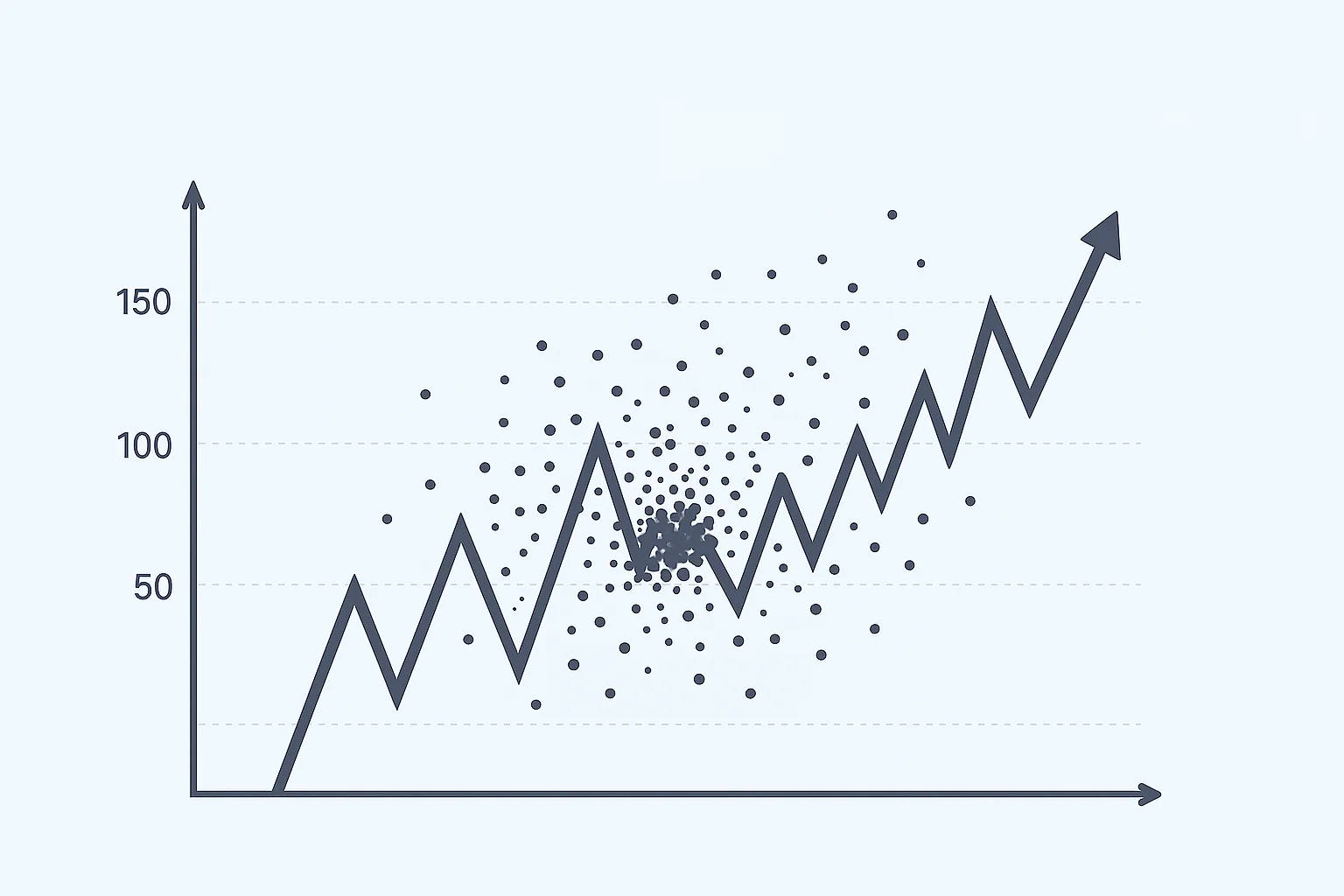
A winning player's result over the long run
Bankroll management is your financial "shield," which lets you survive these inevitable downswings without going broke. It gives you enough margin of safety to wait until your skill and mathematical edge show themselves over the long run.
The golden rules of bankroll management
This section gives clear, practical recommendations. We'll measure the bankroll in "buy-ins."
Bankroll for cash games (No-Limit Hold'em)
A buy-in (BI) in cash games is the amount you sit down at the table with. The standard buy-in is considered to be 100 big blinds (BB). For the NL10 stake (blinds $0.05/$0.10), 1 buy-in equals $10.
Management style | Number of buy-ins (BI) | Example bankroll for the NL10 stake |
Conservative (for hobby) | 30-40 BI | $300 - $400 |
Standard (for regulars) | 50-60 BI | $500 - $600 |
Professional | 100+ BI | $1000+ |
Bankroll for MTT
Tournaments require a more conservative bankroll. To play a $1 MTT, you need $100. We've put the general recommendations in the table:
ABI | Bankroll | Move up | Move down |
$1 | $100 or 100 buy-ins | $220 | $50 |
$2 | $220 or 110 buy-ins | $360 | $170 |
$3 | $360 or 120 buy-ins | $650 | $285 |
$5 | $650 or 130 buy-ins | $1,120 | $500 |
$8 | $1,120 or 140 buy-ins | $1,500 | $880 |
$10 | $1,500 or 150 buy-ins | $2,400 | $1,200 |
$15 | $2,400 or 160 buy-ins | $3,400 | $1,950 |
$20 | $3,400 or 170 buy-ins | $4,500 | $2,800 |
$25 | $4,500 or 180 buy-ins | $5,700 | $3,750 |
Usually poker players combine tournaments with different entry fees. So the bankroll management rules should be adapted to your ABI. For example, to play MTTs with buy-ins from $10 to $15 at the same time, $2,000 will be enough.
Growth strategy: Moving up and down the stakes
The goal of bankroll management isn't only protection, but also growth. Here's how to move up to higher stakes wisely.
The "shot" rule for moving up a stake
The essence of shot-taking: When your bankroll exceeds the requirements for your current stake, you can set aside a small part of it (4-5 buy-ins of the new stake) to try playing the higher stake.
Example: You play $5 tournaments and stick to a standard bankroll of 200 BI ($1000). The next stake is $10 tournaments, for which by the same rule you need 200 * $10 = $2000. You can take a "shot" at the $10 stake when your bankroll reaches, say, $1200. You set aside $50 for this attempt (5 buy-ins of the new stake) and register for several $10 tournaments.
Knowing how to move down is a sign of a professional
This is the most important rule, broken by 9 out of 10 beginners.
If your "shot" failed and your bankroll returned to its starting mark (in our example — to $1000), you are obligated to immediately stop playing the higher stake and return to your working stake ($5).
This isn't a failure. It's a display of iron discipline. The ability to painlessly drop down a stake to rebuild your bankroll is what separates professionals from gamblers who lose everything down to zero.
Conclusions: The bankroll is your shield and working tool
Bankroll management isn't a restriction, it's freedom. The freedom to play your best game without fearing a random loss or a losing streak. It protects you from variance and lets your skill show itself over the long run. Treat your bankroll like the capital of your business, and it will grow.
Proper money management is the foundation. The next step is learning to make mathematically correct decisions in every hand, in order to grow that bankroll. Our Poker Math section will be your next step. And to get a complete system for profitable play, study our FF Start course.
FAQ
What should I do if I lost 5 buy-ins in one session?
It's recommended to use a "stop-loss" — a predetermined loss limit for a single playing session. For beginners this is usually 3-5 buy-ins. Once you've lost this amount, you're obligated to close the tables and take a break, to avoid playing in a state of tilt.
Do these rules apply to live poker?
Yes, the principles are absolutely the same. However, keep in mind that in live casinos the minimum stakes are usually higher (for example, $1/$2, where the buy-in is $200), so the total amount of bankroll required will be significantly larger.
Can I include bonuses and rakeback in my bankroll?
Yes, absolutely. All money received from playing, including cleared bonuses, rakeback, cashback and promotion prizes, is a direct part of your poker bankroll.
Read next

Boards in Poker: A Complete Guide for Beginners
What is a starting-hand chart and why do you need it?
Card Sharps in Poker: Famous Names and Their Main Tricks