River in poker
In this article, we'll break down what the river is in poker, how to correctly bet for value, when to bluff, how to react to your opponent's bets, and what mistakes beginners make on the last street.
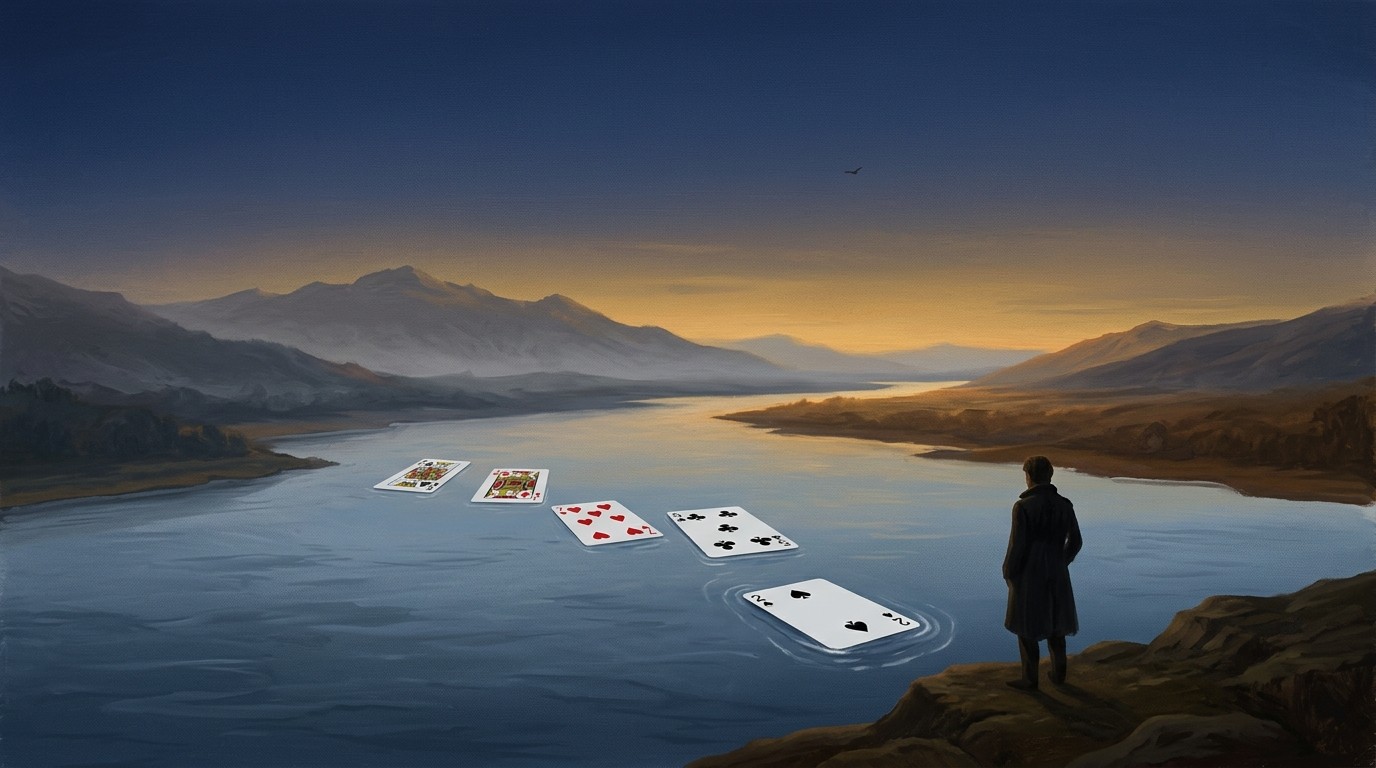
We often find ourselves on the river in a situation where we have a good but non-nut hand. We don't know whether to bet for value, bluff, or check. This happens when we don't have clear criteria in mind on which to base our decision.
It's precisely on the river that mistakes are the most costly. The pot is already big, the bets are high, and any wrong action — missing value, folding the best hand, or bluffing against an aggressive player — costs a lot of money over the long run.
In this article, we'll break down what the river is in poker, how to correctly bet for value, when to bluff, how to react to your opponent's bets, and what mistakes beginners make on the final street.
What the river is in poker
The river is the fifth and final community card on the table. The full structure of a hand looks like this:
preflop → flop → turn → river → showdown
On the river, a fifth card is added to the four cards of the flop and turn. After that, there are no more cards. The players who remain in the hand have all the data to make a final decision. Now each participant has seven cards at their disposal — two of their own and five community cards. This is the maximum information you can obtain in a hand.
By the way, if you want to understand how to play on the flop and on the turn, follow the links to the corresponding articles. The flop is here, the turn is here.
The key difference between the river and the other streets: there are no cards left to improve. All we have is a made hand. We either win at showdown or we don't. That's why decisions on the river must be as precise as possible and based on calculation and on how the hand was built on all the previous streets.
The role of position on the river
Position on the river becomes critically important. This is the final street, and whoever acts last gets a huge advantage.
In position (IP)
We see our opponent's action before our decision. If they check, we can control the pot: either bet ourselves — if we have a strong hand or a good bluff — or check and go to showdown. If the opponent bets, we see their sizing and can make a measured decision about calling, raising, or folding. We have full information.
Out of position (OOP)
We're forced to act first. If we check, the opponent can bet, and we'll be faced with a difficult choice. If we bet, the opponent can call or re-raise. We never know for sure what the opponent will do. Mistakes out of position on the river are especially costly, because after our action the opponent always has the last word.
Value betting on the river
A value bet is a bet we make expecting the opponent to call with a weaker hand. How do you choose the size of a value bet? The choice of sizing depends on which hands we want to get called by.
1. Small sizing (25–33% of the pot)
Used for thin value, when the opponent has few strong hands, weaker than ours, ready to call a big bet. A small bet is also effective against tight players who fold to big bets but call small ones.
2. Standard sizing (66% of the pot)
The main working size for value*. Used when we have a strong hand — for example, a set, two pair, top pair with a good kicker — and we expect a call from a wide range.
*Value — is the profit that a player with a strong combination gets from opponents with weaker but call-worthy holdings.
3. Large sizing (75–100% of the pot)
Used when we have a very strong hand. Large bets are effective against opponents who don't pay attention to the size of the sizing.
How do you tell which board is dangerous and which isn't? Follow the link to our article on board texture in poker and study the topics in more detail.
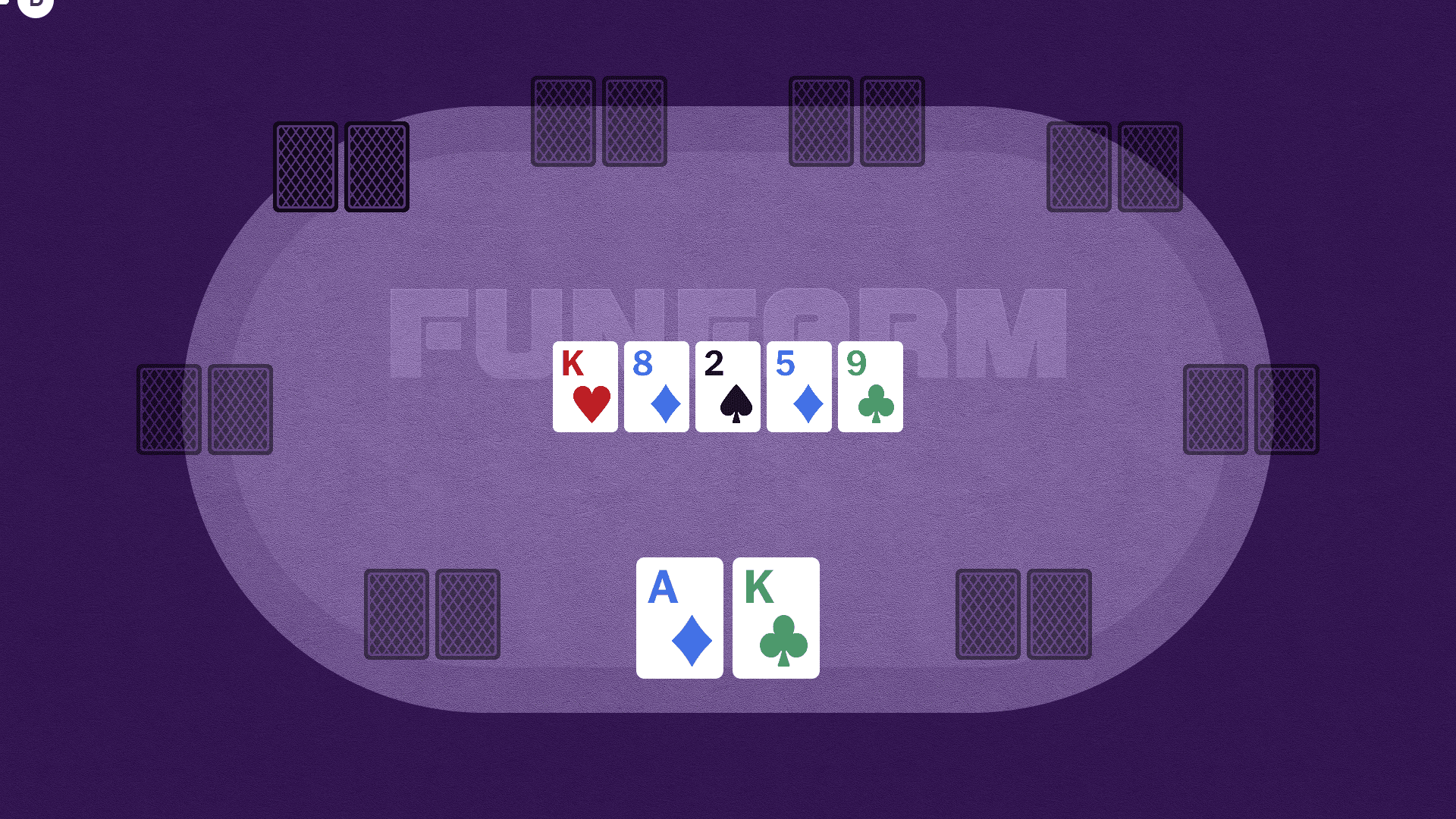
Let's look at an example of a value bet. We have top pair with top kicker. We were the aggressor on all streets. On the river the opponent checks. We bet 70-90% of the pot. The opponent may have KQ, KJ, KT — many weaker hands that will call.
The logic is this: if we bet 30% of the pot, we won't extract value from weaker kings. If we overbet, we may scare the opponent off and force them to fold, and we don't want that.
When to bluff on the river
A bluff on the river is a bet with a hand that loses at showdown. We're counting on the opponent to fold their hand. This is risky, because there are no future streets, and if the opponent calls — we've lost the pot.
When is a bluff justified? At least two conditions must be met at the same time.
A scare card on the river. If a card comes that, for example, completes possible draws — a flush, a straight — we get the opportunity to represent a strong hand. It's especially effective if that card fits our range — for example, we were the aggressor preflop, and an ace came on the river.
An unfilled draw. If there were draws on the flop and turn (a flush draw or a straight draw), and they didn't complete on the river, the opponent may have many hands they'll fold. The opponent's ability to fold. A bluff works against those who know how to fold. Against players who call a lot and willingly, a bluff on the river is a pure loss of money. Against tight players a bluff can be very effective.
How to react to your opponent's bet

When the opponent bets on the river, we have to decide: call, raise, or fold. The decision is made based on three factors.
1. Pot odds
This is a precise mathematical value. The formula: the size of the call divided by the sum of the pot before the call, the bet, and the call. If the opponent bets 50 into a pot of 100, pot odds = 50 / (100+50+50) = 50/200 = 25%.
We need our equity against the range of their bet to be higher than 25%.
2. The opponent's range
We assess which hands the opponent might have, based on their line of play. If their line doesn't look logical for value — we call wider. If strong hands can be traced in the logic of the hand — we fold.
3. The strength of our hand
Let's look at an example. There are 1000 chips in the pot. The opponent bets 500. Pot odds = 500/2000 = 25%. We need 25% equity. We have top pair. Against the opponent's range, which contains both value hands and bluffs, our equity may be around 30–40%. The call is justified.
How to tell a bluff from value
On the river, players often try to determine the strength of their opponent's hand by the bet itself. In practice it's much more important to look not at the individual action, but at the entire line of the hand as a whole. Most strong value hands and bluffs reveal themselves precisely through the sequence of decisions on the previous streets.
Most often a bluff on the river appears in situations where the card fits the aggressor's range well. Lines look especially suspicious where the opponent played passively on previous streets, and on the river suddenly starts applying heavy pressure with large sizing.
Value lines usually look more consistent. The player continues aggression on the cards that strengthen their range, and the bet sizes logically grow from street to street. For example, a c-bet on the flop, a second barrel on the turn, and a large bet on the river on a completed flush or straight more often represent a strong made hand than a random bluff.
Let's look at the variety of actions we can take on the river.
1. Check-call
Check-call is one of the most frequent decisions on the river. This line is used when our hand is strong enough for showdown, but not strong enough for a value bet or a check-raise.
For example, top pair can be a good candidate for a check-call against an aggressive opponent who is capable of turning missed draws into a bluff. We allow the opponent to keep applying pressure with the weak part of their range and keep the pot under control.
The main mistake here is automatically sending medium hands into a fold against any aggression. On some textures, the opponent's bluff range remains fairly wide even on the river.
2. Check-fold
Check-fold becomes the correct decision when the opponent's range is too skewed toward value, and our hand poorly blocks possible bluffs.
If you've become curious about what "block" means, then we've prepared an article for you on the topic of "blockers in poker." Go and get acquainted with this game concept in more detail.
For example, if a tight player passively called the previous streets, and then bets big on the river on a completed flush or a paired board, their range often contains very strong hands. In such situations, the attempt to "not fold too strong a combination" leads to losing calls over the long run.
Check-fold isn't weakness, but part of a disciplined strategy on the river, where every extra mistake costs a lot.
3. Check-raise
A check-raise on the river is one of the strongest and rarely used actions. We check, the opponent bets, and we raise. This requires great confidence, but in the right situations it brings maximum profit.
When we have an absolutely strong hand, and the opponent is aggressive and will bet with a wide range. We check, they bet, we raise — and they call with hands they could have folded to our direct bet.
The check-raise as a bluff is a tool that is used against opponents who bluff too often on the river. If we know the opponent bets with any two cards when we check, we can catch their bluff with a check-raise. But this requires a very precise read.
Typical beginner mistakes on the river
Mistake 1 — too large a value bet
A player with a strong hand makes an overbet, thinking "the bigger the better." As a result, the opponent with two pair or top pair folds, when they could have called a standard bet of 50–66% of the pot. We lose value.
How to fix it? We choose the bet size depending on the board structure and on which hands are ready to pay us off. An overbet — only in cooler situations, when the opponent has many near-nut hands.
What is a cooler situation? You can learn more about that in this article. Go and read it.
Mistake 2 — bluffing against loose players
A player bluffs on the river against a player who, with high probability, isn't planning to give up. The result: the opponent calls with third pair, and the bluff fails.
How to fix it? We bluff only against opponents who are capable of folding — and if we choose a bluff line, we make it logical on all streets of betting.
Mistake 3 — overfolding against aggression on the river
A player folds top pair to the opponent's bet, because they're afraid the opponent has a set or two pair. Yet the opponent may have a bluff or a weaker hand.
How to fix it? We calculate the pot odds and assess the opponent's range. If their range has enough bluffs or weaker hands, we call.
Mistake 4 — automatically checking with a strong hand out of position
A player checks on the river with a good hand because they "don't want to scare anyone off." As a result, the opponent also checks, and we win a small pot instead of a big one.
How to fix it? If we have a strong hand and there's a chance the opponent won't bet themselves but will call, we bet. The exception is aggressive opponents who will bluff if we check.
Mistake 5 — check-raising with a medium-strength hand
A player makes a check-raise on the river with top pair, hoping to catch a bluff. But a check-raise is an action that represents a very strong hand. The opponent with a bluff will fold, and with a strong hand will re-raise or call. We miss value and risk chips in a situation where it would have been enough to just call or fold.
Conclusion
If you want to systematically understand postflop strategy, learn to make the right decisions on all streets, and maximize your winrate* on the river — submit an application to FunFarm.
*Winrate — is a metric that reflects how much money a player wins from opponents over a certain distance.
FAQ
1. How do you tell whether the opponent is bluffing on the river?
By a combination of factors: their stats, previous actions on the flop and turn, the river card, the bet size, our hand, and blockers.
2. What comes after the river?
After the river and the final round of betting comes the showdown. If two or more players remain after the last bet, they reveal their cards, and the best combination wins. No bets can be made after the river — it's the last street.
3. Can you make bets after the river?
No. The river is the last round of betting. After all players have made their actions, and the bets are matched, the showdown comes. There are no additional bets after the river.
4. How do you calculate pot odds on the river?
The same way as on all the other streets in poker. The formula: the size of the call divided by the sum of the pot before the call, the bet, and the call. Example: pot 1000, opponent bets 500. Pot odds = 500 / (1000+500+500) = 500/2000 = 25%. You need 25% equity to call. On the river, equity is simply the probability that our hand beats the opponent's hand.