# Value Bet in Simple Terms: Where Players Most Often Leave Money on the Table
Poker is often romanticized: the main thing is supposedly to know how to bluff, make slick moves, and take down pots on sheer guts. But if you look at the graphs of poker professionals, it becomes clear — money in poker is earned not through expensive, complicated bluffs, but through methodical, mathematically justified decisions.

And here's where one of the most important terms comes up — the one without which poker quickly turns into a rollercoaster: the value bet.
In this article we'll break down what a value bet is in simple terms, how to choose the sizing for this bet, and in which situations you should make it — and in which you shouldn't.
You'll learn:
what a value bet is and how it differs from a bluff
what value-betting looks like on different board structures
how to choose the bet size so that you get paid
when it's better not to bet, even if your hand seems good
What a value bet is in simple terms
A value bet is a bet you make with the intention of getting a call from worse hands.
The logic of this bet can be expressed like this:
"We think we're ahead right now. The opponent has weaker hands that are capable of paying. So we bet to make money."
Important: a value bet isn't about a one-hundred-percent guarantee. Even when we bet for value, sometimes we'll get shown a stronger combination — and that's normal. A value bet is about the long run: we profit because the bet will be a winner more often than a loser.
Why value is the foundation of profit in poker

The essence of poker comes down to this: with medium and weak hands we try to lose the minimum, and with strong hands we try to win the maximum
The second part of this formula often falls short for beginning players. The reason isn't a lack of theory, but psychology — "what if I scare them off," "what if they got there?", "I'll bet and get blown off," "better to check, I'll win anyway," and so on.
The problem is that checking with a strong hand doesn't equal a good and safe action. Sometimes a check is simply a voluntary refusal of money.
There's a simple logic that saves you from chaos. Before betting, ask yourself two questions: "which worse hand pays?" and "what sizing will make worse hands pay?".
The two main mistakes with value bets
1. Fear of "overestimating your hand"
The player sees potentially strong combinations on the board and starts mentally giving the opponent every possible nuts at once. As a result, they don't bet in spots where dozens of worse combinations should be paying them.
2. A "greedy" sizing
The opposite extreme — "I have a strong hand, so I need to bet big." And the result is a bet that knocks out everything we want to get value from, leaving in the calling range only hands that beat us or the second and third nuts.
Concrete examples of value bets
Below are two situations that nicely illustrate different types of value-betting: where you should bet for protection, and where you should bet to get paid.
Example No. 1: a value bet as protection for a strong hand
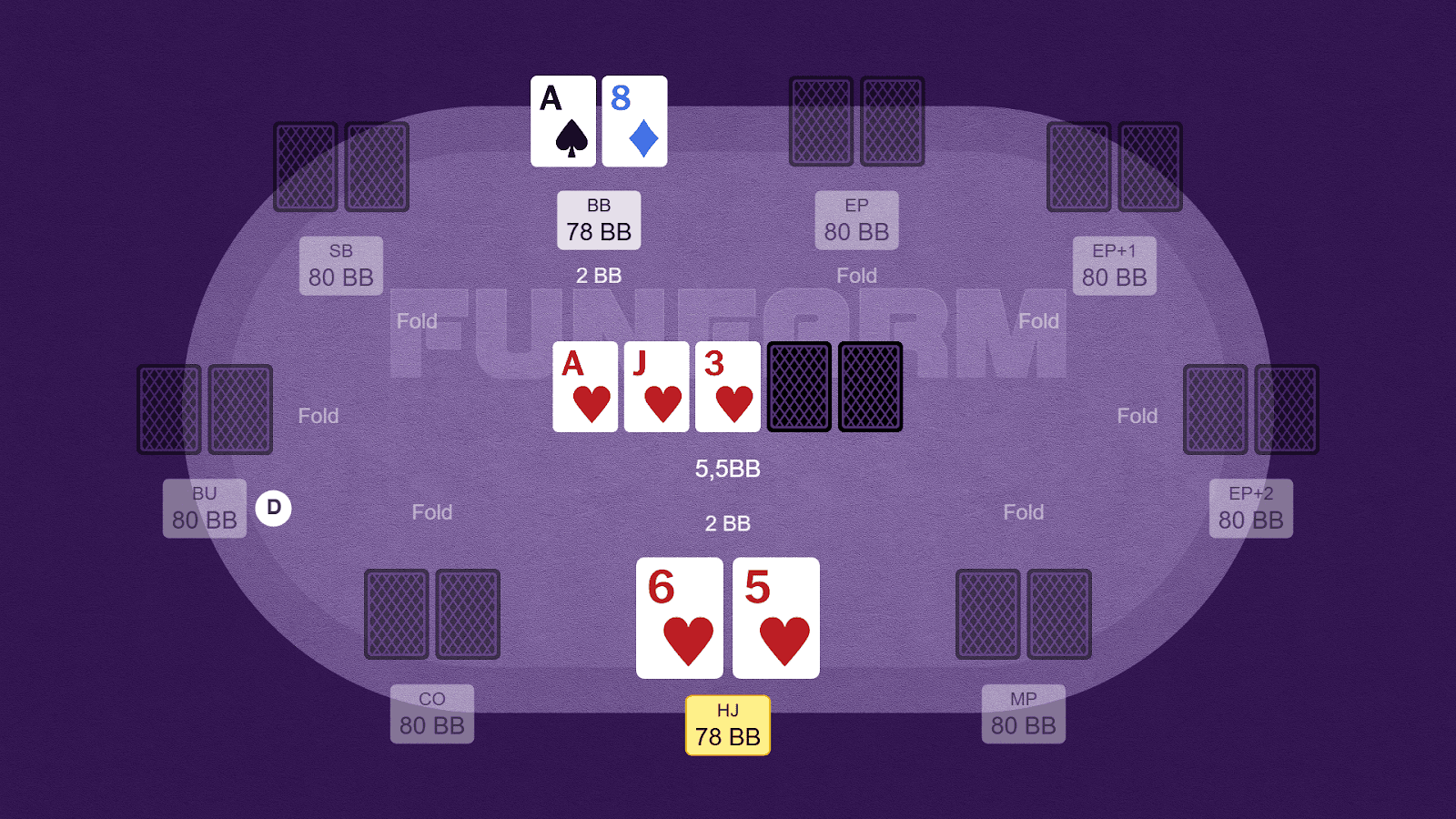
Situation: we opened suited 65 from the HJ and made a flush on the flop. On paper — a monster. In reality — a monster with an asterisk, because the hand is strong but vulnerable.
What's important to understand: the opponent may have a hand like Ax without hearts — as in our example — and be practically dead, but if he has even a single heart, a fourth heart on the turn or river turns our hand into a problem — a low flush can easily end up being second best.
Now the key point — beginning players often go to extremes:
1. Play all-in or overbet
The logic in their head is "I have a flush, let them pay" — and we get folds from most worse hands. We win the pot, but a small one.
And the main value of the nuts is lost — we didn't allow the opponent to make a mistake.
2. Slowplay "so as not to scare them off"
Check-check, a free card, and suddenly a fourth heart appears on the turn or river — and that's it, now we're in guess-mode about whether or not the opponent has a made hand.
We covered what slowplay is in poker in this article. Follow the link to get better acquainted with this play.
How should you play this situation correctly? A bet around 70%–80% is a sound option. Hands like Ax and Jx get a reason to pay, and flush draws get a price that's good for us to chase their combination.
We don't inflate the pot to the point where we knock out everything weak — and at the same time we don't hand out free cards that change the balance of power on the board.
This is the case where a value bet both makes money and doesn't give away equity for free.
Example No. 2: value on the river out of position
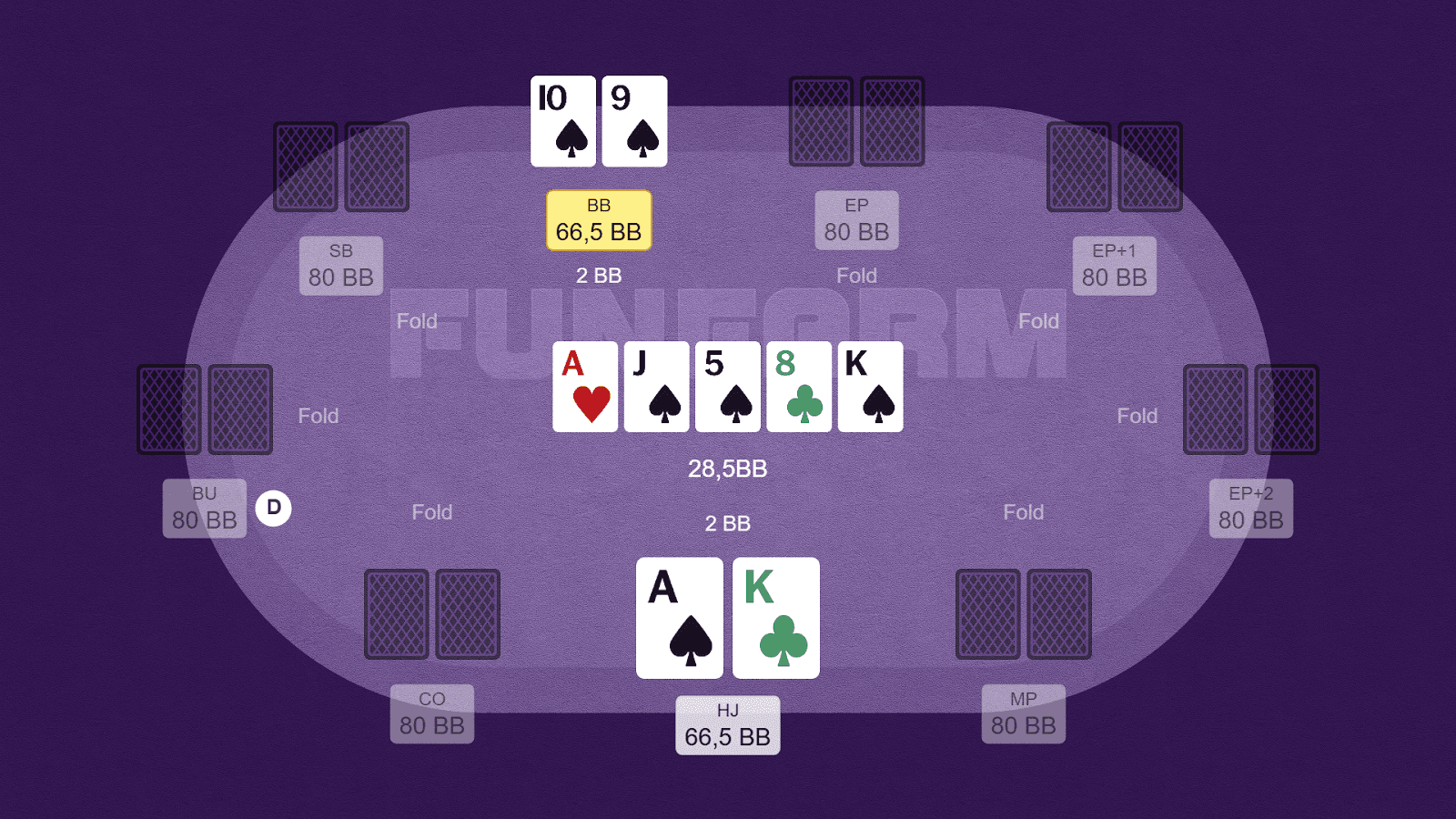
Situation: let's say we called from the BB with suited ten-nine. Let's also assume our opponent made a strong combination on the flop and keeps betting for value.
Initially there was 5.5 BB in the pot. Our opponent bets 2BB, we call. On the turn there's 9.5BB in the pot — and our opponent makes a pot-sized bet. We understand that his range is predominantly strong hands, but we call, because we still have the right pot odds to call — we have an open-ended straight draw and a flush draw.
On the river we get the card we need — it completes our flush. And here it's worth slowing down and thinking — should we check to wait for a bet from the opponent?
We know that the opponent's range was predominantly strong on the flop and turn, but the river changed a lot — both flushes and straights completed. Given that we have the flush, the opponent's hand will often be too weak to keep applying pressure on us, and he doesn't have all that many bluffs — given the way the hand played out. Most likely, we'll very often see a check-back — even with a seemingly strong hand like two pair.
In this case the best option is to make the value bet ourselves — for example, from 60% to 100% of the pot — to make the opponent wonder: "Is this a bluff or not?". Sizing is especially important here: the task is to bet so that worse hands find the call button, not the fold button.
Conclusion
The value bet is a fundamental skill that separates the player who just sometimes wins hands from the player who consistently makes money.
If you often check strong hands so as not to scare off opponents, or bet too much and get folds from worse hands, then the problem isn't luck or variance — most likely, you're simply leaving your money on the table.
If you want to stop playing on feelings and guesswork, submit an application to FunFarm.
FAQ
Is a value bet a bet that's guaranteed to win?
No. When you bet for value, you accept that sometimes you'll see a stronger hand. What matters is something else — that on average worse hands pay you often enough, and then the bet becomes profitable over the long run.
How do I know that the opponent has worse hands to call with?
Look at the history of the hand — which hands he might have been drawing with, where he could have hit his card, which parts of his range he didn't fold on previous streets. The more medium hands in his range, the wider your value.
What should I do if I'm afraid of a raise on the river?
The fear is understandable, and if you're playing low stakes, even justified. For the most part, at low stakes river raises are heavily skewed toward value, because the field doesn't know how to bluff. This means you'll be raised rarely, but almost always with a good hand. So a good skill is not to avoid value, but to avoid making silly bet-calls.
Can you value bet with a not-very-strong hand?
Yes, if the opponent has enough worse hands that pay. This is called thin value. It requires more discipline and understanding of ranges — but it's exactly what often gives a big boost to your winrate over the long run.
Why is it sometimes better to bet less rather than more?
Because your task is to get a call when we bet for value. A small bet widens the continuing range and turns a borderline situation into steady value-betting. Especially against players who like to "just take a look."
Read next
Donk Bet: Beginner's Mistake or Clever Move?

Check-Raise: A Powerful Weapon in Your Arsenal
What Is a 3-bet in Poker: A Complete Guide for Beginners