The History of Online Poker: From the First Hand to a Billion-Dollar Industry
Modern online poker offers dozens of platforms to play on, tournament series with guarantees in the hundreds of millions of dollars, and convenient software. To start playing, all you need is a few taps on your smartphone. But it wasn't always like this. Let's take a look at the industry's journey from its inception to the present day.
Key facts about online poker
The first real-money hand in online poker was played on January 1, 1998. The room Planet Poker went down in history. Other significant moments in the industry look like this:
The launch of PokerStars and Partypoker in 2001. For decades, these rooms embodied online poker.
Chris Moneymaker's win at the WSOP Main Event in 2003. The champion entered the tournament via an $86 PokerStars online satellite.
The poker boom after Moneymaker's success. Three years after Chris's win, the number of participants in the WSOP Main Event grew from 500 to 8,773 people. Millions of people came to try poker online.
Black Friday. Online poker suffered enormous damage from the shutdown of PokerStars, Full Tilt Poker, Absolute Poker, and Ultimate Bet. The FBI restricted their operations in 2011.
The sale of PokerStars. In 2014, the industry leader was bought by Amaya Gaming for $4.9 billion.
The launch of GGPoker. The most popular room of today started in 2014.
The GG World Festival. In 2024, GGPoker organized a record-breaking tournament series with a $250,000,000 guarantee.
The history of poker offline
The history of the popular card game began in the 16th century. In the 1520s, precursors to poker were successfully winning over audiences in Italy, Spain, and France. The first relevant versions of the card game were invented in the 19th century. The pioneers were five-card poker and stud. Dro poker was loved by cowboys in the Wild West. The rise of stud coincided with the period of the U.S. Civil War. At the start of the 20th century, the leaders of modern poker were invented — hold'em and Omaha.

The gold bracelet has been awarded to WSOP winners since 1976
Las Vegas played a crucial role in the history of poker. In 1931, gambling was legalized in the city. As the number of casinos in Las Vegas grew, players increasingly "got a taste" for poker. The key event in promoting the game was the first poker championship in 1970. The debut World Series of Poker tournament was organized by Benny Binion. Johnny Moss won the inaugural WSOP. He was named best player by a vote of the tournament participants.
In the 1980s and 1990s, poker's popularity gradually grew. While in 1972 the WSOP schedule included 2 events, by 1995 they were already holding 24 tournaments. The traditional hold'em and Omaha were supplemented by championships in: seven-card stud, razz, and draw poker. WSOP television broadcasts also helped promote the game. The turning point in the history of the industry — poker moving online — was just a few years away.
The birth of online poker: IRC and Planet Poker (1994–2000)
The first prototype of the internet was invented in 1969. The idea of bringing the popular card game online was realized by students at Carnegie Mellon University in 1994. The first online poker hands were played on the Internet Relay Chat, or IRC, platform. The experiments on IRC bore little resemblance to the action on POKEROK or PokerStars. The hand played out in text format in a chat window. The game was played for play chips. Poker players received 1,000 chips per day. There was no talk of a convenient interface.
Another problem with Internet Relay Chat was the difficulty of setup. IRC required advanced computer and networking skills. That's why the pioneers of online poker were programmers and internet enthusiasts. Among them was the future WSOP ME winner Chris Ferguson. We'll mention him later in the story about Full Tilt Poker.
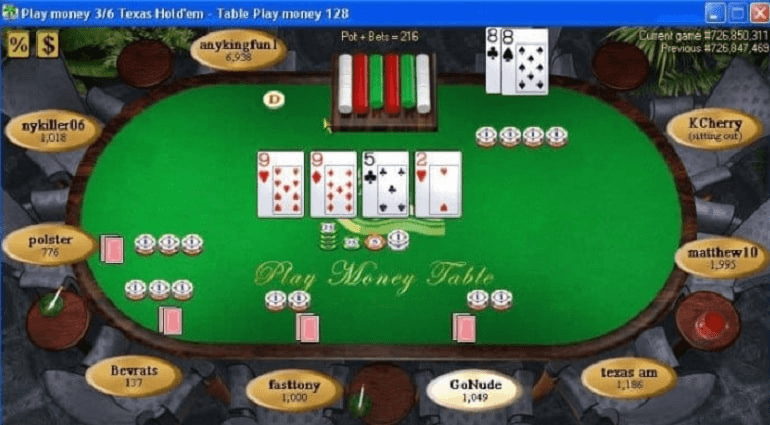
This is what Planet Poker's tables looked like
IRC technology demonstrated poker's potential on the internet. The breakthrough happened on January 1, 1998. The era of commercial poker was opened by Planet Poker. Primitive software and a slow connection didn't prevent the first real-money hand in history from being played. Planet Poker offered one cash table with $3/$6 blinds. You couldn't call the debut of online poker triumphant:
The single 10-handed table was rarely fully filled.
The platform constantly froze and experienced other technical problems.
The story with the random number generator also worked against the room. On the first poker forums, users regularly voiced doubts about the fairness of the RNG. In response to the criticism, Planet Poker's creators made the generator's algorithm publicly available. Experienced programmers studied it and concluded that Planet Poker's RNG could be hacked. Later, special software was released that predicted the players' and the board's cards with 100% accuracy. The generator story undermined trust in Planet Poker.
In 1999, Paradise Poker launched. The new room offered a more convenient interface and stable client operation. A partnership with a fledgling search engine — Google — also helped promote Paradise Poker. The room seized the initiative from the troubled Planet Poker and took the lead in the industry. Paradise Poker was the first to start displaying basic table statistics. We'll also credit the room with the invention of multitabling.
Let's also mention the first failure in the history of online poker — PokerSpot. The room operated a little over a year: from May 2000 to December 2001. Its collapse was predetermined by regular payment-processing problems. Money could take weeks to reach an account. In the end, customers lost $400,000. PokerSpot's organizer — Dutch Boyd — claimed the money never reached him. On the other hand, PokerSpot was the first in history to organize tournaments online. Competitors only offered cash.
The rise of Partypoker, PokerStars, and Full Tilt Poker (2001–2005)
Planet Poker became a pioneer in the world of online poker. Paradise offered new ideas and took the online game to a higher level. However, the full-fledged start of online poker is associated with three brands: Partypoker, PokerStars, and Full Tilt. Let's discuss them in more detail.
Partypoker. The room launched on August 1, 2001. To attract the attention of the entire world, Partypoker organized a tournament with a guaranteed $1,000,000 to the winner. A ticket to the Party Poker Million could be earned through online satellites. The tournament was won by Kathy Liebert.
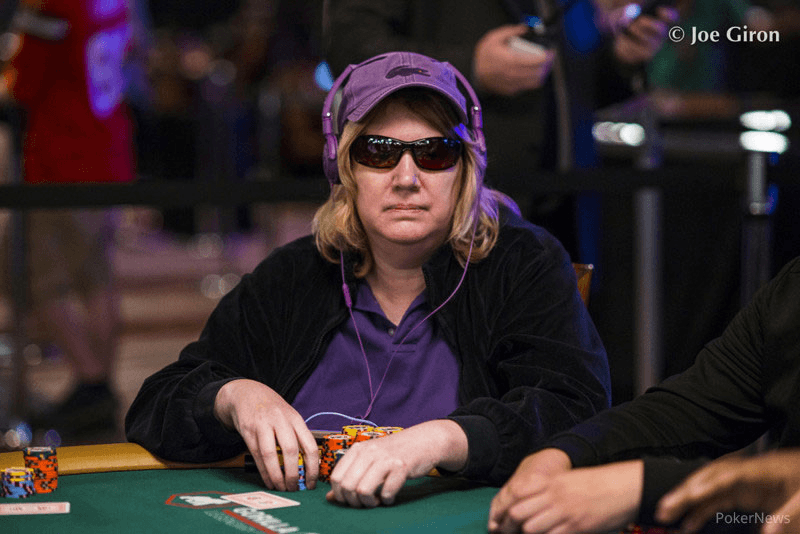
First place in the $1,000,000 tournament went to Kathy Liebert. As of April 2026, she held third place in total winnings among women
The room bought advertising on American television and entered into a partnership agreement with the World Poker Tour. By 2004, Partypoker's average online traffic reached 100,000 people. The brand led the industry by a wide margin. In 2005, the company PartyGaming went public on the London Stock Exchange. The value of its shares reached as high as $12 billion.
PokerStars. The locomotive of online poker started in September 2001. The platform launched real-money poker in December 2001. The PS team developed an excellent client with the best graphics in the industry. A good tournament schedule and a variety of poker types added to the room's appeal. PS's success was cemented by its first tournament series — the World Championship of Online Poker. Later, WCOOP would rise to a leading position in the industry and become the equivalent of the WSOP for internet players. In 2003, the fateful $86 satellite took place on PokerStars. We'll talk about it later.
Full Tilt Poker. The first real-money hand on FTP was played in 2004. The platform was founded by professional poker players — Howard Lederer and Chris Ferguson. Four years before the launch of Full Tilt Poker, Ferguson won the WSOP Main Event. To close the gap with competitors, FTP signed contracts with poker stars. The team of professionals included: Phil Ivey, Patrik Antonius, Tom Dwan, and Gus Hansen. Partypoker's departure from the U.S. market, the FTOPS tournament series, and a direct 27% rakeback allowed Full Tilt Poker to reach second place in number of players.
The poker boom: Moneymaker's win at WSOP 2003
The turning point in the history of online poker was Chris Moneymaker's win at the WSOP ME in 2003. An ordinary accountant from Tennessee turned $86 into $2,500,000. The news of this fantastic success spread beyond the industry and went around the world. Millions of players wanted to repeat Moneymaker's path. Every room in the industry received a huge influx of users. Take Partypoker's online traffic. In 2002, the platform's tables gathered around 1,300 players. In 2004, online traffic shot past 100,000 people. The explosive growth is easy to trace through the number of WSOP ME participants too:
Year | Number of players in the WSOP ME | First-place payout |
2003 | 839 | $2,500,000 |
2004 | 2,576 | $5,000,000 |
2005 | 5,619 | $7,500,000 |
2006 | 8,773 | $12,000,000 |
The surge of interest in the game would later be called the "poker boom" or the "Moneymaker effect."
Chris began his path to the biggest success of his life with an $86 satellite on PokerStars. In the final qualifying round, he made the top three and earned a $10,000 ticket. To make it to the tournament, Moneymaker borrowed $4,000 from his father and friends. The amateur with no live-festival experience wasn't taken seriously. However, Chris successfully endured the four-day marathon. One step before the final, Moneymaker knocked out Phil Ivey — one of the strongest players of the 2000s. In the Heads Up, the "internet guy" outplayed the experienced professional Sammy Farha.

The success of the internet debutant gave a powerful boost to online poker
In the final hand, Sammy with top pair lost to Chris's full house.
The WSOP win brought Moneymaker not only the champion's bracelet and $2,500,000 in prize money. A few months after his triumph, the player signed a professional contract with PokerStars. Chris served as a PS ambassador for over 17 years. Later, Moneymaker joined another industry brand's team — the Winning Poker Network. As of April 2026, the player's total winnings at live festivals reached $8,627,311. In recent years, Chris has been experiencing a poker renaissance. For example, in 2023 he won $2,030,000 in the Triton Poker series.
The first regulatory restrictions on online poker (2006–2010)
The explosive growth in online poker's popularity was slowed by the U.S. government. In October 2006, the country's president signed the Unlawful Internet Gambling Enforcement Act, or UIGEA. The law prohibited banks from processing transactions in favor of gaming sites. Americans were deprived of the ability to make deposits and withdraw money from poker rooms. Partypoker, Paradise Poker, and other industry brands left the U.S. market.
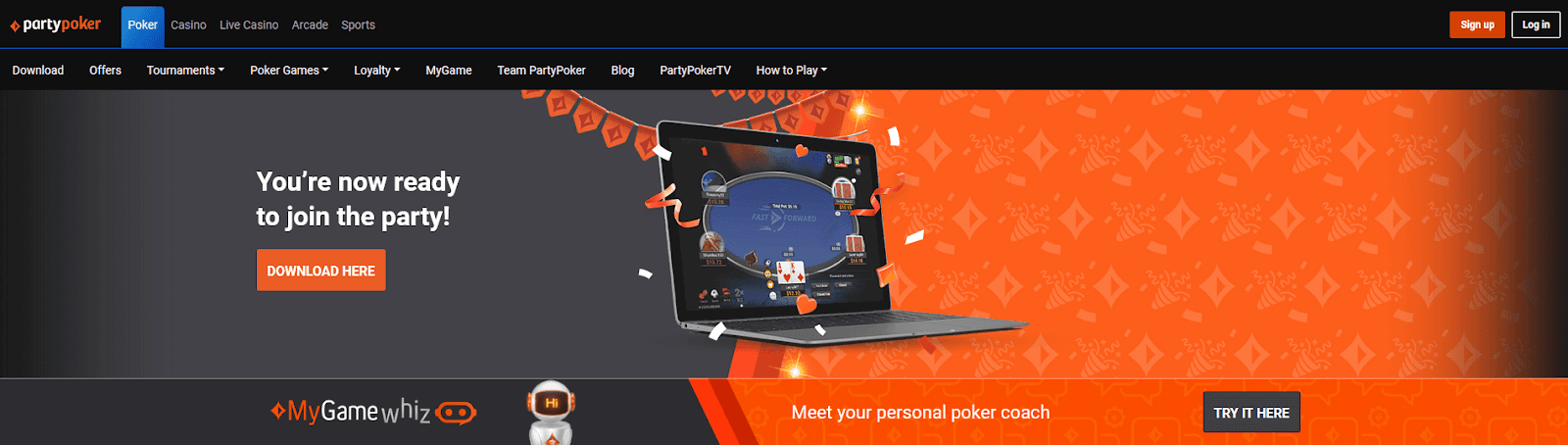
In the 20 years since leaving the U.S., Partypoker has never returned to the throne
PokerStars and Full Tilt Poker took advantage of the leader's departure and filled the niche. Why did PP leave the U.S. market while PS and FTP stayed? It came down to PartyGaming's public status. All stock-exchange-listed companies regularly publish financial reports. PokerStars and Full Tilt Poker remained private firms, so they were able to continue operating in the U.S. through "creative accounting." The hour of reckoning for the new industry leaders would come in 2011.
In the U.S., poker had always enjoyed high popularity, so the "Moneymaker effect" simply raised interest in the game to a new level. Online poker also conquered other territories. Among them was Russia. In 2007, poker in the country was recognized as a sport. The card game's new status gave impetus to the development of legal clubs. The first live festivals were also held. In 2008, Ivan Demidov took second place in the WSOP ME. His success caused a surge of interest in poker. However, in 2009, Russia adopted new legislation. Gambling entertainment was banned everywhere except in gambling zones. Poker fell under the restriction too.
Black Friday 2011: the biggest crisis in online poker
If the passage of UIGEA slowed the development of poker online, the events of "Black Friday" drove the industry into crisis. The turning point in the history of online poker was April 15, 2011. On that day, the FBI seized the domains: PokerStars, Full Tilt Poker, Absolute Poker, and Ultimate Bet. The companies' executives were accused of organizing gambling and money laundering. The rooms stopped working. Users couldn't log into the client or withdraw money.
In 2006, PokerStars, Full Tilt Poker, and other platforms decided not to leave the U.S. market. However, the UIGEA act prohibited banks from processing transactions in favor of online poker rooms. So PS and FTP created sham intermediaries. On paper, players' deposits went not to poker, but to buying golf balls, jewelry, or paying club membership fees. The banks didn't block the payments because they didn't perceive them as deposits for gaming sites.
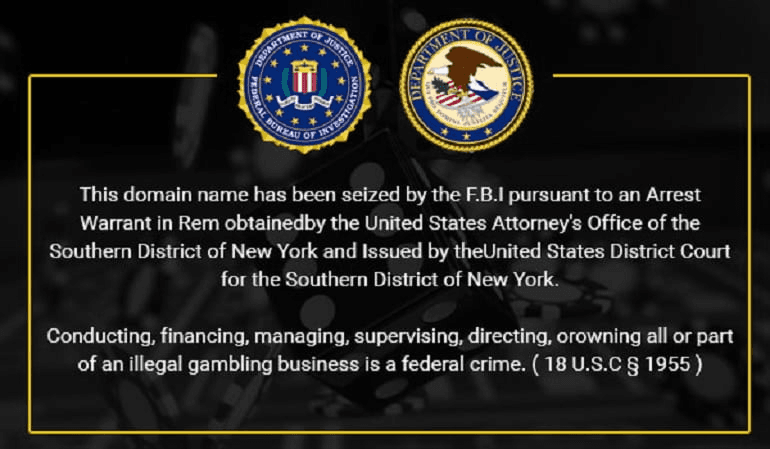
When trying to access the PokerStars and Full Tilt Poker portals, users were greeted by an FBI notice
The court proceedings exposed Full Tilt Poker's sad situation. Investigators established that the room operated like a Ponzi scheme. Chris Ferguson and the other FTP owners paid themselves salaries and bonuses out of players' money. There were no funds in the company's accounts to cover its obligations to clients. Full Tilt failed to return more than $330,000,000 to players. The room lost its authority and went bankrupt.
As a result of the court dispute, the prosecution and PokerStars reached a settlement. The room:
paid a fine of $547,000,000;
returned $150,000,000 to American PS clients;
took on Full Tilt Poker's obligations and paid out $184,000,000 in debts to its players.
As a result of "Black Friday," PokerStars lost a solid share of its audience but retained its leadership in the industry. Full Tilt lost its status as the "second force" and became part of PokerStars. Absolute Poker and Ultimate Bet went bankrupt. They never returned their debts to clients.
"Black Friday" led to catastrophic consequences. Industry brands lost the largest market. Many sponsors abandoned their cooperation with online poker rooms. Thousands of professional players from the U.S. lost their money and their ability to earn from poker. Platforms began raising rake, reducing rakeback and tournament-series guarantees. The breakup of the global player pool into isolated reservations began.
The mobile era and streaming: the industry's recovery (2012–2019)
To adapt to the new conditions and overcome the consequences of "Black Friday," the industry needed several years. Online poker emerged from the crisis thanks to: the invention of new formats, streaming on Twitch, returning to some U.S. states, the emergence of Good Game, and the popularization of playing on smartphones. Let's discuss the prerequisites in more detail.
New formats. In 2012, PokerStars added fast poker, Zoom, to its lobby. Its main feature — after a fold, a player instantly took a seat at another table and a new hand began. Recreational players really liked Zoom. The format was copied from Full Tilt Poker's Rush Poker. In October 2014, PokerStars launched fast tournaments for three players with a random prize. Spin&Go was borrowed from Winamax Poker. Over time, the new discipline displaced the other Sit&Go formats. The chance to win $1,000,000 in a few minutes attracted a huge number of recreational players.
Streams. In 2011, the streaming service Justin.tv launched Twitch. In the initial stage, the platform broadcast exclusively gaming content. Later, poker came to Twitch. One of the first to start streaming was Jeff Gross. As Twitch's popularity grew, other poker players came to the service. In 2015, the platform was visited by a fledgling streamer, Daniel Negreanu. The streams of Lex Veldhuis and Jason Somerville racked up millions of views. Broadcasts on Twitch and YouTube brought a new audience to poker.
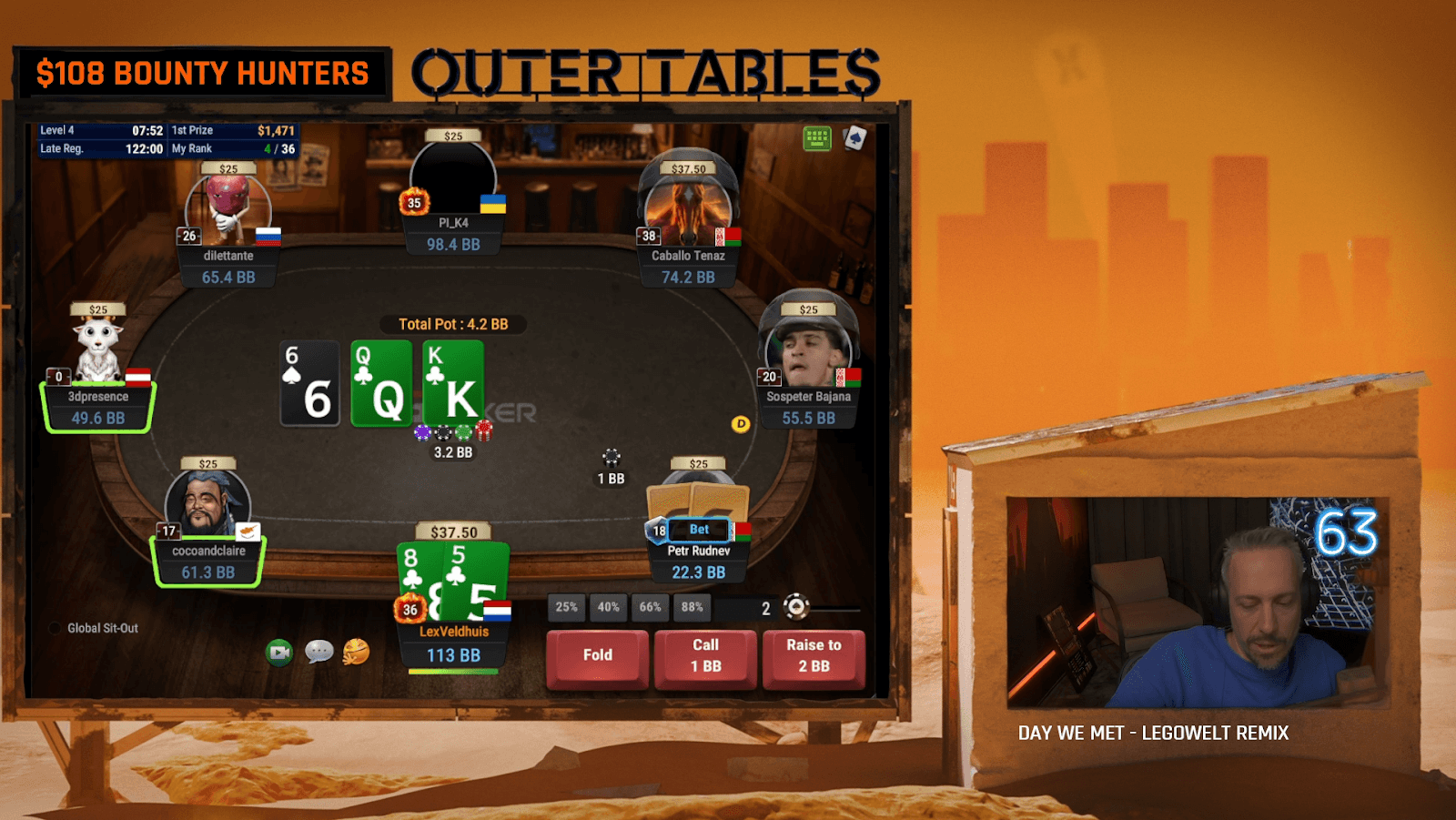
Over ten years on Twitch, Lex Veldhuis managed to: 1) go gray; 2) become the leader in number of followers among poker streamers; 3) switch from PokerStars to GGPoker.
The sale of PokerStars. PS weathered "Black Friday" better than its competitors. The room lost the largest market and paid a big fine but retained its clients' trust. The decision to buy out Full Tilt Poker also worked in PokerStars's favor. However, as part of the settlement with the court, the company's creator — Isai Scheinberg — stepped down from the position of chief executive. To take the brand out of the line of fire and clean up its reputation, PokerStars was sold to the Canadian company Amaya Gaming. The deal amounted to $4.9 billion.
PokerStars's return to the U.S. "Black Friday" killed online poker in the U.S. Local legislation didn't allow the industry to be revived in its former form. But individual states were allowed to issue local licenses. PokerStars took the opportunity in 2016. The room launched a reservation in New Jersey. PokerStars now operates in two more states: Pennsylvania and Michigan. Legal status boosts PS's reputation in the U.S. and allows it to attract a new audience.
The popularization of playing on smartphones. Technological progress turned the phone into a universal tool. Smartphones became powerful enough to handle poker. Companies quickly assessed the prospects of the new market and offered mobile platforms for online poker. Separate apps were released by: PokerStars, Partypoker, 888Poker, and other industry brands. Smartphone users gained the ability to play: cash, tournaments, and Spins. Over time, mobile clients learned to support playing at several tables.
The rise of GGPoker. In 2014, the NSUS Group company founded GGPoker. The platform was launched with the South Asian audience in mind. In 2018, the brand obtained a UK license and entered the European market. In parallel, NSUS Group: bought out Lotos Poker, paid players' debts, and renamed the platform GGPokerOK. By 2020, the renewed Good Game network had drawn close to PokerStars in number of players and ran the best promotions in the industry.

The Good Game network includes: GGPoker, POKEROK, Natural8, BetKings, Olybet
The launch of Pokerdom. The leading Russian poker room started in 2014. The brand offered clients: play in rubles, Russian-language support, and a convenient selection of payment methods. So Pokerdom easily attracted an audience from Russia, Belarus, Kazakhstan, and neighboring states. The platform's popularity was boosted by the regular RPL tournament series and a huge number of satellites to live festivals.
Other factors also contributed to the industry's recovery. Among them: the acquisition of Partypoker by GVC Holdings, the transition of Microgaming network rooms to the iPoker Network, the spread of cryptocurrencies, and the development of advanced software for game analysis.
The COVID boom and the recent history of online poker (2020–2026)
The coronavirus pandemic in 2020 contributed to the rise of online poker. Casinos closed, sporting events were paused, and people were sent to sit at home. As a result, the industry showed record traffic growth: in the U.S., the number of new players increased by 255%, and in New Jersey, online poker revenue in April 2020 grew by 118%. In September 2020, GGPoker ran a tournament with a $27,559,500 guarantee. It was later entered into the Guinness Book of Records for the largest prize pool in the history of online poker.
In 2021, the Good Game network surpassed PokerStars in number of cash players. PokerStars had held the top position since 2006. Along the way, PokerStars changed owners: the Stars Group company was bought out by Flutter Entertainment for $6 billion. The new management didn't help: PS continued to lose its audience and cut tournament-series guarantees. By 2026, Good Game had pulled far ahead. The network ran the largest online festival with a $250,000,000 prize pool and bought the WSOP brand for $500,000,000. The average traffic of GG rooms exceeded 350,000 people.
Mobile apps began to play a significant role in online poker. The closed-club system and the status of platforms with play-chip games returned poker to regulated jurisdictions. PPPoker, PokerBros, and other apps partially united players into a global pool. Crypto rooms, like CoinPoker, also contributed to the development of poker online. The popularization of cryptocurrencies also improved players' lives. The new tools simplified deposits and cashouts.
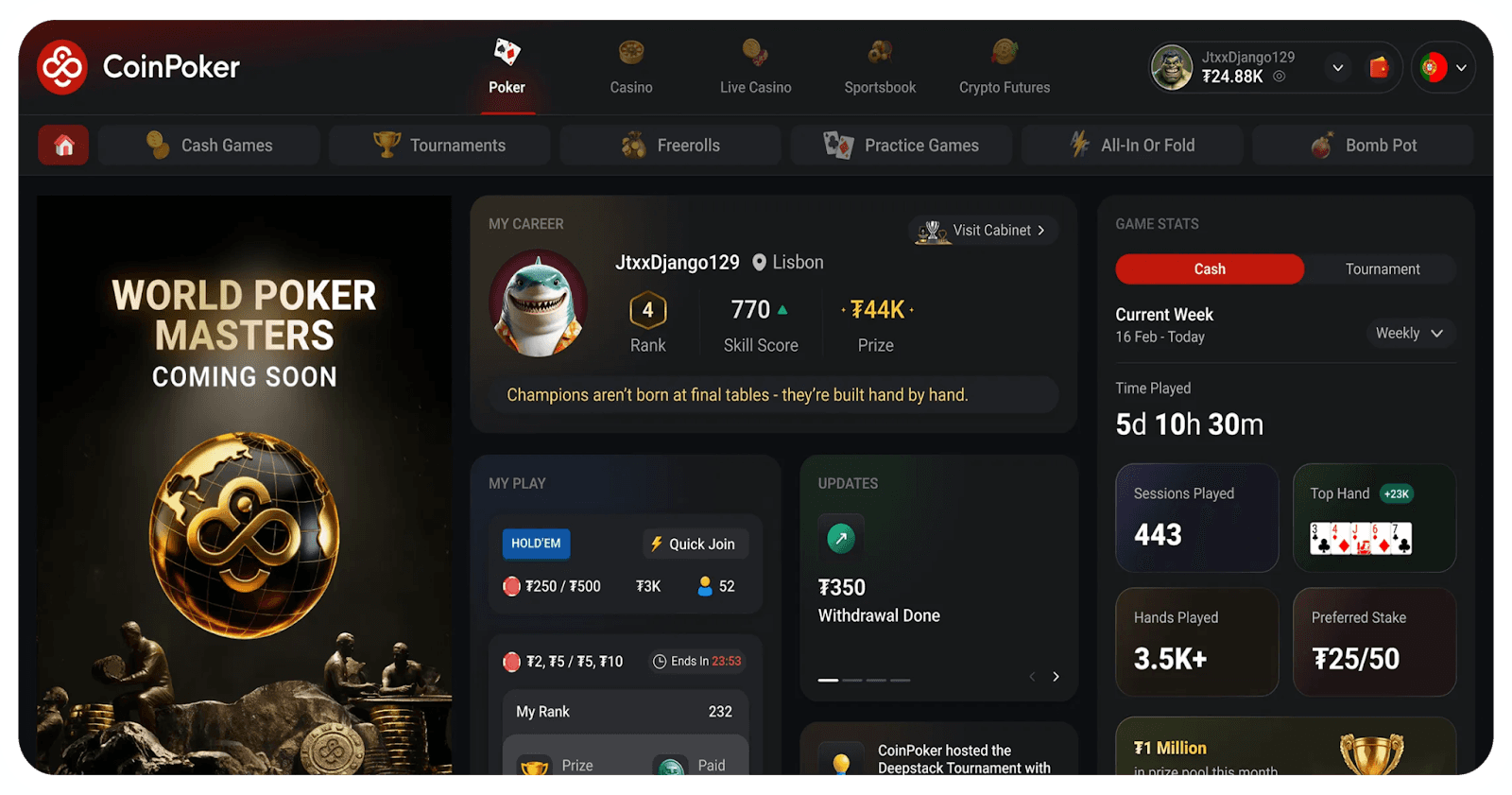
In 2022, the largest pot in the history of online poker was played at a CoinPoker table. By the end of the hand, $7,750,652 lay in the middle of the table
In 2023, the volume of the global online poker market was estimated at $77 billion. The greatest growth came from mobile platforms: more than 60% of poker players played from smartphones. By 2019, the industry had recovered from the consequences of "Black Friday." In the following 6 years, online poker showed growth thanks to new technologies and returning to old markets.
Online poker in 2026
Over 28 years, the industry has lived through the poker boom, the "Black Friday" crisis, and the COVID renaissance. However, even now, online poker is far from stable. National regulators continue to tighten legislation. It's getting harder for rooms to comply. Internet restrictions also don't do poker any good. On the other hand, the game is gradually being legalized in the U.S. PokerStars plans to unite players from New Jersey, Michigan, and Pennsylvania into a single pool. Over the past couple of years, the list of platforms to play on has been joined by a number of crypto rooms: BCPoker, Up Poker, Phenom Poker, TON Poker.
As of April 2026, the top three leaders by number of players are:
POKEROK. Good Game rooms show cosmic online traffic of 350,000 people. POKEROK and the other network members owe their high popularity to: record rake races in all disciplines, tournament series with guarantees up to $250,000,000, separate clients for all current operating systems, and convenient software. The network constantly experiments with promotions. For example, at the end of 2025, a weekly $100,000 freeroll was added to the schedule.
PokerStars. The longtime industry leader is going through hard times. On average, the platform gathers 16,000 users. In 2024, PokerStars updated its loyalty program and introduced rakeback up to 60%. However, you can't bring back greatness with a VIP system alone. PS's bet on regulated markets also reduces its number of users. In 2025, PokerStars left Poland; in 2024, the Czech Republic, Croatia, and Peru.
PokerKing. The Winning Poker Network offers decent average online traffic of 13,500 people. By 2026, the network reached its peak of development. In tournament-series guarantees, PokerKing surpassed PokerStars and trails only POKEROK. The room's loyalty program combined with rake races provides players with rakeback up to 85-90%. Several times a year, WPN attracts the attention of the entire industry with The Venom tournament. Its prize pool reaches $10,000,000. The winner of The Venom receives from $1,000,000.
In April 2026, PokerKing ran a Venom with an $8,000,000 guarantee
Tournaments have remained the most attractive discipline of online poker. The chance to multiply your buy-in hundreds of times attracts many recreational players. Among the formats, we'll single out knockout tournaments. The ability to get a reward for an opponent's head changed tournament dynamics and set PKO apart from other formats. In recent years, interest in Mystery Bounty has been growing. In this new version of knockout tournaments, a random prize drops for an opponent's head. Sometimes the reward exceeds the first-place payout in an MTT. For example, in 2022, a player with the nickname malalyka caught a $503,574 jackpot in a POKEROK tournament.
The first hand in online poker was played 28 years ago. Since then, the average skill level of players has grown enormously. Reading the rules, sitting down at a table, and starting to print money won't work anymore. To outplay opponents and win tournaments, you need a systematic approach. The training course FF Start offers exactly that. The program includes 30 lessons on key topics: poker math, adapting to opponents, push/fold, and final-table strategy. We invite graduates to the next tier — the Player Path. Want to go down in poker history — join FF!
FAQ
When did online poker appear?
The history of online poker started in 1998. The count begins with the first real-money hand. It was played on January 1 at a table in the Planet Poker room. Sometimes the moment of poker's appearance on the internet is considered to be the game on IRC. The first hand in a text chat was played in 1994.
Who invented online poker?
The technology developed gradually, so online poker has no single inventor. The names mentioned most often are Randy Blumer and Mike Caro. Randy launched Planet Poker, and Mike advised him.
What is the "Moneymaker effect"?
The effect was named after the WSOP 2003 winner — Chris Moneymaker. The player made it to the most prestigious tournament through an $86 online satellite. The story of turning $86 into $2,500,000 caused a stir all over the world. As a result, millions of new players came to online poker.
Read next
Poker Hand Rankings by Strength: All 10 Combinations with Examples
Push/Fold in Poker: Short-Stack Strategy and Nash Charts
Rake in poker: how rakeback is calculated