The Turn in Poker
Many players underestimate the importance of the turn. For preflop there are opening hand charts, equity calculators help you figure out flop play, and on the river it's usually clear whether we're ahead or behind. The turn, meanwhile, remains an intermediate stage where it's crucial to make the most accurate decisions.
We often find ourselves in a situation where everything was clear on the flop. We made a continuation bet*, the opponent called. The pot grew, and on the turn a card came that changed everything. And now we don't know for sure what to do.
*A continuation bet is a follow-up bet made by the player who showed aggression preflop.
Many players underestimate the importance of the turn. For preflop* there are hand-opening charts, equity calculators help us figure out flop play, and on the river it's often clear whether we're ahead or behind. But the turn remains an intermediate stage where it's important to make the most accurate decisions.
*Preflop is the initial phase of play, which begins after players are dealt their hole cards but before the community cards are dealt on the table.
We discussed starting-hand charts in more detail in this article. If you want to learn more about this topic, head over and read it.
In this article we'll break down what the turn is in poker, how hand strength changes, which strategies work on this street, and how to avoid typical mistakes.
What the turn is in poker
The turn is the third betting street in poker, when the fourth community card is dealt onto the table. That card is what's usually called the "turn." The full structure of a hand looks like this:
preflop → flop → turn → river → showdown
The turn is important because it's the moment when most decisions become final. While on the flop we still have two streets to maneuver, on the turn there's only one. A mistake here costs more, and the right decision can save the pot or maximize the win.
How hand strength changes on the turn
With the arrival of the fourth card, hand strength changes, and understanding this change is the key to the right strategy.
On the turn we know that only one card remains to improve in the future, i.e. the probability of getting the combination we need decreases.
On the other hand, if we're playing for value*, it's important to start extracting the maximum from the opponent right here and to choose the most optimal strategy to do so.
*Value (from the English "value") is the benefit a player with a strong combination gets from opponents holding weaker but call-worthy holdings.
How the turn card changes the board texture
Not all turn cards affect the hand equally. We distinguish two types of cards.
1. Safe cards
These are cards that don't complete likely draws and don't strengthen the opponent's range. In poker such cards are called a "blank."
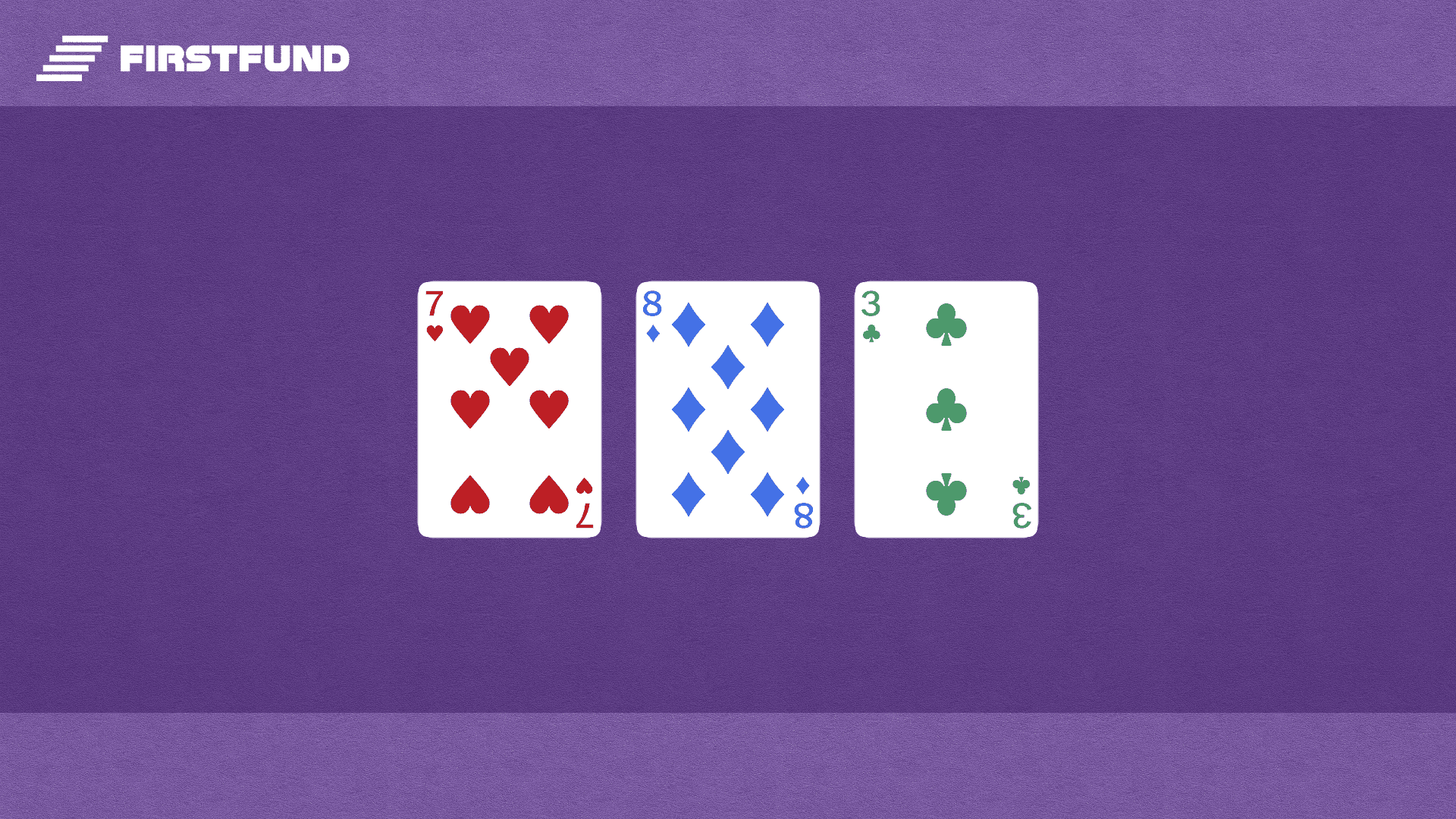
We see a flop like this. If the 9♥️ comes on the turn, that will be a "dangerous" card, because it completes potential straights and leads to a flush-draw situation.
If the 2♠️ comes on the turn, that card doesn't change the situation on the table at all (only in extremely rare cases, when, for example, the deuce completes a set for the opponent).
In these two situations we'll choose a different strategy for playing the hand on the turn, i.e. choose bet sizes in accordance with the board structure.
2. Dangerous cards
These are cards that complete flush draws or straight draws, or, for example, "pair" the board. With strong hands on dangerous cards, on the contrary, we bet bigger to extract from the hands we can still extract from.
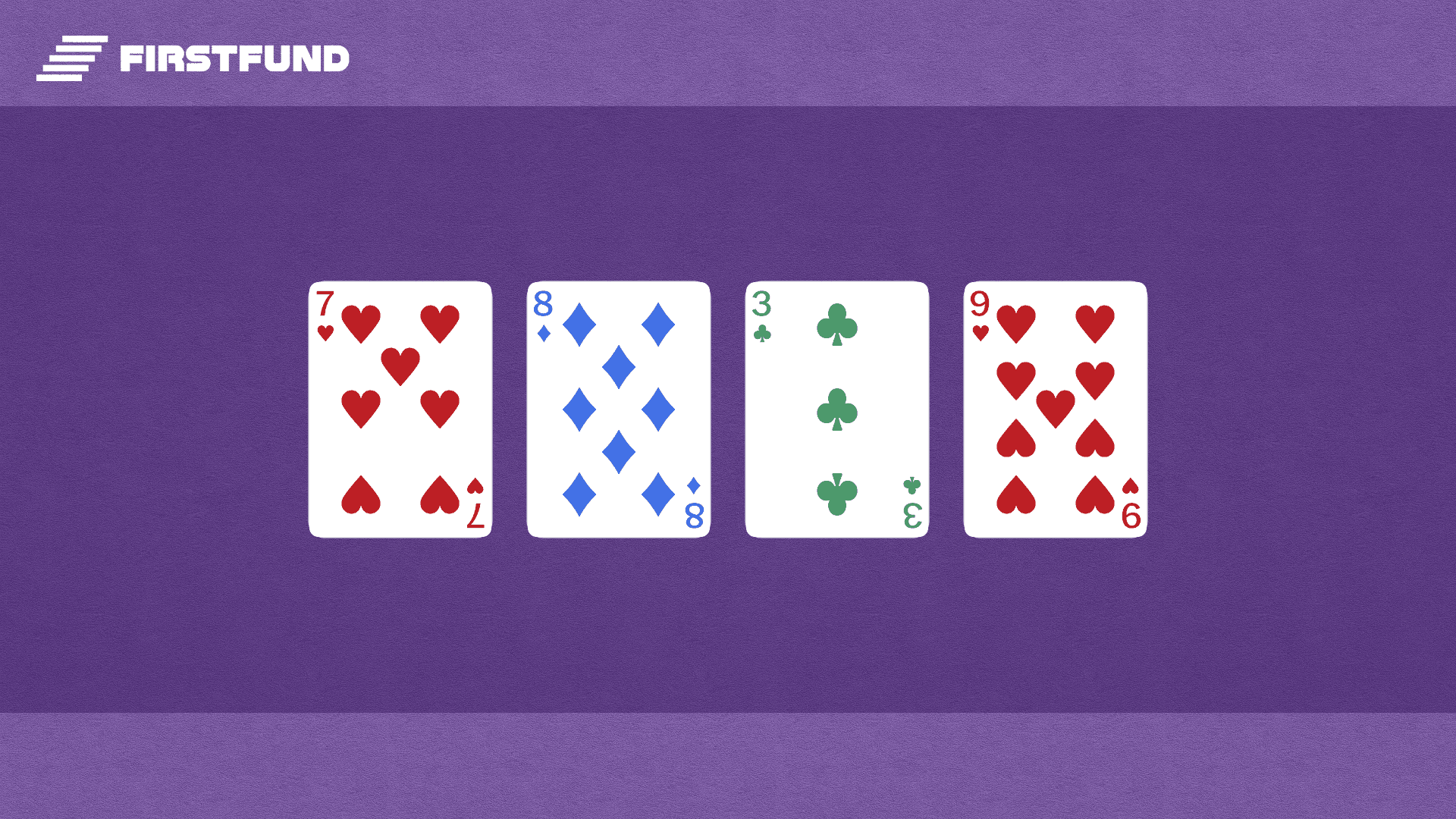
The same situation, where a dangerous card has hit. Let's imagine that in this case we have a set of sevens. The opponent may have flush draws, hands in the T8, T7, J9, etc. category.
In this case we want to make the largest possible bet on the turn — in some cases even an overbet* — to maximize profit here and now, and make the decision about whether to extract on the river based on the card that actually comes.
If you're interested in the term "overbet," we suggest following the link and reading the article on this topic.
The role of position on the turn
Position on the turn becomes even more important than on the flop. The pot is bigger, the bets are higher, and the fact of controlling the hand becomes largely decisive.
In position (IP)
We see the opponent's action before our decision. If he checks, we can control the pot — either bet ourselves or check and see the river for free. If he bets, we can evaluate his sizing and make a decision about calling, raising, or folding.
Out of position (OOP)
We're forced to act first. If we check, the opponent can bet and put us to a difficult choice. If we bet, the opponent can call or re-raise. Mistakes out of position on the turn cost especially dearly, because after our action the opponent always has the last word.
Conclusion: out of position on the turn we more often check with medium-strength hands — in poker this is called playing "pot control" — and bet only with strong hands or hands that have bluff potential on the river. On the other hand, in position we can afford a more flexible strategy.
Turn play strategy
The basic turn strategy is built from answers to several key questions. It's best to ask them every time we reach this street.
Did the card change the board texture?
How many river cards will help me?
If I'm bluffing, which stronger hands do I fold out?
If I'm betting for value, which weaker hands pay me off?
The better structured our thinking is on the turn, the less often we end up in difficult situations. Now let's look at several strategy options.
1. When to keep applying pressure?
We continue aggression on the turn if several conditions are met:
the turn card fits our range better
we have a strong value hand
we have a draw with good equity (flush draw or OESD*) and we're ready for a semi-bluff
the opponent tends to fold to a bet on the turn
*OESD (Open Ended Straight Draw) in poker is translated as "two-way straight draw."
Bet size on the turn
There are several typical situations that come up most often on the turn. We'll tell you which bet sizes will be the best decision in each case:
If we have a strong draw or value, on the turn it's optimal to bet 66–75% of the pot.
If we have a strong top pair and the turn card is a blank — we bet 50% of the pot.
If the board is dangerous, i.e. there are many draws on it, then the turn is our last value street and we can make an overbet — 120–150% of the pot.
Quite often the turn is the last value street for us, so it's frequently right here that the need arises to make an overbet, i.e. a bet larger than the pot. Usually this size ranges from 120% to 200% of the pot.
2. When to stop and check?
We check on the turn if:
the turn card is dangerous and could have strengthened the opponent
we have a medium-strength hand (middle pair, top pair with a weak kicker), and we don't want to bloat the pot
A check on the turn with a strong hand — a slowplay — is sometimes justified, but only against very aggressive opponents or on textures where the opponent has few hands to call with.
Pot control with medium-strength hands
Medium-strength hands are top pair with a weak kicker, second pair, third pair. With such hands we don't want to play a big pot, but it's also too early to fold them. On the turn the best strategy is to check and control the pot. If the opponent bets, we evaluate the sizing and make a decision. Most often on the river our hand turns into a decent bluff-catcher, since it beats all the bluffs in the opponent's range.
*A bluff-catcher is a situation where a player calls a bet or raise with a hand that can only beat the opponent's bluff but loses to his strong combinations.
Breaking down typical situations on the turn
Situation 1: The flop aggressor gets a check on the turn
We were the preflop aggressor and made a continuation bet on the flop. The opponent called. On the turn he checks. Continue or not?
The decision depends on the turn card and our hand. If the card is safe and we have either a strong hand or a draw with good equity — we bet. If the card is dangerous and our hand hasn't improved — we check.
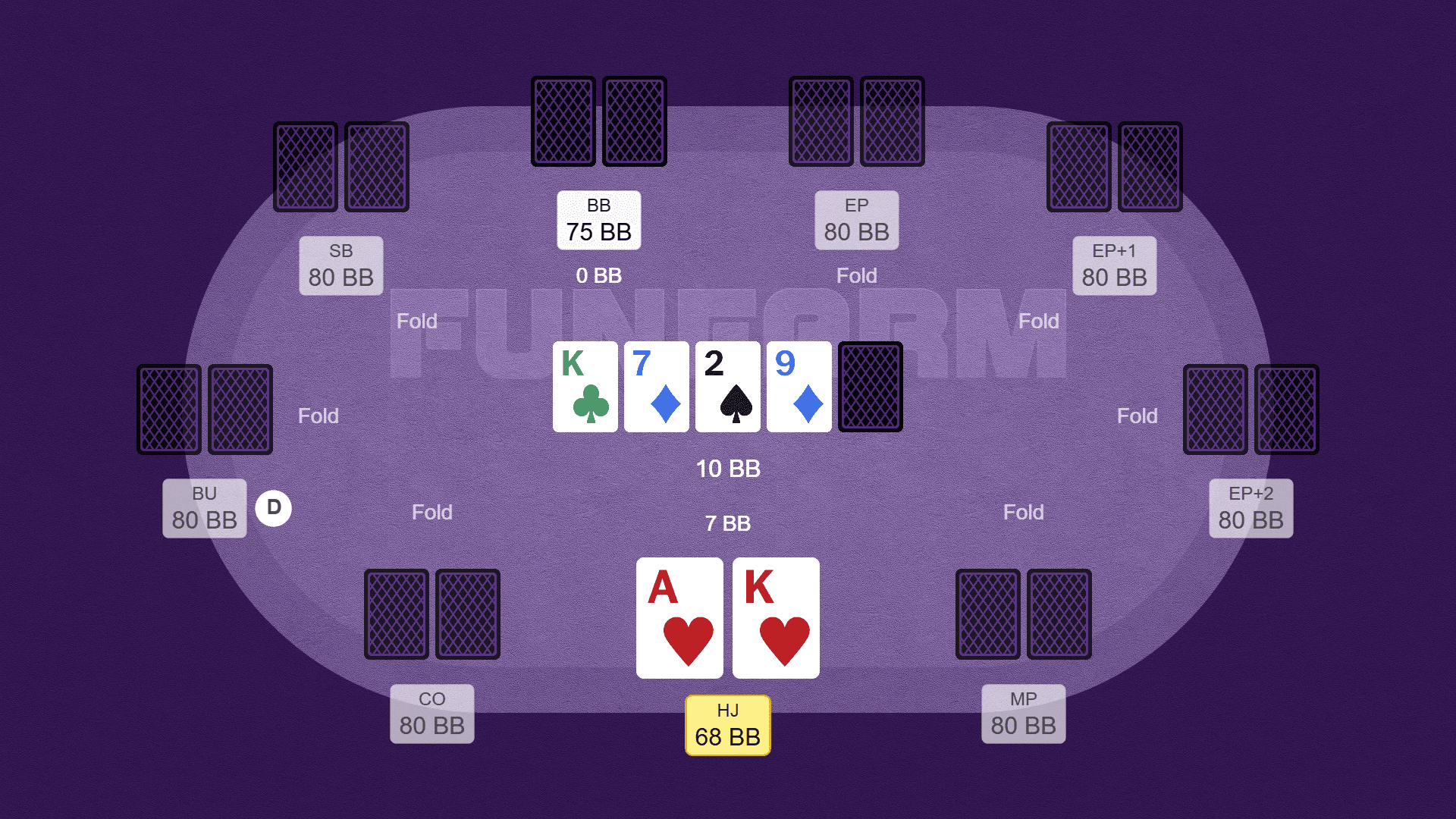
Example. In this situation we have top pair with top kicker on the flop. We bet, the opponent called. Turn 9♦. The card is safe. In this case we can bet 60–90% of the pot, extracting from weaker kings, draws, or medium-strength hands.
Situation 2: A draw completed on the turn
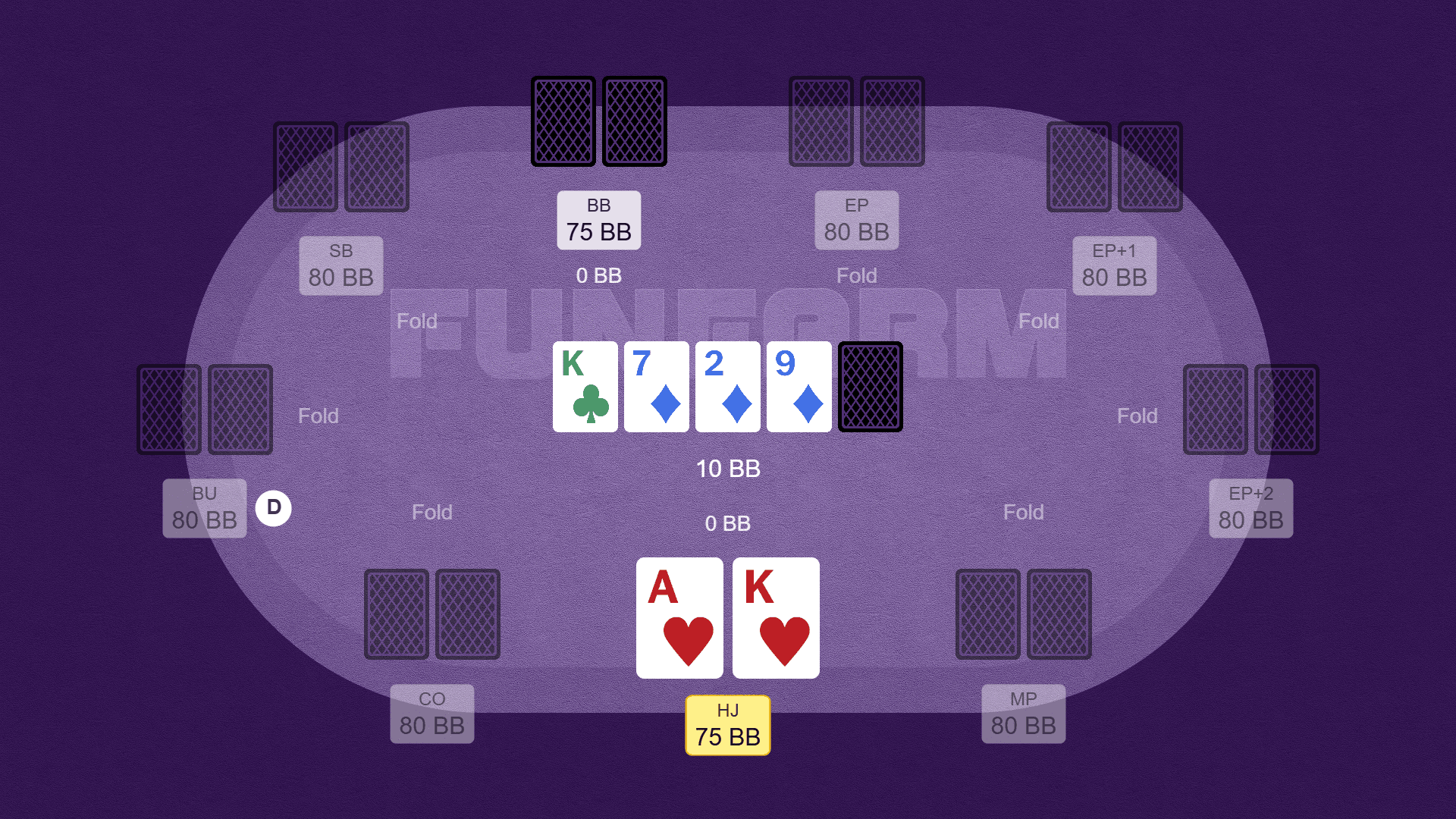
Let's take the same situation, but on the flop the opponent has a potential flush draw. On the turn a card comes that completes the draw, and we still have the same top pair with top kicker.
In this case there's no point in betting the turn, because we're not sure for certain how much this bet is a value bet.
The best strategy is to check and call on any river, because by checking we keep the bluffs in the opponent's range and beat them if he bets.
Typical beginner mistakes on the turn
Mistakes on the turn arise for various reasons. Often it's when players carry flop logic over to the turn, not taking into account that the situation has changed.
On the flop we had two streets ahead, the pot was small, and the ranges were wide. On the turn one street remains, the pot has grown, and the ranges have narrowed. What worked on the flop turns into losing money on the turn.
Let's look at a few more typical mistakes.
Mistake 1 — automatic continuation bet without accounting for the turn card
The player bet on the flop and bets on the turn automatically, without thinking about whether the situation has changed. This leads to him running into check-raises on dangerous cards and losing money.
Mistake 2 — folding too often against aggression on the turn
Some players are too afraid of bets on the turn and fold even strong hands. This makes them vulnerable to bluffs. It's important to distinguish when the opponent is representing a specific dangerous combination and when he's just betting automatically.
Mistake 3 — underestimating pot control
The player keeps betting with medium-strength hands when he should have checked. As a result he bloats the pot with a hand that doesn't win at showdown often enough.
Medium-strength hands (second pair, third pair, top pair with a weak kicker) don't benefit from a bigger pot on the turn. If we bet, the opponent calls only with stronger hands, and everything weaker he folds. We either extract nothing or end up in a difficult situation on the river.
Mistake 4 — too small a sizing with the nuts
The player with a set or straight bets 33–50% of the pot, although he could have bet 75–100%. Because of this he doesn't extract value — especially in cooler* situations.
What's the logic here? The pot is already big, and we only have two streets left to extract. The opponent with a draw gets great pot odds and calls correctly. The opponent with a strong hand will call a big bet anyway. In cooler situations we don't extract the maximum.
*A cooler is a situation in which two players get very strong hands, both play them optimally, but one is mathematically doomed to lose.
You can learn more about cooler situations in poker in this article. Head over and read it.
Conclusion
The turn is the street where the most expensive decisions are often made. The right strategy on the turn requires understanding how hand strength has changed, what type of card came, what position we're in, and what our chances of improving are.
Key principles: strong hands bloat the pot with big bets, medium-strength hands control the pot through a check.
If you want to systematically master postflop strategy, learn to build lines on all streets, and make the right decisions on the turn — submit an application to FunFarm.
FAQ
1. How do you know how much to bet on the turn?
The bet size depends on texture, position, and goal. With a strong hand on a dry board — 50–66% of the pot. With a strong hand on a draw-heavy board — 66–100%, to deny draws their odds. With a bluff — a size that creates pressure, usually 66–75%.
2. Can a check on the turn with a very strong hand be profitable?
Yes, but rarely. This is a slowplay, which works against very aggressive opponents who will bet on the turn and river with a wide range. A check is also justified when we block most of the hands that could call our bet. In other cases a check with a strong hand leads to a loss of value.
3. How do you count outs on the turn?
We count the number of cards that will improve our hand to a winning one. For example, for a flush draw — 9 outs, for an OESD — 8. Then we estimate the chances: with 9 outs the probability of completing on the river is 9/46 ≈ 19.5%. With 4 outs (a gutshot) — 4/46 ≈ 8.7%. We compare with the pot odds. If the probability is higher — a call is justified.